

Roche's Tecentriq + Abraxane Approved in EU as First Immune-Based Therapy for PD-L1-Positive Triple-Negative Breast Cancer
Aug 29, 2019 15:51
CST Updated
15:51

Roche
Oncology Drug Research, Development, and Manufacturing

European Commission
The European Commission, abbreviated as the EU Commission, is a supranational body under the European Union. Within the EU political system, the European Commission primarily undertakes executive tasks, thus being roughly equivalent to the government in a national system. However, the European Commission has other functions as well. In particular, except for the few circumstances specified in the treaties, the European Commission is the only institution with legislative power in the EU legislative process.

August 29, 2019 / BIOON -- Swiss pharmaceutical giant Roche recently announced that the European Commission (EC) has approved the PD-L1 tumor immunotherapy Tecentriq (atezolizumab) in combination with chemotherapy (Abraxane [albumin-bound paclitaxel], nab-paclitaxel) as a first-line treatment for adult patients with unresectable locally advanced or metastatic triple-negative breast cancer (TNBC) whose tumors express PD-L1 (≥1%) and who have not previously received chemotherapy for metastatic disease (chemotherapy-naïve). In the United States, the Tecentriq plus Abraxane regimen has been approved by the FDA for patients with unresectable locally advanced or metastatic TNBC whose tumors express PD-L1.
TNBC is an aggressive and difficult-to-treat form of breast cancer with a high level of unmet medical need. In the United States and the European Union, the Tecentriq + Abraxane combination is the first cancer immunotherapy regimen approved by regulatory authorities for the treatment of PD-L1-positive metastatic TNBC. Currently, Roche is conducting seven Phase III studies evaluating Tecentriq for the treatment of TNBC, including both early-stage and advanced-stage disease.
Dr. Sandra Horning, Chief Medical Officer and Global Head of Product Development at Roche, stated, “Over the past 30 years, we have been committed to transforming the lives of patients with breast cancer. Now, we are pleased to build on this legacy by introducing the first immunotherapy for triple-negative breast cancer. This approval represents a significant step forward in Europe in the treatment of this aggressive form of breast cancer, for which there remains a substantial unmet medical need.”

This approval is based on data from the Phase III IMpassion130 study, the first positive Phase III trial of cancer immunotherapy conducted in patients with triple-negative breast cancer (TNBC). This multicenter, randomized, double-blind study enrolled 902 patients with unresectable locally advanced or metastatic TNBC who had not previously received systemic therapy for metastatic breast cancer. It evaluated the efficacy and safety of Tecentriq in combination with Abraxane as first-line treatment, compared with placebo plus Abraxane. The co-primary endpoints were progression-free survival (PFS) and overall survival (OS). PFS and OS were assessed in all randomized patients (i.e., the intent-to-treat [ITT] population) and in PD-L1-positive patients. Secondary endpoints included objective response rate (ORR), duration of response (DOR), and time to deterioration of global health status/health-related quality of life (GHS/HRQoL).
The results showed that, compared with the placebo plus Abraxane regimen, the Tecentriq plus Abraxane regimen significantly reduced the risk of disease progression or death by 38% in patients with positive PD-L1 expression on tumor-infiltrating immune cells (IC) (median PFS: 7.5 months vs. 5.0 months; HR=0.62, 95% CI: 0.49–0.78; p<0.0001). Furthermore, in the PD-L1-positive population, the Tecentriq plus Abraxane regimen demonstrated a clinically meaningful improvement in overall survival (OS), extending OS by 7 months compared with the placebo plus Abraxane regimen (median OS: 25.0 months vs. 18.0 months; HR=0.71, 95% CI: 0.54–0.93). Formal testing of OS outcomes in the PD-L1-positive population was not performed because the difference in OS did not reach statistical significance in the intent-to-treat (ITT) population (median OS: 21.0 months vs. 18.7 months; HR=0.86, 95% CI: 0.72–1.02; p=0.078). In this study, the safety profile of the Tecentriq plus Abraxane combination was consistent with the known safety profiles of each individual drug, and no new safety signals were identified with the combination therapy.
The study will continue to follow up with patients until the next planned analysis. Assessing PD-L1 expression in tumor-infiltrating immune cells (ICs) is critical for identifying patients with triple-negative breast cancer (TNBC) who may benefit from the Tecentriq plus Abraxane combination. In this study, PD-L1 expression status was assessed using the VENTANA PD-L1 (SP142) diagnostic assay.
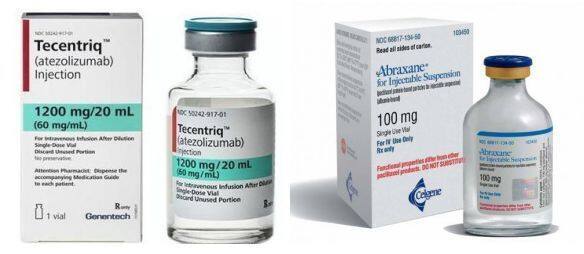
Tecentriq is a PD-(L)1 cancer immunotherapy that targets and binds to the PD-L1 protein expressed on tumor cells and tumor-infiltrating immune cells, blocking its interaction with the PD-1 and B7.1 receptors. By inhibiting PD-L1, Tecentriq can activate T cells.
To date, Tecentriq has been approved in multiple countries as a monotherapy and in combination with targeted therapies and/or chemotherapy for the treatment of various types of non-small cell lung cancer (NSCLC) and small cell lung cancer (SCLC), certain types of metastatic urothelial carcinoma (mUC), and PD-L1-positive triple-negative breast cancer (TNBC). Recently, Tecentriq received approval in Japan for use in combination with chemotherapy (carboplatin plus etoposide) as a first-line treatment for adult patients with extensive-stage small cell lung cancer (ES-SCLC). This approval makes Tecentriq the first cancer immunotherapy in Japan for the treatment of aggressive and refractory ES-SCLC.
Breast cancer is the most common type of cancer in women, with over 2 million new cases diagnosed globally each year. Triple-negative breast cancer (TNBC) accounts for approximately 15% of all breast cancers and is more prevalent in women under the age of 50 compared to other subtypes. TNBC is specifically defined by the negative expression of estrogen receptors (ER), progesterone receptors (PR), and human epidermal growth factor receptor 2 (HER-2). It progresses rapidly, carries a very poor prognosis, and has a 5-year survival rate of less than 15%. TNBC does not respond to hormonal therapy or HER2-targeted therapies (such as Herceptin), leaving very limited treatment options that primarily rely on chemotherapy. Metastatic TNBC is one of the most aggressive and difficult-to-treat forms of breast cancer. (Bioon.com)
Original Source:Roche