

FDA Extends Review Period by Three Months for Roche's Tecentriq Plus Chemotherapy in First-Line Metastatic Non-Squamous NSCLC
Sep 02, 2019 10:47
CST Updated
10:47

Genentech
Pharmaceutical R&D Manufacturer

Roche
Oncology Drug Research, Development, and Manufacturing

FDA
U.S. Food and Drug Administration
September 02, 2019 /BioValleyBIOON/ -- Genentech, a subsidiary of the Swiss pharmaceutical giant Roche, recently announced that the U.S. Food and Drug Administration (FDA) has PD-L1TumorThe review period for the supplemental Biologics License Application (sBLA) for the immunotherapy Tecentriq (atezolizumab) has been extended by three months. This sBLA seeks approval for Tecentriq in combination with the chemotherapy agents Abraxane (nab-paclitaxel, albumin-bound paclitaxel) and carboplatin as a first-line treatment for patients with metastatic non-squamous non-small cell lung cancer (NSq NSCLC) whose tumors harbor no EGFR or ALK genomic alterations.
This extension of the review period will allow the FDA time to evaluate additional information supporting the sBLA.FDAThe final review decision is expected to be made on December 2, 2019.
This sBLA is based on data from the multicenter, randomized, open-label Phase III study IMPOWER130 (NCT02367781). The study enrolled a total of 724 patients with previously untreated Stage IV non-small cell lung cancer (NSCLC) who had not received any prior therapy for metastatic disease. These patients were randomized in a 2:1 ratio into two groups: Group A (Tecentriq + Abraxane + carboplatin, n=483) and Group B (Abraxane + carboplatin, n=241).
Arm A: During the induction treatment phase, patients received Tecentriq (administered on Day 1 of each 21-day cycle), carboplatin (administered on Day 1 of each 21-day cycle), and Abraxane (administered on Days 1, 8, and 15 of each 21-day cycle) for 4–6 cycles or until loss of clinical benefit, whichever occurred first; during the maintenance treatment phase, patients received Tecentriq as maintenance therapy.
Group B: During the induction therapy phase, patients receive carboplatin (administered on Day 1 of each 21-day cycle) and Abraxane (administered on Days 1, 8, and 15 of each 21-day cycle) for 4–6 cycles or until loss of clinical benefit, whichever occurs first; during the maintenance therapy phase, patients receive best supportive care. During maintenance therapy, patients may switch to Alimta (pemetrexed). Patients who provided consent prior to the approval of Protocol Version 5 will also have the option to cross over to Tecentriq monotherapy until disease progression.
The objective of this study was to determine whether Tecentriq improved overall survival (OS) and progression-free survival (PFS) in patients. Secondary endpoints included overall response rate (ORR), duration of response (DOR), and adverse events.
The results demonstrated that the study met its two primary objectives: compared with the chemotherapy group, the Tecentriq plus chemotherapy group showed a significantly prolonged median overall survival (18.6 months vs. 13.9 months) and a 36% reduction in the risk of disease progression or death. In this study, the safety profile of the combination therapy was consistent with the known safety profiles of each individual component. Among patients receiving Tecentriq-based combination therapy, 73.2% experienced serious or life-threatening adverse events, compared with 60.3% in the chemotherapy group.
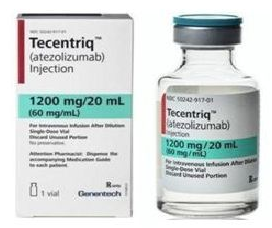
Tecentriq is a PD-(L)1 cancer immunotherapy that targets and binds to tumor cells andTumorPD-L1 protein expressed on infiltrating immune cells, blocking its interaction with PD-1 and B7.1 receptors. By inhibiting PD-L1, Tecentriq can activate T cells.
To date, Tecentriq has been approved in multiple countries as monotherapy and in combination with targeted therapy and/or chemotherapy for the treatment of various types of non-small cell lung cancer (NSCLC) and small cell lung cancer (SCLC), certain types of metastatic urothelial carcinoma (mUC), and PD-L1-positive triple-negativeBreast Cancer(TNBC). (Bioon.com)
Original Source: Genentech Provides Update on Supplemental Biologics Licenseapplication (sBLA) for Tecentriq in First-Line Metastatic Non-Squamous Non-Small Cell Lung Cancer (NSCLC)