

Novartis' Capmatinib Receives FDA Breakthrough Therapy Designation for First-Line Treatment of MET Exon 14 Skipping Mutation-Positive NSCLC with 68% Overall Response Rate
Sep 07, 2019 10:59
CST Updated
10:59

Novartis
Drug Development and Manufacturing
FDA
U.S. Food and Drug Administration
September 07, 2019 News /Bio ValleyBIOON/ -- Swiss pharmaceutical giantNovartis(Novartis) recently announced that the U.S. Food and Drug Administration (FDA) GrantedTumorBreakthrough Therapy Designation (BTD) for the novel MET inhibitor capmatinib (INC280) as first-line treatment for patients with metastatic non-small cell lung cancer (NSCLC) harboring MET exon 14 skipping mutations. Previously,FDACapmatinib was also granted Breakthrough Therapy Designation (BTD) for the treatment of patients with metastatic non-small cell lung cancer (NSCLC) harboring MET exon 14 skipping mutations who experienced disease progression during or after platinum-based chemotherapy. In the United States and Japan, capmatinib has also been granted Orphan Drug Designation (ODD).
Breakthrough Therapy Designation (BTD) is a new drug review pathway established by the FDA in 2012, aimed at accelerating the development and review of new drugs intended to treat serious or life-threatening diseases, where preliminary clinical evidence indicates that the drug may demonstrate substantial improvement over existing therapies. Drugs granted BTD can receive, during development, includingFDACloser guidance, including from senior officials, to ensure that new treatment options are made available to patients in the shortest possible time.
NSCLC is the most common type of lung cancer, affecting more than 2 million people annually. Approximately 3–4% of NSCLC patients harbor MET mutations. Although rare, this mutation is a marker of poor prognosis, and no therapies targeting this mutation have currently been approved.
Capmatinib is an investigational, oral, potent, and selective MET inhibitor that Novartis licensed from Incyte in 2009. Under the agreement, Incyte grantedNovartisExclusive global rights to develop and commercialize capmatinib and certain successor compounds for all indications.
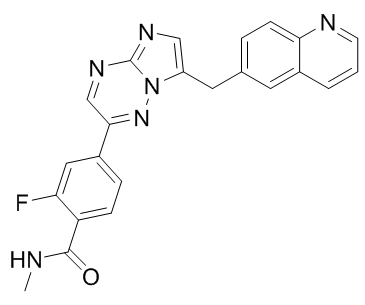
Molecular Structure of Capmatinib (Image Source: medchemexpress.cn)
This Breakthrough Therapy Designation (BTD) was granted based on the initial positive results from the Phase II clinical study GEOMETRY mono-1, presented at the 2019 American Society of Clinical Oncology (ASCO) Annual Meeting. This is an international, prospective, multi-cohort, non-randomized, open-label study involving 97 patients.TumorConducted in adult patients with locally advanced or metastatic NSCLC harboring MET exon 14 skipping mutations. In the study, patients received oral capmatinib 400 mg tablets twice daily.
The results showed that, as assessed by the Blinded Independent Review Committee (BIRC) according to the Response Evaluation Criteria in Solid Tumors version 1.1 (RECIST v1.1): (1) In treatment-naïve patients (Cohort 5b: 28 patients, previously untreated), the overall response rate (ORR) was 67.9% (95% CI: 47.6–84.1), and the median duration of response (DOR) was 11.4 months (95% CI: 5.55–not estimable [NE]). (2) In previously treated patients (Cohort 4: 69 patients, previously treated), the ORR was 40.6% (95% CI: 28.9–53.1), and the DOR was 9.72 months (95% CI: 5.55–12.98). (3) Adverse events were consistent with previously reported data, and no new safety signals were observed; the most common treatment-related adverse events included peripheral edema, nausea, increased creatinine, and vomiting. Among patients treated with capmatinib, 84% experienced adverse events, and 36% experienced Grade 3/4 adverse events (with only 4.5% being Grade 4).
These preliminary results reveal the therapeutic potential of capmatinib in NSCLC patients harboring MET exon 14 skipping mutations. The superior ORR data in the treatment-naïve cohort, compared to the previously treated cohort, highlight the importance of earlyDiagnosisClinical Relevance Between Detection and Early Treatment. (Bioon.com)