

Lilly Announces Positive Results for Selpercatinib (LOXO-292), Demonstrating a 68% Objective Response Rate and Sustained Durability in Heavily Pretreated RET Fusion-Positive Non-Small Cell Lung Cancer
Sep 10, 2019 11:01
CST Updated
11:01

Eli Lilly
Global Pharmaceutical R&D and Production Company

September 10, 2019 News /Bio ValleyBIOON/ --The 20th World Conference on Lung Cancer (WCLC), hosted by the International Association for the Study of Lung Cancer (IASLC) in 2019, was held in Barcelona, Spain, from September 7 to 10. ThisMeetingon,Eli Lilly(Eli Lilly) announced data from the Phase I/II LIBRETTO-001 clinical study supporting the registration of the oral RET kinase inhibitor selpercatinib (also known as LOXO-292) for the treatment of RET fusion-positive non-small cell lung cancer (NSCLC).
The LIBRETTO-001 study is the largest clinical trial ever reported in patients with RET-altered cancers. The data showed that the objective response rates (ORR) to selpercatinib treatment were 68% and 85%, respectively, in patients with RET fusion-positive NSCLC who had previously received chemotherapy and those who were treatment-naïve. Furthermore, selpercatinib is the first and only RET inhibitor demonstrating robust central nervous system (CNS) activity, with a CNS ORR of up to 91%. In the study, responses to selpercatinib were durable, the safety profile was favorable, and the discontinuation rate due to treatment-related adverse events was low (1.7%).
Based on this data,Eli LillyPlanned to be submitted to the United States by the end of the yearFDASubmit the New Drug Application (NDA) for selpercatinib; if approved, selpercatinib will become the first drug for patients with RET fusion-positive NSCLC.GenomicsGuide therapeutic drugs.
The data presented at this meeting are as follows: In the registration dataset, among the first 105 enrolled patients with RET fusion-positive non-small cell lung cancer (NSCLC) who had previously received platinum-based chemotherapy, the objective response rate (ORR) to selpercatinib treatment was 68% (95% CI: 58–76%). This patient population was heavily pretreated: the median number of prior systemic regimens was 3, 55% of patients had previously received anti-PD-1/PD-L1 antibody therapy, and 48% had previously received at least one multi-kinase inhibitor. The ORR was consistent regardless of prior treatment regimens. Up to 50% of patients with RET fusion-positive NSCLC may develop brain metastases. In the subset of patients with brain metastases within the registration dataset, the central nervous system (CNS) ORR with selpercatinib treatment was 91% (95% CI: 59–100%).
As of the data cutoff date of June 17, 2019, the median duration of response (DOR) was 20.3 months (95% CI: 13.8–24.0), and the median progression-free survival (PFS) was 18.4 months (95% CI: 12.9–24.9). As most patients remained in response or had not experienced disease progression at the data cutoff, these median values will continue to mature over time. In the safety analysis of all 531 patients enrolled in the LIBRETTO-001 study, selpercatinib was well tolerated, with only 9 patients (1.7%) discontinuing treatment due to treatment-related toxicities. The most commonAdverse ReactionsFor dry mouth, diarrhea,Hypertension, elevated liver enzymes, fatigue, constipation, and headache.
Furthermore, efficacy data for selpercatinib in treatment-naive patients with RET fusion-positive non-small cell lung cancer (NSCLC) were presented at the conference. The results showed that among the 34 patients analyzed, the objective response rate (ORR) to selpercatinib was 85% (95% CI: 69–95). As most patients remained in response or had not experienced disease progression, the median duration of response (DOR) and progression-free survival (PFS) had not yet been reached in this treatment group.
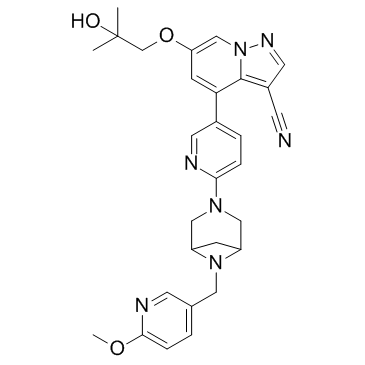
Molecular Structure of Selpercatinib (Image source: medchemexpress.cn)
Selpercatinib (LOXO-292) is a potent, oral, highly selective rearranged during transfection (RET) kinase inhibitor for the treatment of patients with RET-altered cancers. The RET gene is a proto-oncogene that undergoes rearrangement during transfection, from which it derives its name. This gene encodes a receptor tyrosine kinase located on the cell membrane, and its abnormalities serve as rare drivers in various types of tumors. It is estimated that RET fusions are present in approximately 2% of non-small cell lung cancer (NSCLC) cases, 10–20% of papillary thyroid carcinoma (PTC) and other thyroid cancer subtypes, as well as in subsets of other cancers such as colorectal cancer; RET point mutations are found in approximately 60% of medullary thyroid carcinoma (MTC) cases. Cancers harboring RET fusions or RET point mutations primarily rely on RET kinase activation to sustain their proliferation and survival, a dependency commonly referred to as “oncogene addiction,” making this class ofTumorHighly sensitive to small-molecule RET inhibitors.
Selpercatinib is designed to inhibit native RET signaling and anticipated acquired resistance mechanisms. The drug is currently in Phase I/II clinical trials for patients with tumors harboring aberrant RET kinase. Regarding U.S. regulatory affairs,FDABreakthrough Therapy Designation (BTD) has been granted to selpercatinib for the treatment of three patient populations, specifically: (1) those who have received platinum-based chemotherapy and a PD-1 or PD-L1Tumor(1) Patients with metastatic RET fusion-positive non-small cell lung cancer (NSCLC) who have experienced disease progression following immunotherapy and require systemic therapy; (2) Patients with RET-mutant medullary thyroid cancer (MTC) who have experienced disease progression after prior treatment, have no acceptable alternative treatment options, and require systemic therapy; (3) Patients with advanced RET fusion-positive thyroid cancer who have experienced disease progression after other regimens, have no acceptable alternative treatment options, and require systemic therapy.
Selpercatinib by the United StatesTumorPrecision drug developer Loxo Oncology found that,Eli Lillyacquired it for $8 billion in early January this year. In addition to selpercatinib, it also acquired multiple targeted drugs from Loxo, including: (1) the “broad-spectrum” anticancer drug Vitrakvi (larotrectinib), andBayerco-developed, is a tropomyosin receptor kinase (TRK) inhibitor approved for the treatment of NTRK gene fusion-positive solid tumors; (2) LOXO-195, co-developed with Bayer, is a next-generation TRK inhibitor designed to overcome potential acquired resistance; (3) LOXO-305, a reversible BTK inhibitor in preclinical development for the treatment of B-cell malignancies; (4) FGFR program, in preclinical development, for the treatment of cancers with abnormal alterations in fibroblast growth factor receptors (FGFR). (Bioon.com)