

Novartis Data Confirm Long-Term Efficacy and Safety of Aimovig® in Episodic Migraine Patients Over 4.5 Years
Sep 10, 2019 11:00
CST Updated
11:00

Novartis
Drug Development and Manufacturing
September 10, 2019 /BioValleyBIOON/ -- Swiss pharmaceutical giantNovartisNovartis recently announced 4.5-year interim analysis data from a 5-year open-label treatment period (OLTP) study of the migraine medication Aimovig (erenumab) in patients with episodic migraine (EM). The results showed that during the OLTP, Aimovig not only reduced the number of monthly migraine days but also decreased the number of days requiring acute migraine medication. These 4.5-year data further reinforce the established benefits of Aimovig for migraine patients.
This OLTP study (NCT01952574) evaluated the sustained efficacy and long-term safety of Aimovig 70 mg and 140 mg for the treatment of EM. In the study, patients initially received a monthly dose of 70 mg Aimovig, and those who continued in the study after approximately 2 years had their dose increased to 140 mg. A total of 250 patients transitioned from Aimovig 70 mg to 140 mg, of whom 221 patients (88%) completed the OLTP or continued receiving 140 mg treatment at 4.5 years. Efficacy endpoints included changes from baseline in monthly migraine days (MMD) and days of acute migraine medication use. Safety analysis was conducted by evaluating exposure-adjusted adverse event incidence rates from the 12-week short-term study and data from the OLTP extending up to 4.5 years.
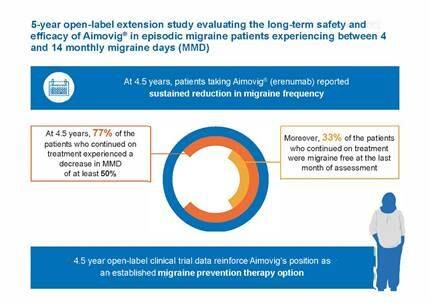
4.5-Year Interim Analysis Data Showed That in the Last Month of Assessment, Among Patients Who Continued Treatment: (1) The Change in Monthly Migraine Days (MMD) from Baseline (8.7 [2.7] Days) Was -5.8 [3.8] Days, and the Change in Monthly Days of Acute Migraine Medication Use from Baseline (6.1 [2.7] Days) Was -4.6 [3.3] Days. (2) 77% of Patients Achieved at Least a 50% Reduction in MMD, 33% Achieved a 100% Reduction in MMD, and 56% Achieved a 75% Reduction in MMD. (3) No New Safety Signals Were Observed with Aimovig, and Its Safety and Tolerability Profile Was Consistent with PreviousClinical TrialData are consistent.
These additional long-term data reinforce Aimovig’s position as the most widely used anti-CGRP medication. Since its launch, Aimovig has been prescribed to more than 250,000 patients worldwide.
Aimovig is the first migraine medication approved globally that targets the calcitonin gene-related peptide (CGRP) pathway. The drug is co-commercialized by Novartis and Amgen in the United States, while Amgen holds exclusive commercialization rights in the Japanese market.NovartisExclusive commercialization rights in the rest of the world.
Migraine: Competitive Landscape of CGRP Targets
CGRP is a neuropeptide that has been shown to be released during migraine attacks and is considered a trigger for migraine episodes. CGRP and the CGRP receptor have become hot targets in the development of migraine medications. To date, three migraine drugs targeting CGRP have been approved for marketing, including:Novartis/Amgen Aimovig (erenumab, targeting the CGRP receptor),Eli LillyEmgality (galcanezumab, targeting CGRP), Teva’s Ajovy (fremanezumab, targeting CGRP).

CGRP-Targeted Migraine Medications—Marketed Products (Image Source: migrainepal.com)
In terms of administration, Aimovig and Emgality are both administered via subcutaneous injection once monthly, whereas Ajovy can be administered via subcutaneous injection either once monthly or once every three months, offering greater convenience and providing patients with a differentiated treatment option. In addition to the aforementioned three antibody drugs, Alder PharmaceuticalsMonoclonal Antibody DrugsEptinezumab (targeting CGRP, administered via intravenous infusion once every three months) is under review in the United States and is expected to be approved in early 2020. The drug has demonstrated a response rate of up to 100% in certain patients.
Currently, several companies are still developing oral CGRP inhibitors. In early March this year, Allergan submitted a marketing application in the United States for the oral drug ubrogepant for the acute treatment of migraine (with or without aura).FDAA final review decision will be made in the fourth quarter of 2019. If approved, ubrogepant will become the first oral CGRP receptor antagonist for the acute treatment of migraine (with or without aura) in the U.S. market in the past 25 years.
However, in mid-March this year, Biohaven splashed out $105 million to purchase a Priority Review Voucher (PRV) from GW Pharmaceuticals, and in the second quarter of this year, it submitted toFDAA marketing application has been submitted for Zydis (rimegepant), an orally disintegrating tablet formulation of the oral CGRP receptor antagonist. This Priority Review Voucher (PRV) will be applied to the New Drug Application (NDA) review, shortening the standard 10-month review period by four months and enabling completion within six months. This signifies that Allergan and Biohaven have entered into direct competition for the title of “first oral CGRP receptor antagonist.” It remains to be seen who will emerge victorious. (Bioon.com)