

Domestic Players Like Nurotron and Lifetech Scientific Break Through in the Implantable Medical Device Boom

LifeTech
Suppliers of Congenital Heart Defect Occluders

Abbott
Diagnostic and pharmaceutical product manufacturers

Medtronic
Chronic Disease Medical Device and Therapy Developer
(This article is based on the VCBeat special feature Pro《Amid the Boom in Implantable Medical Devices, Domestic Players Like Nurotron and Lifetech Scientific Break Through》Compiled and generated; some cases in the text have been slightly abridged. For more information on implantable medical devices, please scan the QR code at the end of the article.)
Recently, Nurotron, a Chinese manufacturer of cochlear implants, has entered into a strategic partnership with Zhejiang Intergroup to jointly expand the domestic market for Chinese-made cochlear implants. The two companies aim to establish a nationwide sales and after-sales service network, enabling more patients with severe hearing loss to regain their "new voice."
China’s implantable medical device market has long been monopolized by foreign giants. However, in recent years, domestic companies such as Nurotron and Lifetech Scientific have been striving to break this monopoly by deeply cultivating niche segments such as otology and cardiology.
According to Article 8 of the "Rules for Classification of Medical Devices" (SFDA Order No. 15) issued by the State Food and Drug Administration, the definition of "implantable devices" is as follows: Implantable devices refer to medical devices that are wholly or partially introduced into the human body or a body cavity (orifice) through surgical procedures, or used to replace the epithelial surface of the human body or the surface of the eye, and remain in the human body for 30 days or more (inclusive) after the surgical procedure or are absorbed by the human body.
Unlike passive implantable devices such as artificial joints, prostheses, stents, mechanical heart valves, and certain tissue-engineered products, this article focuses on active implantable devices, including implantable cardiac pacemakers and defibrillators, cochlear implants, and implantable drug delivery systems.
According to incomplete statistics from the VCBeat database, as of September 2019, a total of four active implantable medical device products had received approval from the U.S. FDA.
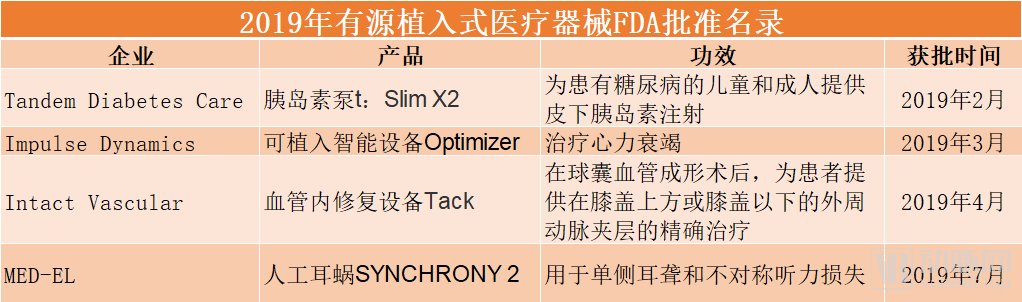
It is understood that due to differences in performance, price, and brand among implantable medical devices, the industry has formed a multi-tiered competitive landscape:
The first tier isForeign-funded Enterprisesprimarily, such enterprises possess significant advantages in branding, product design, and sales channels, and have gained widespread recognition from the international medical community. Their products enjoy high brand awareness and dominate China’s implantable medical device industry, for exampleMedtronicinsulin pumps,Cochlearsuch as cochlear implants.
The second tier mainly refers toIn Chinaleading companies in the implantable medical device sector, which typically possess unique competitive advantages in specific niche markets, such as cochlear implant manufacturersNurotron, Leading Cardiac Pacemaker CompaniesLifetech Scientificetc. These companies are in the brand-building phase, striving to expand their business scale through continuous efforts.
Third-tier implantable medical device companies, constrained by limited capital and technology, operate on a relatively small scale. Consequently, they typically face significant pressure in competition with foreign multinational corporations and leading domestic enterprises.
Currently, the development of domestic enterprises in the field of implantable medical devices is mostly in its early stages. The products of many small and medium-sized enterprises are predominantly at the mid-to-low end, indicating significant room for growth in this market within China.
However, leading domestic players such as Nurotron and Lifetech Scientific have already made significant strides in the field of implantable medical devices by deeply cultivating niche markets.
Nurotron is the leading enterprise in China’s cochlear implant sector. In August 2011, Nurotron obtained the Class III medical device manufacturing certificate for cochlear implants from the National Medical Products Administration (NMPA), breaking the monopoly held by companies from the United States, Australia, and Austria in this field. Currently, Nurotron remains the only company in China holding this certification. The company’s cochlear implant products have captured approximately 17% of the domestic market share, with technical specifications, stability, and reliability ranking among the world’s most advanced levels.
Following the collaboration between Nurotron and Int’l Group, Zhejiang Medical Instrument Co., Ltd., a subsidiary under Int’l Group’s medical device division, will serve as the exclusive distributor for Nurotron’s products. Currently, Nurotron’s Enduro cochlear implant system, representing the company’s latest generation of cochlear implants, has demonstrated improved speech recognition in noisy environments and enhanced Mandarin language recognition.
It is worth noting that Nurotron possesses independently developed chips. Building upon the first-generation professional chip for cochlear implant bodies, Nurotron has developed a second-generation implant chip, which increases the detection sensitivity of auditory nerve responses by tenfold and features an intelligent environmental safety feedback function for the implant, placing it at the forefront of similar international products.
Another notable company in China is Lifetech Scientific.
Leveraging Medtronic’s pacemaker technology, the HeartTone™ series of implantable cardiac pacemakers, manufactured by Lifetech Scientific (Shenzhen) Co., Ltd., received its initial market approval from China’s CFDA in December 2017. The successful approval of this product series, together with the active and passive cardiac pacing leads that had already gained market approval earlier in 2017, established Lifetech Scientific as one of the first manufacturers in China to possess a complete portfolio of implantable cardiac pacemaker products featuring internationally advanced technology and quality standards.
Subsequently, the first implantations of the HeartTone™ series of implantable cardiac pacemakers were rolled out across various provinces and municipalities in China. In 2018, Jiangsu Province People’s Hospital, Yunnan Fuwai Cardiovascular Disease Hospital, and Zhejiang Greentown Cardiovascular Disease Hospital successfully completed multiple implantation procedures.
In the niche segment of implantable devices, leading international players include Medtronic, Boston Scientific, Abbott, and MED-EL.
In addition, a number of powerful startups have emerged abroad in recent years, such as Senseonics, CorMatrix, and Magenta Medical, with most of these companies already having products approved by the FDA. In the future, they may become strong competitors to industry giants in this field.
Notably, in June 2018, Senseonics’ Eversense continuous glucose monitoring (CGM) system received FDA approval for market release. The Eversense CGM system is indicated for patients with diabetes aged 18 years and older. It is the first CGM system approved by the U.S. FDA that incorporates a fully implanted glucose sensor. The system’s miniature sensor utilizes novel optical technology to measure glucose levels in patients with diabetes at regular intervals for up to 90 days, providing timely alerts when glucose levels are too high or too low.
CorMatrix Cardiovascular is a U.S. company primarily engaged in the development of biomaterials and medical devices. It was co-founded in December 2001 by Dr. Robert G. Matheny, a cardiovascular surgeon, and David Camp, an entrepreneur in the field of cardiovascular medical devices. The company mainly leverages its proprietary technology to develop devices capable of repairing human cardiac tissue. This proprietary technology is based on extracellular matrix (ECM) technology, designed to address clinical challenges related to congestive heart failure, heart valve disorders, and cardiovascular diseases.
In June 2019, the Cor Patch epicardial patch, under the medical device company CorMatrix Cardiovascular, received FDA 510(k) clearance for market authorization. It is used to repair atrial damage caused by myocardial infarction, including damage to the left ventricular wall, right ventricular wall, and valves.
Magenta Medical is an Israel-based company specializing in the research and development of clinical intravenous catheter devices, dedicated to creating novel device solutions for heart failure. Notably, Magenta Medical has attracted not only investor interest but also attention from leading industry peers; Abiomed, a publicly listed medical device company that develops implantable artificial hearts, served as the lead investor in Magenta Medical’s Series B financing round. This underscores the significant potential of Magenta Medical’s core technologies and its promising future prospects.
In late July 2019, Magenta Medical announced a new round of financing, stating that the proceeds would be used to support the development of its cardiovascular disease treatment products and planning to submit its first application to the FDA.
Currently, commercially available active implantable medical devices mainly include implantable cardioverter-defibrillators (ICDs), cardiac pacemakers, cochlear implants, insulin pumps, drug delivery systems, deep brain stimulators, and monitoring systems. In addition to international giants such as Abbott and Medtronic, which have diversified their product portfolios, most domestic and foreign startups and small and medium-sized enterprises choose to focus on specific niche sectors for in-depth development. Several leading companies in China’s market, such as Nurotron and Lifetech Scientific, have also opted to narrow their business scope, striving for specialization and refinement.
Cardiac Defibrillator, also known as a cardioverter, is a medical electronic device that uses electrical shocks to rescue and treat arrhythmias. By delivering pulsed current to the heart, the cardiac defibrillator helps restore sinus rhythm, making it one of the widely used emergency devices in clinical practice today.
A cardiac pacemaker is an implantable electronic therapeutic device that delivers battery-powered electrical pulses via a pulse generator. These pulses are conducted through lead electrodes to stimulate the myocardium in contact with the electrodes, thereby inducing cardiac excitation and contraction. This mechanism aims to treat cardiac dysfunction caused by certain arrhythmias.
According to the “Implantable Medical Devices Market Report” released by global market research firm Allied Market Research, driven by the growing global elderly population, the continuously rising incidence of cardiovascular diseases, and ongoing technological innovations, the cardiovascular implantables market is projected to grow at a compound annual growth rate (CAGR) of 7.1% from 2016 to 2020, with the global market size expected to reach $116.3 billion by 2022.
Cardialen is a medical device company developing implantable low-voltage defibrillators. Its Cardialen UPT therapy delivers a series of low-energy electrical pulses to restore abnormally rapid heart rates to normal rhythm. This low-voltage therapy is better tolerated and causes less damage to cardiac function, thereby mitigating the side effects associated with current high-voltage defibrillators. Early feasibility studies in humans have demonstrated that Cardialen’s UPT therapy can successfully treat arrhythmias using significantly lower energy levels than existing defibrillators.
Magenta Medical, the Israeli clinical intravenous catheter therapeutic device R&D company mentioned earlier, has two products in this field: one is a percutaneous device used to decompress the kidneys of patients with acute venous congestion and volume overload; the other is a percutaneous left ventricular assist device, commonly referred to as LVAD, which is a small catheter-based arterial pump that moves blood from the left ventricle into the aorta. This device is designed to improve outcomes for patients with acute heart failure.
Cochlear Implant: An implantable electronic hearing device designed to provide auditory perception for individuals with severe or profound sensorineural hearing loss by electrically stimulating the nerves of the inner ear.
According to the latest report released by market research and consulting firm Market Research Future (MRFR), the global cochlear implant industry is projected to reach a size of USD 3.204 billion by 2023.
The rising prevalence of ear infections and prelingual hearing impairment will drive continuous expansion of market demand. Between 2017 and 2023, an increase in regulatory approvals and the launch of various hearing aid products are expected to propel the market to grow at a compound annual growth rate (CAGR) of 9.86%.
Currently, three major cochlear implant manufacturers collectively hold over 90% of the global cochlear implant market: Cochlear Limited from Australia (55%), Advanced Bionics from the United States (20%), and MED-EL from Austria (20%). (Data sourced from the Cochlear Implant Help website.)
The cochlear implant project developed by Nurotron, a Chinese cochlear implant manufacturer, has not only broken the monopoly of foreign giants in this field but also made China the fourth country capable of independently developing cochlear implants.
In response to the rise of domestic Chinese companies in the cochlear implant sector, Cochlear, one of the global “Big Three” in cochlear implants, invested AUD 50 million in 2017 to establish a manufacturing facility in Chengdu, Sichuan Province. This marks Cochlear’s first overseas production and R&D base. The move not only underscores the importance of the Chinese market to Cochlear but also highlights its urgency to further expand its market share in China.
Drug delivery systems typically administer medication in a regular, slow manner via implantable devices, releasing the drug directly to the optimal physiological site. These devices are generally controlled and powered by electronics and long-life power sources, forming a "drug channel" within the human body.
Among these, the most prominent application of this technology is the insulin pump for diabetes treatment, which offers the advantages of reducing side effects associated with conventional therapy and achieving better control of physiological parameters, such as blood glucose levels. An insulin pump is a medical device used in diabetes management to regulate insulin delivery, also known as a continuous subcutaneous insulin infusion (CSII) device.
In November 2018, Insulet, the global leader in tubeless insulin pump technology, partnered with Samsung to launch the first Omnipod insulin pump system controlled by Galaxy smartphones. As an innovative alternative to traditional insulin delivery methods, this system features a simple, wearable design with a single-use Pod that provides up to three days of uninterrupted insulin delivery without the need for needle handling. Upon regulatory approval, this collaboration will make the system the first product allowing consumers to safely control their insulin pumps using their personal Galaxy smartphones.
In June 2019, Medtronic partnered with Tidepool to develop an interoperable insulin pump. This is an open-source insulin delivery application compatible with iPhone and Apple Watch, and it supports the Tidepool Loop. This means the insulin pump can be used in conjunction with various components that constitute a diabetes treatment system, allowing patients to customize their diabetes management plans and configure the diabetes treatment system according to their personal preferences.
In addition, implantable drug delivery systems for epilepsy treatment and infusion systems for subcutaneous implantation are also important applications of medication delivery systems.
Cerebral Therapeutics’ new therapy employs a chronically implanted infusion system to bypass the blood-brain barrier, delivering appropriate doses of antiepileptic drugs directly to target brain regions via intracerebroventricular (ICV) injection. This approach significantly reduces the need for systemic drug administration and mitigates medication adherence issues, offering a superior option for patients with chronic neurological disorders, particularly those who are refractory to oral and intravenous treatments.
In July 2019, pharmaceutical giant Allergan announced that the U.S. FDA had accepted its New Drug Application (NDA) for bimatoprost sustained-release (SR), an ophthalmic drug. If approved, bimatoprost SR would become a first-in-class, sustained-release, biodegradable implant for lowering intraocular pressure in patients with primary open-angle glaucoma or ocular hypertension.
Also in July 2019, Baxter launched the “HEALTHPORT Implantable Venous Access Port.” This subcutaneously implanted device facilitates easy drug administration and features a simple operation procedure. It helps reduce the risk of infection, bringing significant benefits to patients requiring long-term intravenous therapy by alleviating pain and inconvenience.
Implantable Neuro-Stimulator is an emerging digital therapeutic device.
Based on their therapeutic targets, implantable neurostimulators encompass various treatment modalities, including deep brain stimulation, spinal cord stimulation, vagus nerve stimulation, sacral nerve stimulation, and phrenic nerve stimulation.
Classified by therapeutic indications, implantable neurostimulators hold significant clinical value in the treatment of Parkinson’s disease, pain, epilepsy, bladder dysfunction, respiratory dysfunction, hypertension, and obesity.
As previously reported by VCBeat, BAROSTIM NEO, developed by the US medical device company CVRx, is currently the only implantable device approved for treating heart failure and resistant hypertension. While neuromodulation technology is generally used for pain management, CVRx has pioneered its application in the treatment of hypertension. By implanting BAROSTIM NEO near the clavicle, the device stimulates the body’s baroreflex system to regulate blood flow, thereby achieving therapeutic effects for hypertension and heart failure.
In addition, Neuspera Medical is a technology company specializing in the development of implantable neuromodulation electronic devices. The company holds an exclusive license to patented miniature neuromodulation technology for the development of bioelectronic medicines. Currently, these neuromodulation electronic devices are approved for surgical implantation in the treatment of chronic pain and overactive bladder.
In China, implantable neurostimulators are also being applied in clinical practice. On March 16, 2019, China Mobile, in collaboration with Huawei, assisted a hospital of the People's Liberation Army in completing the first nationwide 5G-based remote human surgery—the implantation of a “brain pacemaker” for Parkinson’s disease. The surgeon, located in Hainan, performed the procedure on a patient in Beijing. Brain pacemaker surgery is currently one of the effective treatments for Parkinson’s disease, wherein physicians precisely place electrodes into deep brain neuronal nuclei and deliver electrical stimulation to alleviate patients’ symptoms.
According to VCBeat’s reports on companies, implantable monitoring systems currently serve primarily to monitor cardiac activity, blood pressure, and blood glucose levels.
Among these, implantable cardiac monitors can help physicians remotely measure blood pressure fluctuations in the patient's pulmonary artery via the implanted device and adjust medication dosages accordingly.
As early as October 2017, Abbott’s smartphone-compatible implantable cardiac monitor (ICM), Confirm Rx, received approval from the U.S. FDA. It was the first device of its kind approved in the United States, offering patients and physicians an alternative method for monitoring and diagnosing abnormal heart rhythms.
In May 2019, Abbott launched the next-generation implantable cardiac monitor (ICM), also named Confirm Rx, which is compatible with smart devices and builds upon its predecessor. This paper-sized implantable device monitors arrhythmias more accurately than traditional devices. It is the only ICM on the market that synchronizes with smart devices via Bluetooth and transmits data to physicians to help rapidly identify irregular heartbeats.
Additionally, Implicity, a French startup specializing in cardiac implantable electronic devices (CIEDs), is also developing a remote monitoring system for such devices. The company completed its seed funding round six months ago.
Implantable glucose monitors can replace frequent and painful finger-prick tests. Once connected to a smartphone, the monitoring device can transmit blood glucose data to the phone. If patients experience blood glucose abnormalities, they will receive alerts on their smartphones and can accordingly administer insulin to lower blood glucose or consume sugar to raise it. Representative companies offering such products include Medtronic and Senseonics.
Medtronic’s MiniMed 670G hybrid closed-loop system is a diabetes management device that automatically monitors blood glucose levels and delivers appropriate doses of basal insulin into the body. Following two consecutive FDA approvals, the indicated population for the MiniMed 670G hybrid closed-loop system has been expanded from patients aged 14 years and older with type 1 diabetes to include those aged 7 years and older with type 1 diabetes. This means that patients with diabetes across multiple age groups can more effectively control their blood glucose levels and improve their condition using this product.
Senseonics’ Eversense continuous glucose monitoring (CGM) system has a slightly narrower indication, primarily intended for patients with diabetes aged 18 years and older. It is the first CGM system approved by the U.S. Food and Drug Administration (FDA) that incorporates a fully implanted glucose sensor. The Eversense CGM system employs a small sensor utilizing novel optical technology to regularly measure glucose levels in patients with diabetes for up to 90 days, providing timely alerts when glucose levels are too high or too low.
Busy lifestyles, unhealthy dietary habits, lack of physical activity, and the continuously growing elderly population leading to a rise in chronic disease incidence are becoming key drivers fueling the growth of the global implantable medical device market.
According to the "Global Implantable Medical Devices Market Report" released by global market research firm IMarc, the global market size for implantable medical devices reached USD 9.66 billion in 2018. With continuously growing market demand, the global market for implantable devices is projected to reach USD 143.3 billion by 2024, representing a compound annual growth rate (CAGR) of 6.8% during the forecast period.
Implantable medical devices feature capabilities such as data acquisition, wireless connectivity, remote monitoring, and near-field communication. They not only monitor human health indicators but also treat diseases and restore physiological functions. As the application scenarios for implantable medical devices expand, many optimists believe that humanity is not far from entering the era of the "Internet of Bodies."
However, while implantable medical devices address numerous challenging diseases, they also face many technical challenges.
For instance, in deep tissues, energy transmission to implants is constrained by the device coils; there is a risk of infection associated with implant materials; electronic leads of implanted devices are prone to displacement; and battery life is limited. These are all challenges faced by implantable medical devices, among which the most critical issue is battery lifespan.
The battery of an implantable device is located inside the human body and requires surgery for replacement. For patients, each battery replacement is a painful experience, carrying even the risk of infection. Furthermore, batteries contain toxic substances; if leakage occurs within the patient's body, it could jeopardize their health.
Furthermore, for cardiac pacemakers, the presence of a battery increases their size and can even impact their design and performance.
In response to the aforementioned challenges, the medical community is currently exploring potential solutions. Recent research from Switzerland suggests that cardiac pacemakers could potentially be powered by solar energy; scientists in the United States have even proposed harnessing gastric acid as an energy source for batteries. These approaches are currently largely confined to the conceptual and experimental stages.
Remarkably, in April 2019, Chinese scientists developed a self-powered pacemaker. This device harvests energy from heartbeats, utilizing an implantable triboelectric nanogenerator to supply its own electrical power. Currently, this pacemaker has been successfully implanted in animal (porcine) models.
As technology continues to advance, these challenges will inevitably be overcome. When that day arrives, we will indeed be close to the era of the “Internet of Bodies.”
This article is based on the VCBeat special feature Pro “Amid the Boom in Implantable Medical Devices, Domestic Players Like Nurotron and Lifetech Scientific Break Through》Compiled and generated; cases cited in the article have been slightly abridged. Updates on implantable medical devices will be continuously provided. For a comprehensive understanding of industry trends and access to more case studies on implantable medical devices, please scan the QR code below to read more!
