

ZhenTai Intelligence Secures Millions in Angel Funding from Lenovo Capital to Advance BCI-Powered Rehabilitation Robotics

ZhenTec
Brain-Computer Interface Medical Industrialization Developer
On September 25, 2019, ZhenTec, a pioneer in brain-computer interface (BCI)-based rehabilitation in China, officially announced the completion of its angel round financing, amounting to several million RMB. This round was exclusively invested by Legend Capital. The funds will be used to accelerate the research and development of its brain-controlled intelligent rehabilitation robot system and to strengthen its team, thereby promoting the clinical application of related products and serving more patients.
Leveraging the technological strengths of Xi’an Jiaotong University, ZhenTec is dedicated to the research and development of brain-controlled active-passive collaborative rehabilitation robots and various brain-computer interface (BCI)-related system applications. The company’s flagship product is a brain-controlled lower-limb rehabilitation robot. Designed to address the limited efficacy of traditional stroke rehabilitation equipment, it integrates BCI, virtual reality, and robotic control technologies to activate patients’ voluntary motor intentions, thereby facilitating active-passive collaborative rehabilitation training.
Currently, the industrial applications of brain-computer interface (BCI) technology in China are predominantly concentrated in the research sector, with no large-scale market adoption yet established. Internationally, companies integrating BCIs with rehabilitation robotics are also in the early exploratory stage. Leveraging its profound technical expertise in EEG hardware, software algorithms, and system applications, ZhenTec has conducted clinical trials in numerous Grade A tertiary hospitals. The company is at the forefront of technological implementation and industrialization experience, positioning itself as a pioneer in China’s brain-controlled medical rehabilitation industry.
According to the "China Stroke Prevention and Treatment Report (2018)" released by the National Health Commission of China, the incidence rate of stroke in China is increasing at an annual rate of nearly 9%. This means that there are 1.5 to 2 million new cases each year in China. By 2030, the number of stroke patients in the country will reach 31.77 million. In addition, there are approximately 5 million elderly people and individuals with disabilities who require rehabilitation training each year.
The traditional rehabilitation methods currently adopted in China, such as acupuncture, massage, and device-assisted therapy, are predominantly passive in nature. These approaches provide only unidirectional stimulation of neural pathways, making it difficult to evoke patients’ active motor intention and often leading to resistance due to fatigue. Currently, the disability rate among post-stroke patients in China is nearly 70%.
Against this backdrop, ZhenTec has independently developed a novel brain-controlled motor rehabilitation approach based on visual evoked potentials. The ZhenTec Brain-Controlled Rehabilitation System applies steady-state motion visual evoked potential (SSMVEP) technology to innovatively design motor stimulation paradigms. By integrating these with virtual reality (VR) motor scenarios, the system forms a closed-loop, active-passive collaborative rehabilitation training platform. This system effectively stimulates the neural pathways involved in motor perception and motor control, enhances patients' voluntary engagement and intent, and improves the overall efficacy of rehabilitation training.
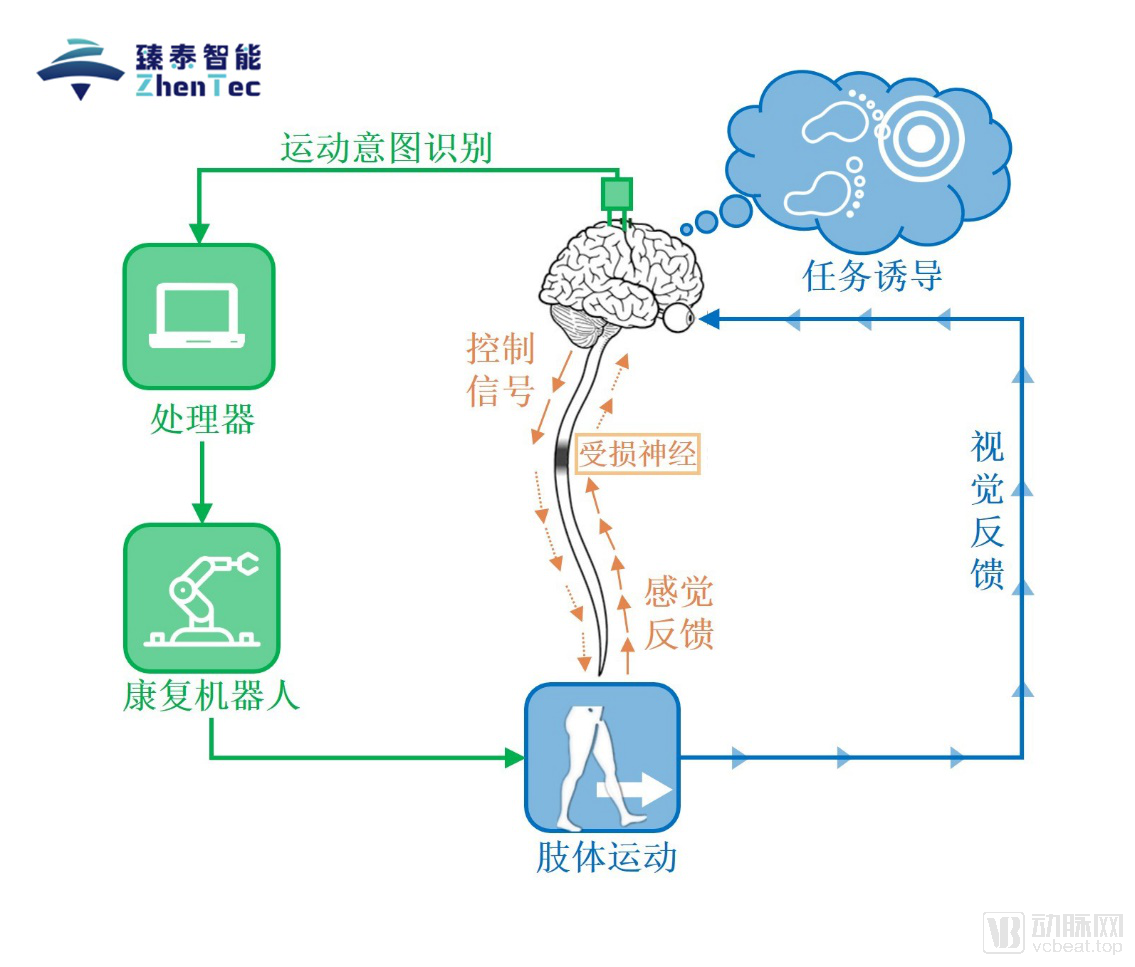
ZhenTec Intelligent Technology Roadmap (Image provided by the company)
ZhenTec has pioneered a novel rehabilitation therapy for patients with stroke and spinal cord injuries. Initially, patients watch motion scenarios to stimulate their own motor sensory nerves, generating "visually induced motor imagery." Subsequently, brain-computer interfaces drive rehabilitation robots to facilitate limb movement, combining central stimulation with peripheral feedback—a process known as "neural bridging"—to effectively promote the recovery of damaged nerves. By continuously reinforcing central neural stimulation and feedback for neurological rehabilitation, and complementing this with robotic collaborative training, the system effectively promotes neural compensation for injured nerves, significantly enhancing patients' neurological rehabilitation outcomes.
The project research team has conducted patient follow-up trials at multiple Grade A tertiary hospitals. Nearly two years of comparative clinical trials have demonstrated that patients undergoing training with the brain-controlled rehabilitation system show significantly better outcomes than those receiving traditional rehabilitation training, particularly exhibiting marked improvements in neurocognitive function and basic motor skills.
The project has won more than ten awards both domestically and internationally, including the China Regional Championship of the World Medical Robot Competition, the Second Prize in the China Medical Device Innovation and Entrepreneurship Competition organized by the Ministry of Science and Technology, and the National Grand Championship of the Lenovo AI Elite Challenge. It has been reported by multiple media outlets such as CCTV and China Youth Daily, and was invited to make public appearances on television stations including Shenzhen Satellite TV and Dragon Television.
The team at ZhenTec comprises PhD and Master’s graduates from Xi’an Jiaotong University, chief experts of the National 863 Program, and senior industry specialists from the frontline medical device sector. The team has participated in multiple projects under the National 863 Program and major projects funded by the National Natural Science Foundation of China, with a long-term focus on research in brain-computer interfaces and rehabilitation robotics.
Regarding this investment, He Zhiqiang, Senior Vice President of Lenovo Group and President of Lenovo Capital, stated: “ZhenTec has accumulated profound expertise in brain-computer interface (BCI) technology and theoretical research, and is at the forefront of promoting clinical industrialization and application. Lenovo Capital highly recognizes its precise market positioning. Furthermore, leveraging Lenovo Group’s global industrial chain resources, Lenovo Capital will utilize the power of capital, combined with talent, market access, supply chain, and management expertise, to comprehensively support the commercialization of its technological achievements.”
ZhenTec is committed to becoming a leader in the brain-controlled medical rehabilitation industry. It will continue to recruit top-tier technical and marketing talent, focus on applied research and clinical applications of brain-controlled medical rehabilitation systems, and implement a comprehensive layout across the brain-computer interface (BCI) medical rehabilitation industry.