

Johnson & Johnson Launches New 3D-Printed Interbody Fusion Device to Expand Spinal Disease Treatment Solutions

Synthes GmbH
Producer of Trauma and Maxillofacial Surgical Tools

Johnson & Johnson
Healthcare Product Manufacturers, Health Service Providers

Johnson & Johnson Medical’s subsidiary, DePuy Synthes, recently announced the launch of its CONDUIT portfolio of interbody fusion devices manufactured using EIT Cellular Titanium 3D printing technology, further expanding Johnson & Johnson’s solutions for the treatment of degenerative spinal diseases.
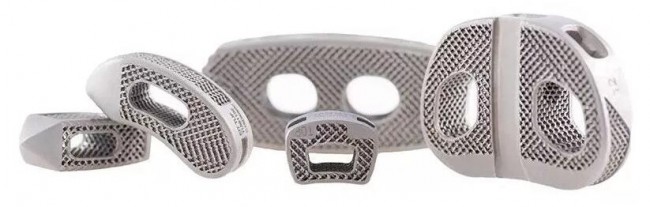
3D-Printed Interbody Fusion Cage Portfolio – CONDUIT. Source: Johnson & Johnson
 Approaching the Microstructure and Mechanical Properties of Cancellous Bone
EIT is a specialized manufacturer of 3D-printed spinal implants that Johnson & Johnson announced it would acquire in September 2018. Following the acquisition, Johnson & Johnson subsidiary DePuy Synthes also strengthened its interbody implant portfolio, including titanium alloy and PEEK implants for minimally invasive spine surgery.EIT’s Cellular Titanium implants are manufactured using selective laser melting (SLM) 3D printing technology, featuring an open and interconnected porous structure that facilitates bone ingrowth. In 2017, EIT’s Cellular Titanium implants received FDA 510(k) clearance. Prior to this, the implants had been used in over 10,000 cases across more than 15 countries worldwide.
Johnson & Johnson Announces Key Features of the CONDUIT Implant:
- Nanoscale Surface Roughness: In vitro studies have demonstrated that, compared with conventional titanium materials, 3D-printed porous titanium exhibits nanoscale features and shows increased osteoblast adhesion;
- The porosity reaches 80%, which is comparable to that of human cancellous bone (50%-90%); CONDUIT exhibits a similar porosity.
- The elastic modulus is similar to that of cancellous bone;
- With the aid of X-ray, CT scan, and MRI medical imaging equipment, the space within and around the implant can be clearly visualized, with no significant artifacts due to the structure of the interbody fusion cage.
The CONDUIT platform reinforces Johnson & Johnson’s commitment to 3D printing technology, as the company emerges as one of the leaders in the field of 3D-printed medical devices. By leveraging 3D printing, Johnson & Johnson is building advantages in product design, manufacturing patient-specific products, accelerating time-to-market, transforming its global supply chain, and driving material innovation.
Review
3D printing is one of the strategic innovative technologies that Johnson & Johnson prioritizes. Over the next five years, Johnson & Johnson will further increase its investment in the research and development of materials for 3D-printed implants. In February 2019, DePuy Synthes, a subsidiary of Johnson & Johnson, invested €36 million in its innovation center in Ireland to support a five-year project aimed at advancing the science of materials for 3D-printed implants.Johnson & Johnson’s recently announced CONDUIT product portfolio consists of spinal implants. Spinal implants, such as spinal fusion devices, represent the area where powder bed metal 3D printing technology is being industrialized most rapidly in the field of orthopedic implant manufacturing.
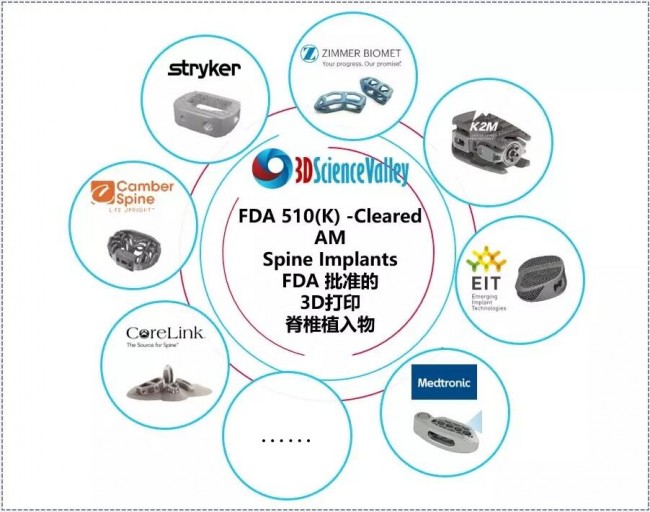
Since 2018, the international market has witnessed a surge in the approval and commercialization of 3D-printed spinal implants. In April 2019 alone, more than ten spinal implant manufacturers made new strides in the research and development of 3D-printed products or the launch of new offerings. For instance, ChoiceSpine released Hawkeye TI, a 3D-printed titanium alloy cervical spine implant; Additive Implants obtained FDA registration for its first 3D-printed titanium alloy cervical interbody system; and Osseus Fusion Systems’ 3D-printed Aries-L lumbar interbody fusion device was utilized in clinical surgical procedures, among other developments.
In the Chinese market, spinal implants were among the first 3D-printed implant products approved for marketing by the National Medical Products Administration (NMPA). Beijing AK Medical Co., Ltd.’s 3D-printed vertebral prostheses and interbody fusion cages received medical device registration certificates between 2015 and 2016.
In addition, other clinical trials related to 3D-printed spinal implants are also underway. For instance, Professor He Xijing’s team at the Second Affiliated Hospital of Xi’an Jiaotong University has engaged in long-term collaboration with Bright Laser Technologies (BLT), jointly dedicating efforts to the optimized design, personalized manufacturing, and clinical application research of 3D-printed cervical prostheses. The novel anatomical titanium cage developed by Professor He Xijing has successfully completed clinical trials. Clinical follow-up data have confirmed that its application in subtotal corpectomy and bone graft fusion surgery for the cervical spine demonstrates significantly superior outcomes in terms of postoperative subsidence rates and correction of cervical curvature compared to traditional titanium cages. Furthermore, Huatai 3D, in collaboration with the Department of Spinal Orthopedics at Nanfang Hospital, successfully performed a 3D-printed personalized “integrated artificial vertebral body/disc” implantation surgery in 2018. In September 2019, the two parties again collaborated to successfully implement the implantation of a 3D-printed artificial vertebral body.
The Center for Medical Device Evaluation of the National Medical Products Administration organized the drafting of the “Guiding Principles for Registration Review of 3D-Printed Artificial Vertebral Bodies” and released a draft for public comment in September 2019. These Guiding Principles apply to 3D-printed titanium alloy artificial vertebral body products intended for fusion and fixation with the adjacent normal vertebrae above and below following vertebrectomy due to vertebral lesions or injuries. The products covered include standardized TC4 and TC4 ELI titanium alloy artificial vertebral bodies, manufactured using additive manufacturing techniques such as selective laser melting (SLM) or electron beam melting (EBM), designed for use in conjunction with spinal auxiliary internal fixation systems, and incorporating bone grafts.
“Guidance on Registration Review of 3D-Printed Artificial Vertebral Bodies”
(Editor: China 3D Printing Network)