

Amgen Reports Positive Phase 3 Results for Blincyto in Pediatric Patients with Relapsed B-Cell Acute Lymphoblastic Leukemia
Sep 25, 2019 12:13
CST Updated
12:13

Amgen
Developer of Treatment Drugs for Serious Diseases

September 25, 2019/BioValleyBIOON/-- U.S. biotechnology giant Amgen recently announced the results of a pre-specified interim analysis of a Phase III clinical trial (20120215, NCT02393859) of its BiTE immunotherapy Blincyto (blinatumomab), showing that the study’s primary endpoint, event-free survival (EFS), had been met.
This study is an open-label, randomized, controlled, global multicenter trial evaluating Blincyto versus conventional consolidation chemotherapy for the treatment of high-risk B-cell acute lymphoblasticLeukemiaEfficacy, Safety, and Tolerability at First Relapse in Patients with Acute Lymphoblastic Leukemia (ALL). Due to the encouraging efficacy observed in the Blincyto treatment arm, patient enrollment in this study was terminated early upon the recommendation of the Independent Data Monitoring Committee (DMC). Subsequent activities will continue to proceed in accordance with the clinical protocol.
Furthermore, a randomized Phase III study (COG AALL1331, NCT02101853) evaluating Blincyto for the treatment of pediatric patients with B-cell ALL at first relapse, based on pediatricTumorPer the recommendation of the Children’s Oncology Group (COG) Data Monitoring Committee (DMC), enrollment of patients in the high-risk and intermediate-risk arms has been closed. The DMC’s decision to close these arms was based on the strong trend toward improvement in disease-free survival (DFS), improved overall survival (OS), significantly reduced toxicity, and superior minimal residual disease (MRD) clearance observed with Blincyto compared with chemotherapy. The COG DMC recommended that enrollment and randomization of patients in the low-risk arm of the AALL1331 study continue until the enrollment target is reached. The AALL1331 study is sponsored by the National Cancer Institute (NCI) Cancer Therapy Evaluation Program, part of the U.S. National Institutes of Health (NIH), and conducted by the COG, which is funded by the NCI. Amgen provides Blincyto for the AALL1331 study under a collaborative research agreement between the NCI and Amgen.
David M. Reese, Executive Vice President of Research and Development at Amgen, stated, “Taken together, the results of these studies are significant. Children and adolescents with relapsed acute lymphoblastic leukemia face a poor prognosis, and there remains an unmet need for additional treatment options, particularly for those identified as high-risk. These data have the potential to change clinical practice and may offer a therapeutic approach for preventing relapse that is superior to chemotherapy. We look forward to discussing these data with regulatory authorities.”
The adverse events observed with Blincyto in the aforementioned two Phase III studies (20120215 and COG AALL1331) were consistent with the known safety profile of Blincyto. These interim data will be presented at future medicalMeetingpublished above.
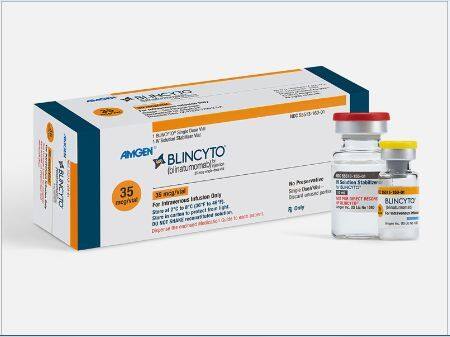
Blincyto is the first and only CD19-CD3 bispecific T-cell engager (BiTE) immunotherapy approved globally, and it is also the first bispecific antibody product developed from Amgen’s BiTE technology platform. It works by presenting the CD19 protein on tumor cells to the CD3 protein specifically expressed on T cells, thereby activating the immune system to recognize and destroy them.TumorCells.
BiTE antibody technology represents an innovative immunotherapy approach capable of exerting its effects at very low concentrations. Amgen acquired the BiTE technology following its $1.2 billion acquisition of Micromet in 2012. Currently, Amgen is extensively investigating refractoryTumorAmong the types, explore the potential of innovative BiTE therapies.
Previously, the United StatesFDABoth the U.S. FDA and the European Medicines Agency (EMA) have granted Blincyto orphan drug designation, breakthrough therapy designation, and priority review for the treatment of various types of hematologic cancers, including acute lymphoblastic leukemia (ALL), chronic lymphocytic leukemia (CLL), hairy cell leukemia (HCL), prolymphocytic leukemia (PLL), indolent B-cell lymphomas, and mantle cell leukemia (MCL).
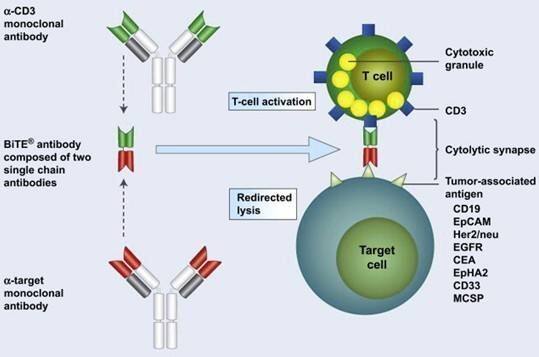
Mechanism of Action of BiTE Immunotherapy
In the United States, Blincyto has been approved for the treatment of: (1) adult and pediatric patients with relapsed or refractory B-cell precursor acute lymphoblastic leukemia (ALL); and (2) adult and pediatric patients with B-cell precursor ALL who have minimal residual disease (MRD) ≥0.1% at first or second complete remission.
In the European Union, Blincyto has been approved for the treatment of: (1) adult patients with Philadelphia chromosome-negative, CD19-positive, relapsed or refractory acute lymphoblastic leukemia (ALL); (2) adult patients with Philadelphia chromosome-negative, CD19-positive B-cell precursor ALL who have minimal residual disease (MRD) ≥0.1% at first or second complete remission; (3) patients who are relapsed or refractory after having received at least two prior therapies, or who have previously undergone allogeneic hematopoieticStem CellsPediatric patients (≥1 year of age) with relapsed Philadelphia chromosome-negative, CD19-positive B-cell precursor acute lymphoblastic leukemia after transplantation.
In patients with acute lymphoblastic leukemia (ALL), detection of residual cancer cells (i.e., minimal residual disease, MRD) after complete remission is the strongest prognostic factor for assessing relapse. Notably, Blincyto is the first therapy approved by regulatory authorities in the United States and the European Union for the eradication of MRD. (Bioon.com)