

European Commission Approves Astellas' XOSPATA™ (Gilteritinib) as Monotherapy for Relapsed or Refractory FLT3-Mutated AML
Oct 29, 2019 00:20
CST Updated
Oct 27, 14:37

Astellas
Pharmaceutical R&D Manufacturer

European Commission
The European Commission, abbreviated as the EU Commission, is a supranational body under the European Union. Within the EU political system, the European Commission primarily undertakes executive tasks, thus being roughly equivalent to the government in a national system. However, the European Commission has other functions as well. In particular, except for the few circumstances specified in the treaties, the European Commission is the only institution with legislative power in the EU legislative process.

October 27, 2019 /Bio ValleyBIOON/ -- Japanese pharmaceutical company Astellas recently announced that the European Commission (EC) has approved the targeted anticancer drug Xospata (gilteritinib). This once-daily oral medication is indicated as a monotherapy for the treatment of relapsed or refractory (drug-refractory) acute myeloid leukemia harboring FLT3 mutations (FLT3mut+).Leukemia(AML) adult patients. Xospata is expected to improve the prognosis of AML patients carrying the two most common types of mutations—FLT3 internal tandem duplication (ITD) in the juxtamembrane domain and FLT3 tyrosine kinase domain (TKD) mutations.
AML is a cancer that affects the blood and bone marrow, with its incidence increasing with age. In the European Union, the annual incidence of AML is 3.7 per 100,000, with an estimated 18,400 people beingDiagnosisDiagnosed with AML. AML is associated with various genetic mutations.
This approval is based on the results of the Phase III ADMIRAL trial, which evaluated the efficacy and safety of Xospata versus salvage chemotherapy in patients with relapsed or refractory FLT3-mutated acute myeloid leukemia (AML). The results demonstrated that patients treated with Xospata had a significantly longer overall survival (OS) compared to those receiving salvage chemotherapy (median OS: 9.3 months vs. 5.6 months; HR=0.64 [95% CI: 0.49–0.83]; p=0.0004). The one-year survival rate was 37% for patients treated with Xospata, compared to 17% for those receiving salvage chemotherapy.
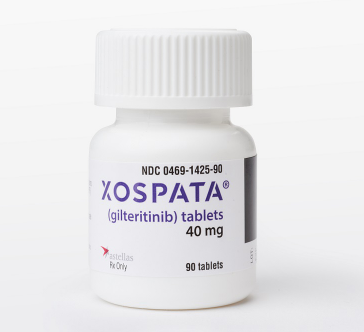
Xospata is a second-generation FLT3 inhibitor that inhibits two distinct mutations: the internal tandem duplication (ITD) in the FLT3 juxtamembrane domain and the FLT3 tyrosine kinase domain (TKD) mutation. FLT3-ITD mutations affect approximately 30% of patients with acute myeloid leukemia (AML) and are associated with worsened disease-free survival and overall survival. FLT3-TKD mutations affect approximately 7% of AML patients. Although the impact of these mutations is not fully understood, they are associated with treatment resistance.
Xospata was discovered through a research collaboration with Kotobuki Pharmaceutical Co., Ltd. Astellas holds exclusive global rights for the development, manufacturing, and potential commercialization of Xospata. Xospata has been granted orphan drug designation in the United States, Japan, and the European Union; it has also received Fast Track designation in the United States and SAKIGAKE designation in Japan.
Xospata was first approved in Japan in mid-October 2018 for adult patients with FLT3 mutation-positive relapsed or refractory AML. In late November 2018, Xospata received approval from the U.S. FDA for the treatment of adult patients with relapsed or refractory (drug-refractory) AML who have been confirmed by testing to harbor FLT3 mutations. This approval makes the drugFDAThe first FLT3-targeted agent approved for the patient population with relapsed or refractory AML, also marking Astellas’ entry into the field of hematologic cancer treatment in the United States.
It is worth mentioning that in April 2017,Novartisof the targeted anticancer drug Rydapt (midostaurin) was approvedFDAApproved for the treatment of adult patients with newly diagnosed FLT3 mutation-positive AML. This approval makes Rydapt the first targeted therapy worldwide for the first-line treatment of FLT3 mutation-positive AML. (Bioon.com)