

AbbVie's JAK1 Inhibitor Rinvoq Shows Significant Efficacy in Phase II/III Trial for Ankylosing Spondylitis
Nov 15, 2019 09:47
CST Updated
09:47

AbbVie
Innovative Drug Developer

November 15, 2019 News /BioValleyBIOON/ -- Biopharmaceutical giant AbbVie recently announced positive data from the Phase II/III SELECT-AXIS 1 trial (NCT03178487) evaluating the JAK1 inhibitor Rinvoq (upadacitinib) in adult patients with active ankylosing spondylitis (AS) at the 2019 Annual Meeting of the American College of Rheumatology/Association of Rheumatology Health Professionals (ACR/ARP) held in Atlanta. The results demonstrated that, compared with placebo, Rinvoq significantly improved the symptoms and signs of AS.
SELECT-AXIS 1 is a multicenter, randomized, double-blind, parallel-group, placebo-controlled, Phase II/III study conducted in adult patients with active ankylosing spondylitis (AS) who are biologic disease-modifying antirheumatic drug (bDMARD)-naïve and have had an inadequate response to at least two nonsteroidal anti-inflammatory drugs (NSAIDs), or are intolerant to or have contraindications for NSAIDs, aiming to evaluate the safety and efficacy of Rinvoq versus placebo.
The study comprises two phases. Phase 1 lasts 14 weeks, with the primary endpoint being the proportion of patients achieving ASAS40 response (Assessment in SpondyloArthritis international Society 40% improvement) after 14 weeks of treatment. Secondary endpoints include: the proportion of patients achieving Bath Ankylosing Spondylitis Disease Activity Index (BASDAI) 50 and ASAS Partial Response (PR) at Week 14; changes from baseline in the Ankylosing Spondylitis Disease Activity Score (ASDAS), MRI Spondyloarthritis Research Consortium of Canada (SPARCC) score (spine), and Bath Ankylosing Spondylitis Functional Index (BASFI) at Week 14. Phase 2 is an open-label extension period to evaluate the long-term safety, tolerability, and efficacy of Rinvoq in patients who have completed Phase 1.

The results presented at this meeting were from the first stage of the study. The results showed that the study met its primary endpoint: at Week 14 of treatment, the proportion of patients achieving ASAS40 (Assessment in SpondyloArthritis international Society 40% improvement) in the Rinvoq (15 mg, once daily) treatment group was double that of the placebo group (52% vs. 26%, p < 0.001). After multiplicity adjustment, at Week 14, Rinvoq treatment demonstrated statistically significant differences compared with the placebo group in the following measures: ASDAS, SPARCC MRI spine, BASDAI50, ASAS PR, and BASFI. Based on nominal p-values, all endpoints except WPAI were significant.
In the first phase of the study, the safety profile of Rinvoq was consistent with previous rheumatoid arthritis (RA) studies, and no new safety risks were identified. By week 14, the proportions of patients in the Rinvoq treatment group who experienced adverse events leading to discontinuation, serious adverse events, and infections were 2%, 1%, and 20%, respectively, compared to 3%, 1%, and 28% in the placebo group. There were no cases of serious infection, herpes zoster, or malignancy.Tumor, Adjudicated Major Adverse Cardiovascular Events, Venous Thromboembolic Events, or Death Reports。
Professor Désirée van der Heijde of Leiden University Medical Center in the Netherlands commented, “Ankylosing spondylitis is a chronic, progressive, inflammatory disease that begins in early adulthood and primarily causes pain and stiffness in the spine. Apart from biologics, treatment options are limited for patients who have an inadequate response to or contraindications for nonsteroidal anti-inflammatory drugs (NSAIDs). The results of this study highlight the potential of Rinvoq as an additional treatment option for patients with ankylosing spondylitis.”
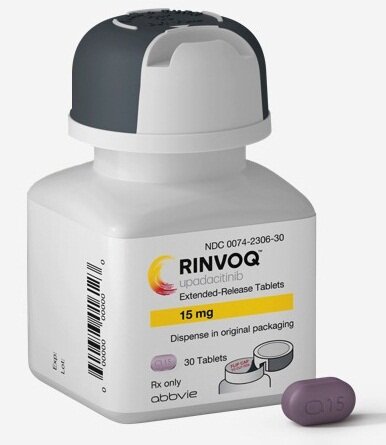
The active pharmaceutical ingredient of Rinvoq is upadacitinib, an oral selective JAK1 inhibitor discovered and developed by AbbVie, which is being developed for the treatment of various immune-mediated inflammatory diseases.
In mid-August this year, Rinvoq received U.S.FDAApproved for the treatment of moderate to severe active rheumatoid arthritis in patients who have had an inadequate response or intolerance to methotrexate (MTX-IR)Rheumatoid Arthritis(RA) Treatment of adult patients. Currently, Rinvoq is marketed in the United States. The drug is administered orally at a dose of 15 mg once daily and is not indicated for patients who have not previously been treated with MTX. Rinvoq also marks AbbVie’s U.S. approval this year.FDAThe second approved targeted immunomodulator (TIM) therapy. Notably, AbbVie utilized a Priority Review Voucher (PRV) to expedite the review of Rinvoq, shortening the review cycle from the standard 10 months to 6 months.
In the European Union, Rinvoq received a positive opinion from the Committee for Medicinal Products for Human Use (CHMP) of the European Medicines Agency (EMA) recommending approval for the treatment of rheumatoid arthritis (RA); the European Commission (EC) is expected to make its approval decision in the fourth quarter.
JAK1 is a kinase that plays a pivotal role in the pathophysiology of various inflammatory diseases. Currently, Phase III clinical trials of upadacitinib are underway for the treatment of psoriatic arthritis (PsA), Crohn’s disease (CD), atopic dermatitis (AD), ulcerative colitis (UC), and giant cell arteritis. Furthermore, upadacitinib is also being evaluated for the treatment of ankylosing spondylitis (AS).
The industry is highly optimistic about the commercial prospects of Rinvoq. In a previously released report, pharmaceutical market research firm EvaluatePharma predicted that Rinvoq’s global sales would reach $2.57 billion in 2024, making it the fifth best-selling antirheumatic drug worldwide. (Bioon.com)