

OYMotion Breaks Through Bionic Hand Technology: Six Years of R&D Enables Prosthetic Hands to Move with Intention

OYMotion
Provider of Rehabilitation Medical Technology Solutions
The history of human use of prosthetics spans thousands of years. Details on suturing in the writings of Hippocrates, the ancient Greek “Father of Medicine,” confirm that basic amputation techniques for fingers, toes, hands, and feet were already in practice at that time.
The earliest prosthetics discovered to date were found on Egyptian mummies. In China, the earliest prosthetics appeared during the Spring and Autumn and Warring States periods. At that time, a large number of people were subjected to a cruel punishment known as “yue xing” (foot amputation), which involved cutting off the feet of criminals, leading to the emergence of corresponding prosthetic devices. Historical records note that Duke Jing of Qi imposed heavy taxes and harsh penalties, subjecting those unable to pay their taxes to foot amputation. As a result, vendors specializing in the sale of prosthetics appeared outside the city gates, with even more people buying prosthetics than shoes.
After years of development, lower-limb prostheses now enable users to walk normally and even run. In contrast, most currently available upper-limb prosthetic devices consist of simple mechanical mechanisms. Consequently, upper-limb prostheses primarily serve a cosmetic purpose for patients, rather than providing significant functional benefits.
Due to the complex functionality and multi-dimensional mobility of the human hand, replicating a mechanical hand poses significant challenges. However, the emergence of bionic hands has offered new hope.
Bionic hands collect electromyographic (EMG) signals from the user's residual limb. When the prosthesis is in use, specialized sensors detect these minute electrical signals and subsequently control the movements of the robotic hand.
Companies developing bionic hands are primarily concentrated overseas, making such cutting-edge technology largely inaccessible to the general public in the past. However, at the Shanghai China International Import Expo (CIIE), reporters encountered a domestically produced bionic hand. This device can perform 18 different movements based on the user’s intent, helping individuals with upper-limb amputations independently carry out daily activities such as eating, drinking, lifting objects, and writing.
The company behind the development of this bionic hand is OYMotion. Its products utilize the gForce gesture recognition control system to capture bioelectrical signals, known as electromyography (EMG), from the user’s arm. Artificial intelligence algorithms are then employed to interpret movement intentions, ultimately enabling the OHand intelligent bionic hand to execute actions in accordance with the patient’s intent through sophisticated mechanical design. To date, OYMotion has sold dozens of its bionic hands.
In 2019, OYMotion’s products were featured on Xinwen Lianbo (CCTV News Broadcast). For the Chinese public, appearing on this program signifies a unique emotional recognition and endorsement. Ni Hualiang, founder of OYMotion, specifically noted that their products appeared for approximately six seconds in the broadcast segment—a milestone that culminated six full years of dedicated research and development efforts by the company.
OYMotion Featured on CCTV's "Super Brain"
The impetus for OYMotion’s entry into the field of bionic hand development was linked to the industry downturn experienced by the VR/AR sector.
Prior to 2017, OYMotion’s primary R&D focus was on the development of underlying human-machine interface technologies, with VR/AR being a key application area for these technologies.
Ni Hualiang stated, “Brain-computer interface technology is a foundational technology; for its practical implementation, it must be anchored in specific applications. AR/VR somatic gaming represents a key application area, but the industry’s downturn at the time created significant bottlenecks.”
By chance, while exhibiting at the Asia CES, OYMotion noticed that many attendees were drawn to its gesture-controlled, 3D-printed robotic hand. This prompted OYMotion to seriously consider applications in the prosthetics market.
After spending nearly three months studying the prosthetics market, Ni Hualiang discovered that, from a business logic perspective, the prosthetics market for people with disabilities is fraught with loopholes.
“First, this market has a large patient population, numbering in the millions. Second, all products in this market are very expensive. Third, product performance is very weak. Fourth, product penetration rate is also very low. We believe that we can launch competitive products in this market.”
After establishing the R&D direction of bionic hands, OYMotion operated like a laboratory for the next two years. This was because there were too many challenges to overcome in the field of bionic hand development.
Overall, OYMotion's R&D efforts can be divided into three parts: "Sensing," "Perception," and "Action."
“Sensing” refers to the acquisition of electromyographic signals. Electromyography (EMG) is one of the three major biological signals in the human body, alongside electroencephalography (EEG) and electrocardiography (ECG). Within the human body, the motor cortex of the brain generates and transmits control commands through the central and peripheral nervous systems to the arm muscles. Muscle contraction produces force that pulls on joints to facilitate movement and complete actions. During this process, an observable electrical signal is generated within the muscles, known as the electromyographic (EMG) signal.
OYMotion uses non-invasive electromyography (EMG) sensors to collect biosignals. Since the signals are acquired through the skin surface, they are already weak microvolt-level signals, making signal acquisition highly challenging. To address this challenge, OYMotion has developed neural interface and biosensor array technologies to achieve high-precision EMG signal acquisition.
“Our EMG wristband functions like a microphone array, capable of amplifying and capturing sounds from various directions. However, the acquisition of biosignals is not the most challenging aspect; the greatest difficulty lies in intent recognition technology.”
Intent recognition, or the “knowing” aspect, requires the bionic hand to accurately identify the patient’s movement intentions.
“In practical use, neural signals change with factors such as a person’s level of fatigue and state of attention. Meanwhile, for individuals with disabilities, the loss of both hands makes it inherently difficult to imagine the process of controlling them.”
In the current market, neither traditional myoelectric prostheses nor foreign bionic hands have incorporated artificial intelligence technology into their research and development. OYMotion has integrated an AI edge computing module, allowing users to contribute their myoelectric signals to build a database. These data are then used to train algorithms developed by OYMotion, ultimately generating intent recognition models.
Having achieved recognition in "sensing" and "perception," the final step lies in "action." The "action" component involves more mechanical design. Analyzing a single human arm from a mechanical perspective, it can be represented by a linkage mechanism with approximately 27 degrees of freedom, but about 20 of these degrees of freedom are concentrated in the hand. Simulating human hand movements within a compact size presents significant challenges in mechanical design.
OYMotion’s high-precision intelligent bionic hand comprises over 280 components and supports a wide range of hand postures. The current version of its intelligent algorithm can recognize eight movement intentions, with the mechanical structure capable of expanding to a total of 18 gestures.
For able-bodied individuals, the latency between neural command issuance and motor execution is imperceptibly brief, necessitating that bionic hands be designed with minimal latency.
Currently, OYMotion’s bionic hand requires only 0.8 seconds to transition from fully open to fully closed. Meanwhile, each finger of this robotic hand can support a static load of 5 kg, and the entire hand can bear a load of 20 kg, ensuring stability and durability for users with disabilities during use.
Ni Hualiang stated, “Our ultimate goal is to enable individuals with upper-limb disabilities to play the piano and truly use assistive devices with ease and freedom. However, to be honest, we are still far from achieving that goal. Nevertheless, we are gratified that we can already help people with disabilities significantly improve their quality of life.”
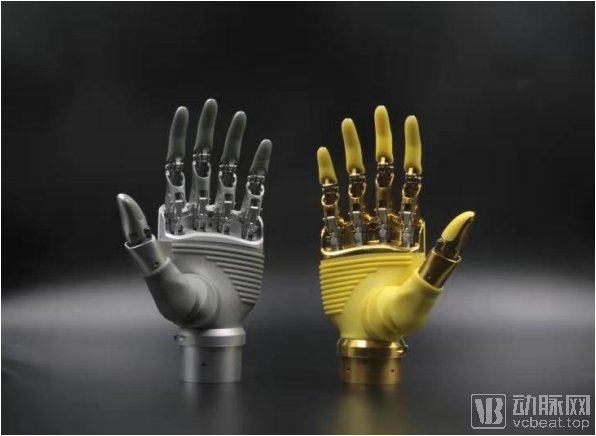
OYMotion Product Prototype
There are also international manufacturers of bionic hands, including Germany’s Ottobock and Iceland’s Össur. Ottobock boasts a century-long history in prosthetics manufacturing, with annual revenues exceeding one billion US dollars. Iceland’s Össur is listed on the US stock market.
It is reported that their bionic hands are also controlled via electromyography (EMG) and can be operated through a mobile app, but they do not employ intelligent EMG signal recognition technology. Currently, EMG-controlled prosthetic limbs on the market are expensive and require collaborative programming by patients and experts to respond to the wearer’s intentions, resulting in a prolonged training period for patients.
Currently, bionic hand products are expensive. Moving forward, OYMotion aims to leverage its core technologies combined with the advantages of Chinese manufacturing to reduce the production costs of intelligent bionic hands, thereby enabling more people with disabilities to access genuine bionic prosthetics.
Although OYMotion’s products currently primarily serve the disabled population, it is difficult to categorize the company as a traditional prosthetic device manufacturer. This is because its underlying human-computer interaction (HCI) technology can be applied across numerous fields, and its bionic hand also serves as a critical actuation module for bionic robots.
Ni Hualiang believes that for a technology company, choosing to enter the field of prosthetic development is a natural embodiment of “tech for good.” “For able-bodied individuals, we can clearly perceive the conveniences that technological progress brings to daily life. However, people with disabilities have not equally benefited from these technological dividends; most products in the prosthetics industry lack any level of intelligence. The integration of artificial intelligence into this field can bring about significant changes for the disabled community, making their prosthetic limbs more ‘responsive’ and user-friendly.”
Leveraging its advantages in bioelectric sensors and intelligent analysis algorithms, OYMotion will further develop products for stroke rehabilitation in the healthcare sector.
In other application areas, OYMotion can also be applied to AR/VR human-computer interaction, gesture-controlled toys, remote-assistance robots, remote control, and motion-sensing game interactions.
OYMotion is currently seeking external financing.
For those interested in the company, please contact the financing assistant Xiao Yun: DongMai_Investent