

Israeli Unicorn OrCam Files IPO Prospectus: AI-Powered Wearable Gives Voice to Text for Over 17 Million Blind Individuals in China

OrCam Technologies
Developer of Artificial Intelligence Vision Assistive Devices
“Use your eyes as if tomorrow you would be stricken blind.” This is a famous quote from Three Days to See, yet it also serves as a true reflection of many people’s lives.
In 1984, at the founding congress of the World Blind Union held in Riyadh, the capital of Saudi Arabia, October 15 was designated as International White Cane Day, also known as White Cane Safety Day, to raise awareness and support for the blind community.
According to the classification and grading of disabilities, visual impairment is categorized into blindness and low vision. A visual field radius of less than 10 degrees is classified as Grade 2 blindness, while a visual field radius of less than 5 degrees is termed Grade 1 blindness.
According to the latest data, the number of blind people in China has reached 17.31 million, accounting for 1.26% of the total population. Fortunately, due to technological advancements, the incidence of congenital blindness has gradually decreased. In China, visual impairments leading to blindness are primarily caused by eye diseases such as fundus disorders, macular degeneration, amblyopia, as well as severe glaucoma and diabetes. Additionally, population aging is driving a rapid increase in the number of individuals with visual impairments.
According to the "Survey on Disease Information Among the Visually Impaired," 70% of visually impaired individuals require accompaniment when going out, while the remaining 30% choose not to leave their homes. This explains why, despite the large number of blind people, they are rarely seen on the streets.
The eyes are a vital source of information, and the damage caused by blindness is nearly irreversible. An Israeli company named OrCam took an unconventional entrepreneurial approach, focusing not on “how to restore vision,” but rather on “how to help visually impaired individuals access information.”
Liang Weiyang, Head of OrCam China, stated that the number of people with visual impairments in China has reached 17 million, of whom 5 million are completely blind. Furthermore, approximately 400,000 individuals experience worsening vision each year, progressing from low vision to partial blindness or from partial blindness to total blindness. The daily lives and activity ranges of visually impaired individuals are severely restricted. OrCam leverages artificial vision technology by integrating advanced devices into wearable equipment, thereby improving the quality of life for the visually impaired.
OrCam was founded in Israel in 2010, dedicated to the research and development of AI-powered visual assistive devices. In 2013, OrCam successfully developed its first-generation product, OrCam MyEye 1.0, and secured a $15 million investment from Intel the following year. The first-generation product was successfully launched in European and American markets. As of December 2018, OrCam had obtained 36 patented inventions and raised $130 million in funding. With a current valuation of $1 billion, OrCam has become one of the few elite unicorn companies in Israel.
After continuous research and development and extensive exploration, OrCam MyEye 2.0 was officially launched in 2017. Following years of market expansion, OrCam began entering the Chinese market in early 2019.
OrCam MyEye 2.0 is a wireless AI-powered visual assistance device with a rectangular form factor, weighing 22.5 grams, and featuring a built-in speaker. The device currently offers five core functions: text recognition, face recognition, product recognition, color recognition, and time recognition.
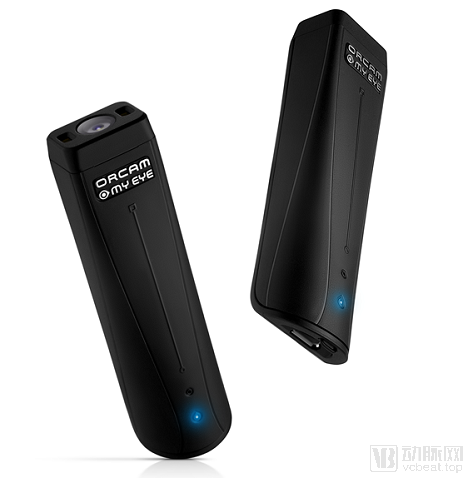
OrCam MyEye 2.0 (Image provided by the interviewee)
OrCam’s second-generation product features an advanced machine learning system and employs an optical character recognition (OCR) system capable of distinguishing text structures, enabling it to parse visual input elements and capture printed or digital text on any surface.
OrCam’s camera attaches to eyeglass frames via magnets. When users look at text or other text-bearing surfaces, the high-resolution camera and intelligent algorithms analyze the captured text or objects, converting images into speech within 1–2 seconds and reading them aloud through built-in speakers, enabling users to “read” newspapers, menus, or books. The speaker outputs dual-channel stereo sound, with a reception range exceeding 10 meters in free space. The device is currently available in more than 50 countries and supports over 30 languages.
The device’s database can also store facial images. Users can capture a facial image by pressing a button and verbally provide the individual’s identity information. When the same person reappears within the camera’s field of view, the device will inform the user of their identity. Additionally, the device can identify product categories via barcode scanning and currently supports storage for details of up to 300 products.
Liang Weiyang introduced that OrCam MyEye 2.0 is a wearable artificial vision device operable via gestures or eye gaze. Users with some light perception can opt for manual indication, defining the camera’s field of view within a 180-degree arc centered on their finger. Fully blind users, when unable to ascertain their immediate surroundings or objects in front of them, can press a button to capture an image, prompting the device to interpret the scene from distant to near elements sequentially.
In low-light conditions, the device’s two built-in LED lights automatically provide supplemental illumination. The OrCam MyEye 2.0 can operate continuously for up to 90 minutes. Additionally, the accompanying charging dock is only the size of a lighter, making it highly portable. A fully charged dock can recharge the device four times, extending its total battery life to 6 hours.
It is worth noting that another major computational feature of the OrCam MyEye 2.0 is that it does not require an internet connection for use. Liang Weiyang explained that textual materials such as ID cards, social security cards, and insurance policies constitute personal private information. The offline design serves to protect patient privacy on one hand, and on the other, avoids disruptions to the continuity and integrity of information delivery caused by fluctuating signal strength.

OrCam MyEye 2.0 attaches to eyeglass frames for use (image provided by the interviewee)
Furthermore, OrCam’s MyReader incorporates all the portable features of OrCam MyEye but is primarily focused on reading, offering a simplified device for users who may not require all the functionalities of OrCam MyEye.
“For visually impaired individuals, time seems to pass very slowly while waiting, which places high demands on the product’s information recognition feedback time and accuracy.” It is worth mentioning that OrCam’s founding team has an impressive track record in computer vision technology.
OrCam’s two founders, Professor Amnon Shashua and Mr. Ziv Aviram, were previously the co-founders of Mobileye, a global leader in automotive collision avoidance systems and an innovator in autonomous driving. In 2017, Intel acquired Mobileye for $15.3 billion, marking the largest high-tech startup acquisition in Israel’s history to date and the largest transaction in the autonomous driving sector.
The same founding team and the same computer vision theory were transferred to the application scenario of human vision.
Mobileye leverages camera and sensor technologies along with artificial intelligence algorithms to develop its EyeQ series of vision system chips, addressing collision issues in vehicle assisted driving and autonomous driving. OrCam, based on advanced computer vision interpretation capabilities, has developed the OrCam MyEye product series, solving reading, shopping, and working challenges for blind or visually impaired individuals.
OrCam’s team comprises approximately 300 members distributed globally, including around 220 in its technical division. “The technical team has laid a solid foundation for product performance, anticipating nearly all the functionalities required by users’ core application scenarios.” In the future, OrCam may expand into certain areas of indoor navigation.
Unlike in developed countries, China has yet to establish a reimbursement system for rehabilitative assistive devices. Liang Weiyang noted that to expand its market size, OrCam is seeking collaboration opportunities with medical institutions, financial service providers, and disabled persons’ federations. Interested parties may contact the financing assistant, Xiao Yun, at: DongMai_Investent