

Janssen Secures EU Approval for Darzalex® (Daratumumab) in Combination with Lenalidomide and Dexamethasone as First-Line Treatment for Transplant-Ineligible Newly Diagnosed Multiple Myeloma
Nov 20, 2019 14:55
CST Updated
14:55

Janssen Pharmaceuticals
Pharmaceutical R&D Developer

Johnson & Johnson
Healthcare Product Manufacturers, Health Service Providers

European Commission
The European Commission, abbreviated as the EU Commission, is a supranational body under the European Union. Within the EU political system, the European Commission primarily undertakes executive tasks, thus being roughly equivalent to the government in a national system. However, the European Commission has other functions as well. In particular, except for the few circumstances specified in the treaties, the European Commission is the only institution with legislative power in the EU legislative process.

November 20, 2019/BioValleyBIOON/-- Janssen Pharmaceuticals, a subsidiary of Johnson & Johnson, recently announced that the European Commission (EC) has approved the three-drug regimen of Darzalex (daratumumab) in combination with lenalidomide and dexamethasone (DRd) for patients ineligible for autologousStem Cellsnewly diagnosed multiple myeloma (MM) patients who are eligible for autologous stem cell transplantation (ASCT). Previously, the four-drug regimen of Darzalex in combination with bortezomib (a proteasome inhibitor), melphalan (an alkylating chemotherapeutic agent), and prednisone (a corticosteroid) (D-VMP) had received European Commission (EC) approval for the treatment of newly diagnosed MM patients who are ineligible for ASCT. The recently approved DRd regimen will provide a new treatment option for newly diagnosed MM patients in Europe who are ineligible for ASCT. In the United States, both the three-drug DRd regimen and the four-drug D-VMP regimen have been approvedFDAApproved for use in newly diagnosed multiple myeloma (MM) patients who are ineligible for autologous stem cell transplantation (ASCT).
The approval of this DRd triplet regimen was based on data from the Phase III clinical study MAIA (MMY3008). This study, in newDiagnosisconducted in patients with multiple myeloma (MM) who were ineligible for high-dose chemotherapy and autologous stem cell transplantation (ASCT), evaluating the efficacy and safety of the DRd regimen compared with the two-drug regimen of lenalidomide and dexamethasone (Rd). The study results were published in the New England Journal of Medicine (NEJM) and presented at the 2018 American Society of Hematology (ASH) Annual Meeting.
Data showed that with a median follow-up of 28 months, the study met its primary endpoint of improving progression-free survival (PFS): a pre-planned interim analysis conducted by an independent data monitoring committee (IDMC) demonstrated that the DRd treatment group had a significant 44% reduction in the risk of disease progression or death compared to the Rd treatment group (HR=0.56, 95% CI: 0.43-0.73, p<0.0001). The median PFS for the DRd group was not reached, while it was 31.9 months for the Rd group. Furthermore, DRd achieved deeper responses compared to Rd, including higher rates of complete response or better (48% vs 25%), and also showed improved overall response rates (93% vs 81%).
In the study, the most common grade 3/4 treatment-emergent adverse events (≥10%) in the DRd treatment group included neutropenia (50%), lymphopenia (15%), pneumonia (14%), andAnemia(12%). Infusion-related reactions occurred in 41% of patients, with 3% being Grade 3/4. The safety profile of Darzalex was consistent with previous studies.
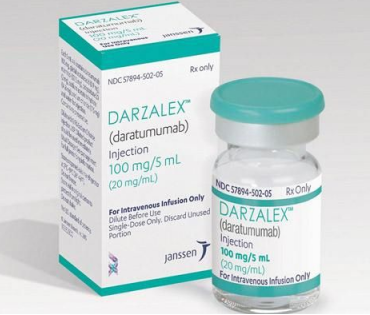
Darzalex is the first CD38-mediated, cytolytic antibody drug approved globally. It possesses broad-spectrum killing activity and can target and bind to the CD38 molecule, a transmembrane extracellular enzyme highly expressed on the surface of multiple myeloma cells and various solid tumor cells. Darzalex induces rapid tumor cell death through multiple immune-mediated mechanisms of action, including complement-dependent cytotoxicity (CDC), antibody-dependent cell-mediated cytotoxicity (ADCC), antibody-dependent cellular phagocytosis (ADCP), and viaApoptosis(apoptosis). In addition, Darzalex has also been shown to targetTumorImmunosuppressive cells in the microenvironment thereby exhibit immunomodulatory activity.
Darzalex was licensed by Janssen Biotech, Inc. from Genmab in 2012, granting it exclusive global rights. This drug is a key product heavily developed by Johnson & Johnson. In addition to multiple myeloma, Darzalex also holds potential for treating other types of cancers with high expression of the CD38 molecule.Tumor, including diffuse large B-cell lymphoma (DLBCL), chronic lymphocyticLeukemia(chronic lymphocytic leukemia [CLL]), acute lymphoblastic leukemia (ALL), plasma cell leukemia (PCL), acute myeloid leukemia (AML), follicular lymphoma (FL), and mantle cell lymphoma (MCL), etc.
Darzalex was approved for marketing in November 2015 and is currently approved for multiple therapeutic indications, which vary by country and region, including: (1) Darzalex in combination with bortezomib, thalidomide, and dexamethasone (D-VTd) as a first-line treatment for eligible autologousStem Cells(1) newly diagnosed multiple myeloma (MM) patients eligible for autologous stem cell transplantation (ASCT); (2) Darzalex in combination with lenalidomide and dexamethasone (DRd) as a three-drug regimen for the first-line treatment of newly diagnosed MM patients ineligible for ASCT; (3) Darzalex in combination with bortezomib, melphalan, and prednisone (D-VMP) as a four-drug regimen for the first-line treatment of newly diagnosed MM patients ineligible for ASCT; (4) Darzalex in combination with lenalidomide and dexamethasone, or with bortezomib and dexamethasone, for adult MM patients who have received at least one prior therapy; (5) in combination with pomalidomide and dexamethasone, for adult MM patients who have received at least two prior therapies, including lenalidomide and a proteasome inhibitor (PI); (6) as monotherapy, for adult MM patients who have received at least three prior therapies, including a proteasome inhibitor (PI) and an immunomodulatory drug (IMiD), or who are double-refractory to both a PI and an IMiD.
In February this year, a split-dose regimen of Darzalex was also approvedFDAApproved. This protocol will allow healthcare professionals to choose, as needed, when treating MM patients, to split the initial intravenous infusion of Darzalex from a single one-time infusion into divided intravenous infusions over two consecutive days.
In July this year, the subcutaneous formulation of Darzalex was submitted for marketing approval in the United States and Europe. Phase III clinical study data demonstrated that the subcutaneous formulation of Darzalex was non-inferior to the intravenous formulation in terms of efficacy (overall response rate: 41% vs. 37%; ratio=1.11, 95% CI: 0.89–1.37) and pharmacokinetics (daratumumab trough concentration [Ctrough]: 499 mg/mL vs. 463 mg/mL; ratio=108%, 90% CI: 90%–122%). Additionally, the subcutaneous administration required significantly less time (5 minutes vs. over 3 hours) and was associated with a lower incidence of infusion-related reactions (13% vs. 35%).
According to Johnson & Johnson’s 2019 performance report, Darzalex achieved sales of $2.168 billion in the first three quarters of the year, representing a 50.4% year-over-year increase. EvaluatePharma, a pharmaceutical market research firm, had previously predicted that Darzalex’s global sales would reach $6.033 billion by 2024, positioning the drug as a key product driving Johnson & Johnson’s future growth. (Bioon.com)