

FDA Grants Priority Review to Roche’s Risdiplam, the First Oral Treatment for Spinal Muscular Atrophy
Nov 26, 2019 09:45
CST Updated
09:45

Roche
Oncology Drug Research, Development, and Manufacturing

FDA
U.S. Food and Drug Administration
November 26, 2019 /Bio ValleyBIOON/ -- Roche recently announced that the U.S. Food and Drug Administration (FDA) has accepted the New Drug Application (NDA) for risdiplam and granted it Priority Review. Risdiplam is a survival motor neuron 2 (SMN2) splicing modifier indicated for the treatment of spinal muscular atrophy (SMA). The FDA has assigned a Prescription Drug User Fee Act (PDUFA) target action date of May 24, 2020. Previously,FDARisdiplam has been granted orphan drug designation and fast track designation. Risdiplam is an oral liquid formulation; if approved, it will become the first medication available for home administration to patients with spinal muscular atrophy (SMA).
As part of its collaboration with the SMA Foundation and PTC Therapeutics, Roche led the clinical development program for risdiplam. The acceptance of the New Drug Application (NDA) also triggered a $15 million milestone payment from Roche to its partner, PTC. If approved, Roche will be responsible for the commercialization of risdiplam in the United States.
The risdiplam NDA includes 12-month data from Part 1 (dose-finding) of the pivotal FIREFISH and SUNFISH studies, as well as data from Part 2 (confirmatory) of the SUNFISH study. FIREFISH is an open-label, two-part pivotalClinical Trialconducted in infants with Type 1 SMA. Part 1 was a dose-escalation study that enrolled a total of 21 infants aged 1–7 months, with the primary objective of assessing the safety of risdiplam in infants and determining the dose for Part 2; the exploratory endpoint was to evaluate efficacy. Part 2 is a pivotal, single-arm trial evaluating 41 infants with Type 1 SMA receiving risdiplam treatment for 24 months, followed by an open-label extension period.
SUNFISH is a two-part, double-blind, placebo-controlled pivotal clinical trial conducted in pediatric and young adult patients (aged 2–25 years) with type 2 or type 3 spinal muscular atrophy (SMA). Part 1 determined the dose for the confirmatory Part 2, with exploratory endpoints assessing efficacy. Part 2 was a large-scale, placebo-controlled trial evaluating risdiplam in patients with type 2 or type 3 SMA. Recently released data from Part 2 demonstrated that the study met its primary endpoint of change from baseline in the Movement Disorder-Childhood Rating Scale 32 (MFM-32) score: after one year of treatment, patients receiving risdiplam showed significant improvements in motor function compared with the placebo group. To date, the comprehensive evaluation of risdiplamClinical TrialsNo treatment-related safety findings leading to study drug discontinuation were identified in either group. The safety profile of risdiplam was consistent with the known safety profile, and no new safety signals were detected. Results will be presented at the upcoming medicalMeetingpublished above.
Levi Garraway, M.D., Chief Medical Officer and Global Head of Product Development at Roche, stated, “The FIREFISH and SUNFISH trials were designed to represent the real-world population of patients with SMA, including many who had previously beenClinical Trialpatients who are underrepresented in China. We look forward to working withFDAWork closely together to explore broad access to risdiplam for all patients in the SMA community who may benefit.”
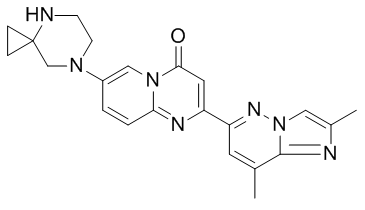
Risdiplam Chemical Structure (Image source: medchemexpress.cn)
Risdiplam is an oral liquid and a splicing modifier of the survival motor neuron 2 (SMN2) gene, designed to continuously increase and maintain SMN protein levels in the central nervous system and peripheral tissues. Growing clinical evidence indicates that spinal muscular atrophy (SMA) is a multisystem disease, and the loss of SMN protein may affect many tissues and cells beyond the central nervous system. Following oral administration, risdiplam exhibits systemic distribution, sustainably increasing SMN protein levels in both the central nervous system and peripheral tissues, and has demonstrated improvements in motor function in patients with Type 1, Type 2, and Type 3 SMA. Risdiplam is poised to become the first oral medication for the treatment of all three types of SMA.
In addition to the studies included in the NDA, risdiplam is undergoing extensive SMAClinical TrialResearch is being conducted in the project, with enrolled patients ranging from neonates to elderly individuals up to 60 years of age, including those who have previously received SMA therapy. Currently, Roche is conducting four global, multicenter clinical trials (SUNFISH [NCT02908685], FIREFISH [NCT02913482], JEWELFISH [NCT03032172], and RAINBOWFISH [NCT03779334]) to evaluate the efficacy and safety of risdiplam for the treatment of all types (Type 1, Type 2, and Type 3) of spinal muscular atrophy (SMA), as well as presymptomatic SMA in neonates.
Spinraza: The world’s first SMA treatment, approved in China this February
Spinal Muscular Atrophy (SMA) is a motor neuron disease that causes muscle weakness and atrophy. It is an autosomal recessive genetic disorder caused by gene defects, affecting muscles throughout the patient's body. Patients primarily present with generalized muscle atrophy and weakness, progressively losing various motor functions, including breathing and swallowing. SMA is the leading cause of death in infants under the age of two.GeneticsSMA Killer: This disease is a relatively common "rare disease," with an incidence rate of 1 in 6,000 to 1 in 10,000 among newborns. According to relevant reports, there are currently approximately 30,000 to 50,000 SMA patients in China.
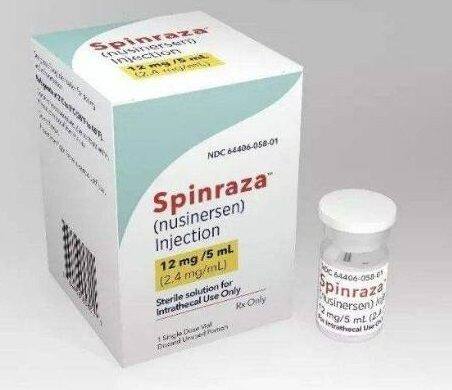
In December 2016, Spinraza (nusinersen), a drug developed by Biogen and its partner Ionis, was approved, becoming the first therapy worldwide for spinal muscular atrophy (SMA). This medication is an antisense oligonucleotide (ASO) administered via intrathecal injection, delivering the drug directly into the cerebrospinal fluid (CSF) surrounding the spinal cord. It modulates the splicing of SMN2 pre-messenger RNA (pre-mRNA), thereby increasing the production of full-length functional SMN protein. In patients with SMA, insufficient levels of SMN protein lead to the degeneration of motor neuron function in the spinal cord. Clinical studies have demonstrated that treatment with Spinraza significantly improves motor function in patients with SMA.
In May this year, fromNovartisThe gene therapy Zolgensma (onasemnogene abeparvovec) was approved, becoming the world’s first gene therapy for the treatment of spinal muscular atrophy (SMA). Administered as a single, one-time intravenous infusion, it enables sustained expression of the SMN protein to halt disease progression, addresses the root cause of SMA, and holds promise for long-term improvement in patients’ quality of life.
In the Chinese market, Spinraza was approved in late February this year for the treatment of patients with 5q spinal muscular atrophy (5q-SMA). This approval makes Spinraza the first drug for the treatment of SMA in the Chinese market. 5q-SMA is the most common type of SMA, accounting for approximately 95% of all SMA cases. This type of SMA is caused by mutations in the SMN1 (survival motor neuron 1) gene on chromosome 5, hence the name 5q-SMA. (Bioon.com)