

FTC2019 | Dr. Ji Zhang of JieCheng Medical: Physician-Led Innovation Behind the J-Valve Transcatheter Heart Valve

CAUSPER MEDICAL
Cardiac Valve Implantation System Technology Product R&D and Production Manufacturer
Where Do the Challenges of Medical Innovation Lie? VCBeat Previously Compiled Speeches from Medical Experts, Including Sun Lizhong from Anzhen Hospital, Professor Zheng Jun from the Chinese Medicine Education Association, and Professor Cao Yong, Director of Cardiovascular Surgery at Gaozhou People’s Hospital, Outlining the Difficulties and Solutions in Medical Innovation from a Physician’s Perspective.
Key perspectives include, but are not limited to:
Technology is driving a disruptive transformation in cardiac surgical treatment modalities; minimally invasive interventions, heart failure therapies, and the personalized development of cardiac surgery subspecialties will become the mainstream in the future;
Standardized development of cardiac surgery departments at the primary care level is helping grassroots hospitals establish diagnostic and treatment capabilities in cardiac surgery, thereby retaining patients within their local regions;
Heart failure treatment will be a key area of development.
In addition to physicians, Dr. Zhang Ji, General Manager of CAUSPER MEDICAL INC., also delivered a presentation titled “Discussing Physician Innovation from the Perspective of J-Valve” at the FTC 2019 Conference. Dr. Zhang spoke on medical innovation from a corporate perspective.
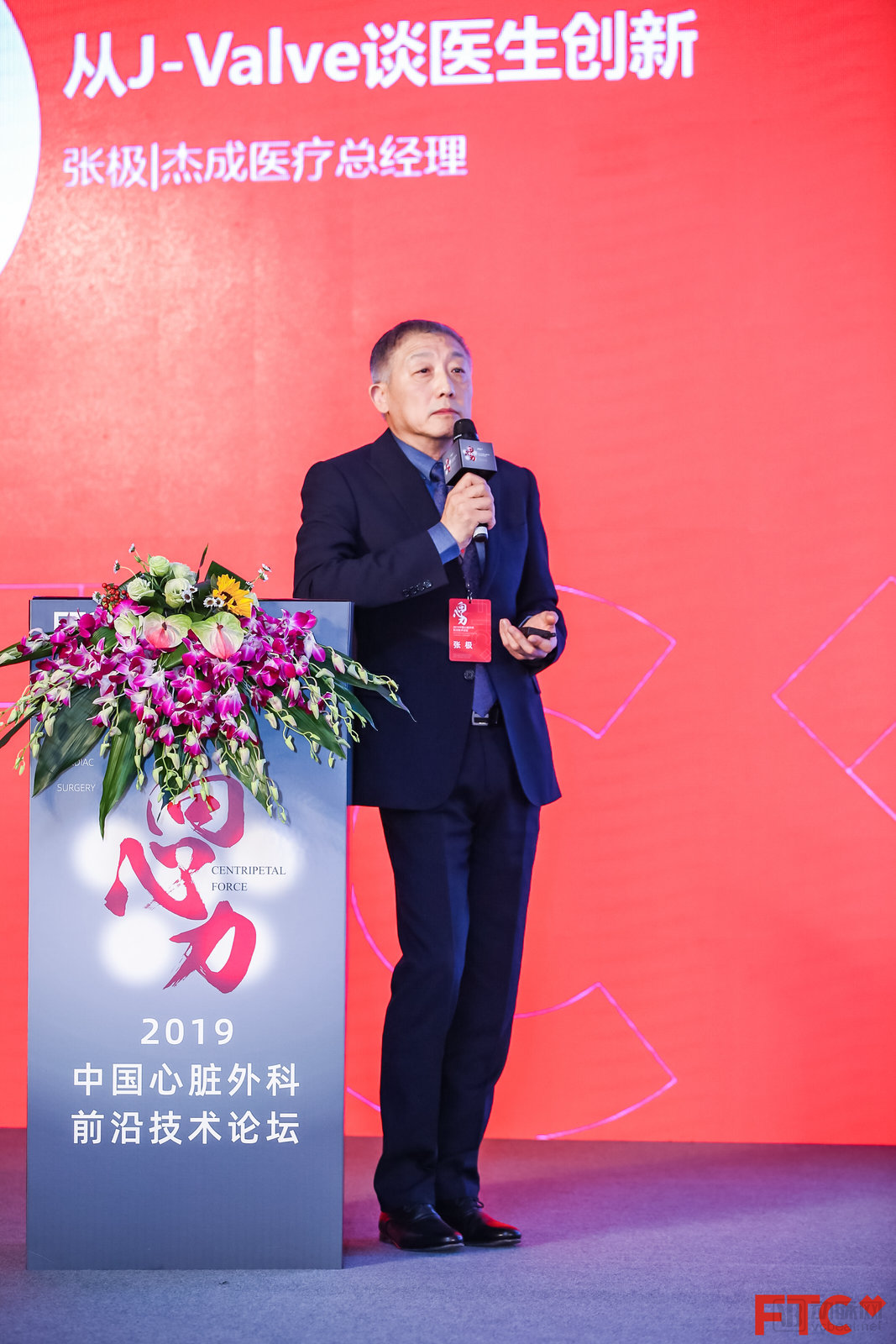
Zhang Ji, General Manager of CAUSPER MEDICAL, delivering a speech. Photo by VCBeat.
He believes that innovation requires five elements: accumulating knowledge, identifying key issues, and solving problems (innovation),Validating the Correctness of Innovation(Confirm Indications)Believe in the Power of Innovation(Completion of Surgical Standardization).
VCBeat reported on the perspectives of numerous experts and physicians regarding medical innovation; this article summarizes the views of corporate innovators on innovation.
CAUSPER MEDICAL is an innovative enterprise. The J-Valve transcatheter tissue heart valve, developed and manufactured by us, fills a global gap in the field. The primary feature of the J-Valve is its ability to treat aortic regurgitation, aortic stenosis, or combined aortic stenosis and regurgitation.
Regarding Innovative Thinking: First, Accumulate Knowledge. This was also mentioned by Mr. Steve Jobs in his first commencement speech at Stanford University. Innovation requires a sufficient knowledge base, and every bit of knowledge acquired in daily life may prove useful in the future.
Next, identify the key issues. We must acknowledge the areas of dissatisfaction in our current lives and consider how to change them. This method or process of change is innovation. After innovating, we need to validate whether the innovation is correct. Finally, we must believe in our innovation and persevere.
Knowledge Accumulation
How do cars generate power? How do helicopters achieve lift? How do ships maintain watertight integrity? In fact, the principle behind the hemostatic valve function of the J-Valve is analogous to the watertight principle used in ships. This theoretical framework provides significant insights.
Next, how are these functions implemented? We require various tools, such as screws, nuts, and 3D printing. As a medical device, particularly a precision instrument designed for intravascular use, it must be capable of both locking and unlocking. In other words, the device must be theoretically fully openable, akin to a bottle cap, which is theoretically designed to be completely removable.
Beyond that, there are materials. We need to know which materials can be bent under certain conditions or other details. In terms of craftsmanship, some materials can be welded while others cannot; we must have a thorough understanding of this. For medical inventions, we also need to be sufficiently familiar with anatomy, pathophysiology, hemodynamics, the cardiac conduction system, and related knowledge.
Returning to heart valves, we must understand the history of cardiac surgery and the developmental history of heart valves. The first artificial heart valve wasInvented by Hufnagle in the 1950s, this technique involved placing a prosthetic valve in the descending aorta to treat patients with aortic regurgitation. Hufnagle performed approximately 50 such procedures, achieving a certain survival rate.
With the advancement of medicine, we know that coronary blood flow occurs primarily during diastole. Yet, Hufnagle’s placement of a prosthetic valve in the descending aorta was able to improve patients’ conditions—a phenomenon that remains unexplained to this day.
Identify Key Issues
With the advancement of science and technology, artificial heart valves such as caged-ball valves, mechanical valves, and bioprosthetic valves have been successively introduced. After 2000, transcatheter heart valves emerged. Following their clinical application, are we satisfied with these products? Some have cautioned, “Do not get carried away; many issues still remain.”
What are the specific issues? Anatomically, the placement of certain transcatheter heart valves is unclear. Historically, most prosthetic valves were incompatible with the native valves, and some valves might become angulated. In summary, the primary clinical issues are complications arising from inaccurate positioning.
Innovation
So, how can these issues be addressed?—Innovation.
Interventional valve procedures are performed under imaging guidance, with the primary challenge being precise placement. As the heart is a dynamic organ, there are essentially two solutions to the placement issue: first, arresting cardiac motion; second, accommodating cardiac movement. Therefore, we proposed the need for an anchoring mechanism. The evolution from a locator to an anchor system represents the core innovation of the J-Valve. The anchor must enable autonomous positioning, guiding the valve to the target area and ensuring that the valve can deploy properly from its central position.
Therefore, following research and development, we launched our first product—the transapical implantation device—in 2009. After receiving clinical approval in 2017, the device was adopted extensively, with over 1,000 cases performed to date. When approximately 50 J-Valve procedures had been completed, we subsequently developed the transfemoral implantation device.
Once the product has been invented, what remains is to verify its correctness.
Validate the Correctness of Innovation
We can treat aortic regurgitation and stenosis, which has been extensively validated in clinical practice. In contrast, artificial heart valves approved by the U.S. FDA are not indicated for the treatment of aortic regurgitation and low coronary arteries. Since our product was used to treat the first patient in Vancouver, all patients with aortic regurgitation and low coronary arteries have been treated byTreated with J-Valve.
Subsequently, our product also began to be used in the United States, with its efficacy remaining highly significant. Issues that some other marketed products fail to address can be resolved simply and conveniently with our product.
So far, our team hopes that everyone can trust it.
Believe in the Power of Innovation
This year, we conducted live demonstrations in Vancouver and at the TCT 2019 conference. At TCT 2019, Professors Jian Ye, John G. Webb, and David A. Wood from the Heart Team at St. Paul’s Hospital in Canada jointly performed a procedure on an 80-year-old patient with severe aortic stenosis, NYHA functional class III heart function, an annulus measurement of 24.6 mm, and a left coronary ostium height of only 7 mm. This was a high-risk case with low coronary artery involvement.
The J-Valve® TF device was selected for the procedure. Following adequate predilation with a 25-mm balloon, the J-Valve® 25-mm TF system was implanted via a transfemoral approach. After the positioning elements entered the sinus of Valsalva, the valve was precisely deployed. The procedure was performed without the need for rapid pacing. Postoperatively, there was no paravalvular leak, and the patient was discharged on the second day.
Similarly, in the United States, we have treated nearly 20 patients, some of whom underwent procedures under local anesthesia and were discharged the following day. The four-year clinical outcomes of our transapical implantation procedure are already comparable to the one-year clinical outcomes reported for other products.
Finally, I will conclude my speech with a quote from Steve Jobs:Stay Hungry,Stay Foolish. I hope this statement will continually inspire myself and my colleagues to keep striving for progress.