

Darzalex (Daratumumab) Plus VMP Demonstrates Significant Overall Survival Benefit in Transplant-Ineligible Newly Diagnosed Multiple Myeloma Patients
Dec 11, 2019 11:20
CST Updated
11:20

Janssen Pharmaceuticals
Pharmaceutical R&D Developer

Johnson & Johnson
Healthcare Product Manufacturers, Health Service Providers

December 11, 2019 /Bio ValleyBIOON/ -- The 61st Annual Meeting of the American Society of Hematology (ASH 2019) was recently held in Orlando, Florida, USA. ThisMeetingAt the conference, Janssen Pharmaceuticals, a subsidiary of Johnson & Johnson (JNJ), announced overall survival (OS) data from the Phase III ALCYONE clinical study. The study evaluated the four-drug regimen (D-VMP) consisting of the targeted anticancer drug Darzalex (daratumumab) in combination with bortezomib (a proteasome inhibitor), melphalan (an alkylating chemotherapeutic agent), and prednisone (a corticosteroid) for the treatment of patients ineligible for autologousStem Cellspatients with newly diagnosed multiple myeloma (NDMM) undergoing autologous stem cell transplantation (ASCT). The results showed that, compared with the three-drug regimen of bortezomib, melphalan, and prednisone (VMP), D-VMP treatment reduced the risk of death by 40% and achieved a higher rate of minimal residual disease (MRD) negativity.
Darzalex was developed pursuant to an agreement entered into in August 2012, under which Genmab granted Janssen Biotech, a subsidiary of Johnson & Johnson, exclusive global rights to develop, manufacture, and commercialize Darzalex. In connection with this approval in Japan, Genmab will receive a $70 million milestone payment from Janssen.
ALCYONE (MMY3007) is a randomized, open-label, multicenter Phase III study that enrolled a total of 706 patients with newlyDiagnosiswho are not suitable for receiving high-dose chemotherapy and autologousStem Cellspatients with multiple myeloma undergoing autologous stem cell transplantation (ASCT) (aged 40–93 years; median age, 71 years). In the study, patients were randomly assigned to receive either nine cycles of the Darzalex-VMP regimen or the VMP regimen. In the Darzalex treatment group, patients received Darzalex at a dose of 16 mg/kg: once weekly for the first 6 weeks (Cycle 1), then once every three weeks for the subsequent 48 weeks (Cycles 2–9), and continued on once-every-four-week dosing after Cycle 9 until disease progression. The primary endpoint was progression-free survival (PFS). Previously reported results demonstrated that the Darzalex plus VMP regimen significantly reduced the risk of disease progression or death by 50% compared with the VMP regimen.
Results presented at this year’s ASH meeting showed that, with a median follow-up of more than 3 years, prespecified interim analysis data indicated an estimated 42-month overall survival (OS) rate of 75% in the D-VMP treatment group versus 62% in the VMP treatment group. Compared with the VMP group, the D-VMP group demonstrated a statistically significant improvement in OS, with a 40% reduction in the risk of death (HR=0.60; 95% CI: 0.46–0.80; p=0.0003). Notably, median OS was not reached in either group, as follow-up is ongoing. After a median follow-up of 40.1 months, the median progression-free survival (PFS) was 36.4 months in the D-VMP group and 19.3 months in the VMP group. The results also showed that, compared with the VMP treatment group, the D-VMP treatment group had 1 case per 100,000 white blood cellsTumorThe MRD negativity rate was significantly higher below the cellular threshold (28% vs. 7%).
In terms of safety, compared with the VMP treatment group, the most common (incidence ≥3%) grade 3/4 treatment-emergent adverse events (TEAEs) in the D-VMP treatment group included neutropenia (40.2% vs 39%) and thrombocytopenia (34.7% vs 37.9%),Anemia(17.3% vs 19.8%), pneumonia (13% vs 4.2%). Regarding Grade 5 TEAEs, the incidence was 6.9% in the D-VMP treatment group and 5.6% in the VMP treatment group. The discontinuation rate due to TEAEs was 6.9% in the D-VMP treatment group and 9.3% in the VMP treatment group. Invasive second primaryTumorThe incidence rate was 4.9% in the D-VMP treatment group and 4.5% in the VMP treatment group. No new safety concerns were identified.
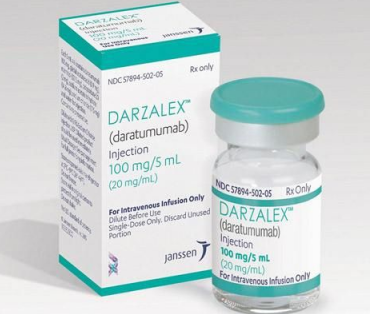
Darzalex is the first CD38-mediated, cytolytic antibody drug approved globally. It exhibits broad-spectrum cytotoxic activity by targeting and binding to CD38, a transmembrane ectoenzyme highly expressed on the surface of cells in multiple myeloma and various solid tumors. Darzalex induces rapid tumor cell death through multiple immune-mediated mechanisms, including complement-dependent cytotoxicity (CDC), antibody-dependent cell-mediated cytotoxicity (ADCC), antibody-dependent cellular phagocytosis (ADCP), and apoptosis. Furthermore, Darzalex has been demonstrated to target immunosuppressive cells within the tumor microenvironment, thereby exhibiting immunomodulatory activity.
Darzalex was licensed by Janssen Biotech, Inc. from Genmab in 2012, granting it exclusive global rights. As a key product heavily developed by Johnson & Johnson, Darzalex holds potential not only for the treatment of multiple myeloma but also for other CD38-high-expressing malignancies, including diffuse large B-cell lymphoma (DLBCL), chronic lymphocytic leukemia (CLL), acute lymphoblastic leukemia (ALL), plasma cell leukemia (PCL), acute myeloid leukemia (AML), follicular lymphoma (FL), and mantle cell lymphoma (MCL).
Darzalex was approved for marketing in November 2015 and is currently approved for multiple therapeutic indications, which vary by country and region, including: (1) Darzalex in combination with bortezomib, thalidomide, and dexamethasone (D-VTd) as a first-line treatment for newly diagnosed multiple myeloma (MM) patients eligible for autologous stem cell transplantation (ASCT); (2) Darzalex in combination with lenalidomide and dexamethasone (DRd) as a first-line treatment for newly diagnosed MM patients ineligible for ASCT; (3) Darzalex in combination with bortezomib, melphalan, and prednisone (D-VMP) as a first-line treatment for newly diagnosed MM patients ineligible for ASCT; (4) Darzalex in combination with lenalidomide and dexamethasone, or with bortezomib and dexamethasone, for adult MM patients who have received at least one prior therapy; (5) Darzalex in combination with pomalidomide and dexamethasone for adult MM patients who have received at least two prior therapies, including lenalidomide and a proteasome inhibitor (PI); (6) Darzalex as monotherapy for adult MM patients who have received at least three prior therapies, including a PI and an immunomodulatory drug (IMiD), or who are double-refractory to both PIs and IMiDs.
In February this year, a split-dose administration regimen for Darzalex was also approved by the FDA. This regimen will provide healthcare professionals with an optional approach when treating MM patients, changing the initial intravenous infusion of Darzalex from a single one-time infusion to split intravenous infusions administered over two consecutive days.
In July this year, the subcutaneous formulation of Darzalex was submitted for marketing approval in the United States and Europe. Phase III clinical study data demonstrated that the subcutaneous formulation of Darzalex was non-inferior to the intravenous formulation in terms of efficacy (overall response rate: 41% vs. 37%; ratio=1.11, 95% CI: 0.89–1.37) and pharmacokinetics (daratumumab trough concentration [Ctrough]: 499 mg/mL vs. 463 mg/mL; ratio=108%, 90% CI: 90%–122%). Additionally, the subcutaneous administration required significantly less time (5 minutes vs. more than 3 hours) and was associated with a lower incidence of infusion-related reactions (13% vs. 35%).
According to Johnson & Johnson’s 2019 performance report, Darzalex achieved sales of $2.168 billion in the first three quarters of the year, representing a 50.4% year-over-year increase. EvaluatePharma, a pharmaceutical market research firm, had previously predicted that Darzalex’s global sales would reach $6.033 billion by 2024, positioning the drug as a key driver of Johnson & Johnson’s future growth. (Bioon.com)