

Amgen and Janssen's KdD Regimen Demonstrates Deep and Durable Responses in Phase 3 CANDOR Trial for Relapsed/Refractory Multiple Myeloma
Dec 12, 2019 09:28
CST Updated
09:28

Amgen
Developer of Treatment Drugs for Serious Diseases

Johnson & Johnson
Healthcare Product Manufacturers, Health Service Providers

Janssen Pharmaceuticals
Pharmaceutical R&D Developer

December 12, 2019 /BioValleyBIOON/ -- The 61st Annual Meeting of the American Society of Hematology (ASH 2019) was recently held in Orlando, Florida, USA. ThisConferenceAmgen announced the results of the Phase III CANDOR study (NCT03158688), which evaluated the three-drug regimen of Kyprolis (carfilzomib) and dexamethasone in combination with Darzalex (daratumumab) (KdD) for the treatment of relapsed or refractory multiple myeloma (R/R MM). Notably, this is the first Phase III study to combine two agents with distinct mechanisms of action—Kyprolis (a proteasome inhibitor) and Darzalex (an anti-CD38 monoclonal antibody)—for the treatment of multiple myeloma.
CANDOR is a randomized, open-label, Phase III study conducted as part of a collaboration with Janssen, a subsidiary of Johnson & Johnson, which co-funded the study under the agreement. The study enrolled 466 patients with relapsed/refractory multiple myeloma (R/R MM) who had previously received 1–3 prior therapies, to evaluate the efficacy and safety of the KdD regimen compared with the two-drug regimen of Kyprolis plus dexamethasone (Kd). In the study, patients in the first group received Kyprolis (56 mg/m² twice weekly), dexamethasone, and Darzalex, while those in the second group (control arm) received Kyprolis (56 mg/m² twice weekly) and dexamethasone. All patients received treatment until disease progression. The primary endpoint was progression-free survival (PFS), and secondary endpoints included overall response rate (ORR), minimal residual disease (MRD), and overall survival (OS). PFS was defined as the time from randomization to disease progression or death from any cause.
The results showed that at a median follow-up of 17 months, the study met its primary endpoint of progression-free survival (PFS): compared with the Kd treatment group, the KdD treatment group demonstrated a statistically significant 37% reduction in the risk of disease progression or death (HR=0.630; 95% CI: 0.464–0.854; p=0.0014). The median PFS was 15.8 months in the Kd group and had not been reached in the KdD group. In addition to meeting the primary endpoint, KdD also showed significant efficacy over Kd in key secondary endpoints, including: overall response rate (ORR) (84.3% vs. 74.7%, p=0.0040), minimal residual disease (MRD)-negative complete response rate at month 12 of treatment (12.5% vs. 1.3%, nearly a 10-fold increase, p<0.0001), and overall survival (OS) (median not reached in either group; HR=0.75; 95% CI: 0.49–1.13; p=0.08).
In this study, the safety profile of the KdD regimen was consistent with the known safety profiles of each individual drug in the regimen. The most frequently reported treatment-emergent adverse events (occurring in ≥20% of patients in both treatment groups [KdD and Kd]) included thrombocytopenia,Anemia, diarrhea,Hypertension, upper respiratory tract infection, fatigue, and dyspnea. Compared with the Kd group, the KdD group had a higher incidence of grade ≥3, serious, and fatal adverse events during treatment. The rates of treatment discontinuation due to adverse events were similar between the two groups.
David M. Reese, M.D., Executive Vice President of Research and Development at Amgen, stated, “The results of the CANDOR study provide robust evidence that the KdD regimen induces deep and durable responses in patients with relapsed disease. The combination of Kyprolis (a proteasome inhibitor) and Darzalex (an anti-CD38 monoclonal antibody), two potent targeted therapies, represents a highly promising new approach for treating patients with relapsed or refractory multiple myeloma.”
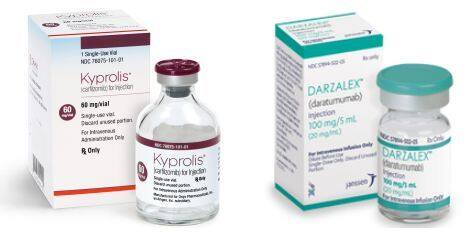
Multiple myeloma (MM) is an incurable hematologic malignancyTumor, characterized by a recurring cycle of remission and relapse. This disease is a rare and highly aggressive condition, accounting for approximately 1% of all cancer types. Worldwide, there are approximately 160,000 cases annuallyDiagnosisIn MM, there are 106,000 deaths annually. Proteasomes play a crucial role in cellular function and growth by degrading damaged or unnecessary proteins. Kyprolis is an intravenously administered irreversible proteasome inhibitor that has been shown to block the proteasome, leading to excessive accumulation of proteins within cells. In certain cells, particularly multiple myeloma cells, Kyprolis can induce cell death, as these cells are more likely to contain higher levels of abnormal proteins.
Since its initial approval in 2012, Kyprolis has been used to treat approximately 130,000 patients worldwide. In the United States, the approved indications for Keytruda are: (1) in combination with dexamethasone, or in combination with dexamethasone and lenalidomide, for the treatment of patients with relapsed or refractory multiple myeloma (R/R MM) who have previously received one to three prior therapies; (2) as a monotherapy for patients with R/R MM who have previously received one or more prior therapies.
Darzalex is the first CD38-mediated, cytolytic antibody drug approved globally, featuring broad-spectrum cytotoxic activity. It targets and binds to the CD38 molecule, a transmembrane ectoenzyme highly expressed on the surface of cells in multiple myeloma and various solid tumors, inducing rapid tumor cell death through multiple immune-mediated mechanisms, including complement-dependent cytotoxicity (CDC), antibody-dependent cell-mediated cytotoxicity (ADCC), and antibody-dependent cellular phagocytosis (ADCP), as well as throughApoptosis(apoptosis). In addition, Darzalex has also been shown to targetTumorImmunosuppressive cells in the microenvironment thereby exhibit immunomodulatory activity.
In the United States, Darzalex was first approved in November 2015FDAApproved, with global sales exceeding $2 billion in 2018. Darzalex indications include: as monotherapy and in various combination regimens for the treatment of newlyDiagnosisMM patients, as well as patients with relapsed or refractory MM. (Bioon.com)