

Pfizer's Xeljanz XR (Tofacitinib Extended-Release) Approved by FDA as First Once-Daily JAK Inhibitor for Ulcerative Colitis
Dec 13, 2019 13:44
CST Updated
13:44

Pfizer
Pharmaceutical R&D Developer

FDA
U.S. Food and Drug Administration

December 13, 2019 /BioonBIOON/ --Pfizer(Pfizer) recently announced that the U.S. Food and Drug Administration (FDA) has approved Xeljanz XR (tofacitinib) extended-release tablets, 11 mg and 22 mg, for the treatment of adult patients with moderately to severely active ulcerative colitis (UC) who have had an inadequate response or intolerance to TNF blockers. Xeljanz XR will be the first and only once-daily JAK inhibitor for the management of disease in adult patients with moderately to severely active UC.
Pfizer Global Product Development, Inflammation &ImmunologyChief Development Officer Michael Corbo stated, “Ulcerative colitis is a chronic inflammatory disease of the colon that significantly impacts patients’ quality of life and imposes a psychological burden due to symptoms, flares, and complications. We are pleased to offer a convenient once-daily dosing option for Xeljanz for patients with moderately to severely active ulcerative colitis and their healthcare providers.”
Xeljanz/Xeljanz XR is indicated for: Patients with moderately to severely active ulcerative colitis (UC) who have had an inadequate response or intolerance to TNF blockers. The concomitant use of Xeljanz/Xeljanz XR with biologics used to treat UC or with potent immunosuppressants such as azathioprine and cyclosporine is not recommended. Xeljanz 10 mg twice daily or Xeljanz XR 22 mg once daily may be administered for eight weeks or up to 16 weeks as induction therapy. Subsequently, Xeljanz 5 mg twice daily or Xeljanz XR 11 mg once daily may be administered as maintenance therapy. For patients who lose response during maintenance therapy, consideration may be given to administering Xeljanz 10 mg twice daily or Xeljanz XR 22 mg once daily, limited to the shortest duration necessary, while carefully considering the benefits and risks for the individual patient. Use the lowest effective dose required to maintain response. Dosage adjustment is required in patients with moderate to severe renal impairment or moderate to severe hepatic impairment. For dosage adjustments, please refer to the full Prescribing Information for Xeljanz/Xeljanz XR: https://labeling.pfizer.com/ShowLabeling.aspx?id=959.
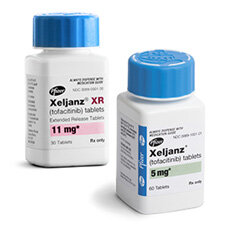
The active pharmaceutical ingredient in Xeljanz/Xeljanz XR is tofacitinib, an oral Janus kinase (JAK) inhibitor that selectively inhibits JAK enzymes and blocks the JAK/STAT signaling pathway. This pathway, a cytokine-stimulated signal transduction cascade identified in recent years, participates in numerous critical biological processes, including cell proliferation, differentiation, apoptosis, and immune regulation.
In the United States, Xeljanz was approved in 2012 as the first marketed JAK inhibitor, administered orally twice daily; Xeljanz XR is an extended-release formulation approved in 2016 as the first once-daily oral JAK inhibitor on the market.Currently, these two drugs have been approved for three indications: (1) treatment of moderate to severe active rheumatoidRheumatoid Arthritis(RA) adult patients; (2) treatment of adult patients with active psoriatic arthritis (PsA); (3) treatment of adult patients with moderate to severe ulcerative colitis (UC).
Currently, Pfizer remains the leader in the field of JAK inhibitors. According to the company's third-quarter earnings report released in late October, in the first nine months of this year,Xeljanz'sSales reached $1.634 billion, a 34% increase from the same period in 2018, with the U.S. market up 25% and the international market up 69%.
However, safety concerns regarding the high dose of Xeljanz (10 mg tablets) have persisted. In the first half of this year, regulatory authorities in the United States and the European Union both raised issues concerning pulmonary embolism and an imbalance in mortality rates associated with Xeljanz10 mg TabletsIssuance of safety warnings and restrictions will adversely affect the commercial prospects of Xeljanz. On the other hand, in the JAK inhibitor market, two newly launched drugs—Eli LillyOlumiant, AbbVie’s Rinvoq, and Gilead’s filgotinib, which is scheduled to launch in 2020, will all exert greater competitive pressure on Xeljanz. Of particular importance, these two drugs, Rinvoq and filgotinib,Clinical Trialdemonstrated high safety. (Bioon.com)