

Nat Microbiol: Alarming Emergence of Drug-Resistant Influenza Viruses Following Use of Roche’s Novel Antiviral Xofluza
Dec 21, 2019 14:28
CST Updated
14:28

Roche
Oncology Drug Research, Development, and Manufacturing
December 21, 2019 News/BioValleyBIOON/---A novel anti-influenza drug called baloxavir marboxil (Xofluza) was first approved in Japan in 2018 and received the green light in the United States later that year; however, this drug may be promoting the emergence of drug-resistant influenza virus strains. In a new study, researchers from institutions including the University of Wisconsin–Madison in the United States and the University of Tokyo in Japan found that nearly one-quarter of patients treated with Xofluza carried influenza viruses with genomic mutations that reduced their susceptibility to the drug. These mutations were not present prior to treatment. The related findings are scheduled to be published in the January 2020 issue of Nature Microbiology, under the title “Influenza A variants with reduced susceptibility to baloxavir isolated from Japanese patients are fit and transmit through respiratory droplets.”
Andrew Pekosz, a molecular biologist at Johns Hopkins University in the United States (who was not involved in the study), stated, “In the worst-case scenario, these mutations could render the drug completely ineffective. They have not reached that point thus far, and it remains unclear why.”
In previous cell culture studies andClinical TrialsScientists have observed that influenza virus mutants sometimes emerge following exposure to Xofluza. Each of these influenza virus mutants harbors an identical mutation in the gene encoding a polymerase subunit. Since Xofluza typically disrupts the polymerase complex, this mutation in the influenza virus attenuates the drug’s efficacy.
In this new study, Yoshihiro Kawaoka of the University of Wisconsin–Madison, the corresponding author of the paper, and his colleagues collected influenza virus samples from 38 patients with influenza virus infection before and after treatment with Xofluza. None of the study participants carried this influenza virus mutant prior to taking the drug; however, mutations were detected in influenza virus samples from nine patients after treatment.
To assess whether influenza virus mutants associated with this treatment impact the drug’s efficacy, the researchers conducted experiments in hamsters, ferrets, and cell cultures, finding that these viral mutants were pathogenic, transmissible, and exhibited higher drug resistance.
Kawaoka and his team also sequenced influenza virus samples from a boy carrying the virus before he took Xofluza and from his sister (who contracted influenza a few days later). Apart from mutations in the genes encoding this polymerase subunit, the genomes of the influenza virus samples from both individuals were identical. Kawaoka stated, “This indicates that the influenza virus acquired drug resistance during treatment and was transmitted between siblings.”
He added that although this drug-resistant influenza virus strain poses a threat to those in close contact with infected individuals, it is unlikely to become a widespread problem. Kawaoka stated, “This drug-resistant influenza virus can indeed spread, but given the vast number of influenza viruses circulating worldwide, only a small fraction of people receive treatment with this drug. The vast majority of people remain susceptible to it.” (Bioon.com)
References:
1.Masaki Imai et al. Influenza A variants with reduced susceptibility to baloxavir isolated from Japanese patients are fit and transmit through respiratory droplets. Nature Microbiology, 2019, doi:10.1038/s41564-019-0609-0.
2.Drug-Resistant Flu Can Emerge After Patients Take Antiviral
https://www.the-scientist.com/news-opinion/drug-resistant-flu-can-emerge-after-patients-take-antiviral-66785
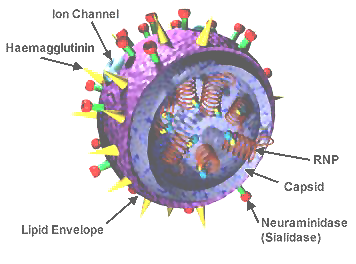
Influenza D virus, image from Wikipedia Commons.
Andrew Pekosz, a molecular biologist at Johns Hopkins University in the United States (who was not involved in the study), stated, “In the worst-case scenario, these mutations could render the drug completely ineffective. They have not reached that point thus far, and it remains unclear why.”
In previous cell culture studies andClinical TrialsScientists have observed that influenza virus mutants sometimes emerge following exposure to Xofluza. Each of these influenza virus mutants harbors an identical mutation in the gene encoding a polymerase subunit. Since Xofluza typically disrupts the polymerase complex, this mutation in the influenza virus attenuates the drug’s efficacy.
In this new study, Yoshihiro Kawaoka of the University of Wisconsin–Madison, the corresponding author of the paper, and his colleagues collected influenza virus samples from 38 patients with influenza virus infection before and after treatment with Xofluza. None of the study participants carried this influenza virus mutant prior to taking the drug; however, mutations were detected in influenza virus samples from nine patients after treatment.
To assess whether influenza virus mutants associated with this treatment impact the drug’s efficacy, the researchers conducted experiments in hamsters, ferrets, and cell cultures, finding that these viral mutants were pathogenic, transmissible, and exhibited higher drug resistance.
Kawaoka and his team also sequenced influenza virus samples from a boy carrying the virus before he took Xofluza and from his sister (who contracted influenza a few days later). Apart from mutations in the genes encoding this polymerase subunit, the genomes of the influenza virus samples from both individuals were identical. Kawaoka stated, “This indicates that the influenza virus acquired drug resistance during treatment and was transmitted between siblings.”
He added that although this drug-resistant influenza virus strain poses a threat to those in close contact with infected individuals, it is unlikely to become a widespread problem. Kawaoka stated, “This drug-resistant influenza virus can indeed spread, but given the vast number of influenza viruses circulating worldwide, only a small fraction of people receive treatment with this drug. The vast majority of people remain susceptible to it.” (Bioon.com)
References:
1.Masaki Imai et al. Influenza A variants with reduced susceptibility to baloxavir isolated from Japanese patients are fit and transmit through respiratory droplets. Nature Microbiology, 2019, doi:10.1038/s41564-019-0609-0.
2.Drug-Resistant Flu Can Emerge After Patients Take Antiviral
https://www.the-scientist.com/news-opinion/drug-resistant-flu-can-emerge-after-patients-take-antiviral-66785