

Takeda Receives Complete Response Letter from U.S. FDA for Subcutaneous ENTYVIO® in Moderate to Severe Ulcerative Colitis
Dec 23, 2019 16:06
CST Updated
16:06
Takeda
Biopharmaceutical Manufacturer

FDA
U.S. Food and Drug Administration
December 23, 2019 /BioValleyBIOON/ -- Japanese pharmaceutical giant Takeda recently announced that the U.S. Food and Drug Administration (FDA) has issued a Complete Response Letter (CRL) regarding the Biologics License Application (BLA) for the subcutaneous formulation of Entyvio (vedolizumab). The BLA sought approval of the subcutaneous (SC) formulation of Entyvio as a maintenance therapy for the treatment of adult patients with moderately to severely active ulcerative colitis (UC).
Currently, the Marketing Authorization Application (MAA) for Entyvio SC formulation in the treatment of adult patients with moderate-to-severe UC and CD is also under review by the European Medicines Agency (EMA). In the United States and the European Union, the BLA and MAA applications include prefilled syringes and injection pens for the SC formulation of Entyvio. The additional administration options will provide patients with more choices. If approved, Entyvio will become the only maintenance therapy offering both intravenous (IV) infusion and subcutaneous (SC) injection formulations for UC and CD.
Entyvio is a gut-selective biologic agent, and its intravenous (IV) formulation was approved in 2014.FDAApproved for the treatment of patients with moderately to severely active ulcerative colitis (UC) and Crohn’s disease (CD). In the United States, more than 150,000 patients have been treated to date. Currently, the intravenous (IV) formulation of Entyvio is marketed in more than 60 countries worldwide.
Takeda stated that it is evaluating the details in the Complete Response Letter (CRL) to gather the information necessary to address the FDA’s concerns. The company will work closely with the FDA. It should be noted that the issues raised by the FDA in the CRL are not related to the clinical data and conclusions from the pivotal trials supporting the Biologics License Application (BLA). Takeda firmly believes that the subcutaneous (SC) formulation of Entyvio will provide potential benefits for patients with moderate-to-severe ulcerative colitis (UC). The company remains committed to working withFDACollaboration to address unmet patient needs through this important route of administration, enhancing the patient experience in alignment with treatment preferences and lifestyle.
The Biologics License Application (BLA) and Marketing Authorization Application (MAA) for the subcutaneous (SC) formulation of Entyvio were both based on data from the pivotal Phase III VISIBLE-1 study. This study was a randomized, double-dummy, double-blind, placebo-controlled trial that included an intravenous (IV) Entyvio control group. The study enrolled a total of 383 patients with moderately to severely active ulcerative colitis (UC) who had previously failed treatment with corticosteroids, immunomodulators, orTumorInsufficient response, loss of response, or intolerance to tumor necrosis factor-alpha (TNF-α) antagonists. In the study, patients received two doses of open-label intravenous (IV) Entyvio at Weeks 0 and 2. Patients who achieved clinical remission were randomized at Week 6 into three treatment groups: Entyvio subcutaneous (SC) (108 mg) + placebo IV group (n=106), Entyvio IV (300 mg) + placebo SC group (n=54), and placebo SC + placebo IV group (n=56). Subcutaneous injections were administered every 2 weeks, and intravenous infusions were administered every 8 weeks. The primary objective of the study was to evaluate the efficacy and safety of Entyvio SC as maintenance therapy.
The data showed that at Week 52 of treatment, a statistically significantly higher proportion of patients in the Entyvio SC group achieved clinical remission compared with the placebo group (46.2% vs. 14.3%, p < 0.001; clinical remission was defined as a Mayo score ≤ 2 with no individual subscore > 1), thereby meeting the primary endpoint of the study. A similar clinical remission rate was observed in the Entyvio IV control group (42.6%).
Furthermore, compared with the placebo group, the Entyvio SC treatment group also demonstrated statistical superiority in key secondary endpoints, including mucosal healing (56.6% vs. 21.4%, p<0.001) and durable clinical remission (64.2% vs. 28.6%, p<0.001). The rates of durable clinical remission (15.1% vs. 5.4%, p=0.076) and corticosteroid-free clinical remission (28.9% vs. 8.3%, p=0.067) were also higher in the Entyvio SC treatment group than in the placebo group, but these differences were not statistically significant. Similar results were observed in the Entyvio IV treatment group.
Further subgroup analysis indicated that in patients who had not previously received treatment (treatment-naïve) and those who had previously received treatment (pre-treated)TumorAmong patients treated with tumor necrosis factor-alpha (TNFα) inhibitors, the clinical remission rate of Entyvio SC was significantly higher than that of placebo (treatment-naïve subgroup: 53.7% vs. 18.9%, p < 0.001; previously treated subgroup: 33.3% vs. 5.3%, p = 0.023).
Regarding safety, the incidence of adverse events (including serious adverse events and infections) was similar between the Entyvio SC and Entyvio IV treatment groups. Injection site reactions were mild, with an incidence of 9.4% in the Entyvio SC group (0% in the placebo group), and no patients discontinued treatment due to these reactions. The detection rates of anti-Entyvio antibodies (AVAs) were similar in the Entyvio SC and IV groups (5.7% and 5.6%, respectively).
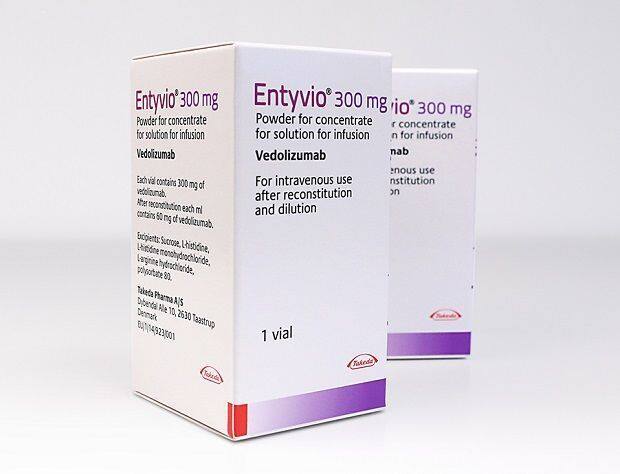
Entyvio is a gut-selective humanized monoclonal antibody that was approved for marketing in the United States and the European Union in May 2014. Currently, Entyvio intravenous infusion has been approved in more than 60 countries worldwide for the treatment of adult patients with moderately to severely active ulcerative colitis (UC) or Crohn’s disease (CD).
The active pharmaceutical ingredient of Entyvio is vedolizumab, a fully humanized monoclonal antibody that specifically antagonizes α4β7 integrin, thereby inhibiting the binding of α4β7 integrin to MAdCAM-1, the mucosal addressin cell adhesion molecule-1 on intestinal endothelial cells. MAdCAM-1 is selectively expressed in the gastrointestinal vasculature and lymph nodes. α4β7 integrin is expressed on a subset of circulating leukocytes, which have been demonstrated to play a critical role in mediating inflammation in Crohn’s disease (CD) and ulcerative colitis (UC).
It is worth noting that on March 9 this year, Takeda announced the results of VARSITY, the first head-to-head Phase IIIb study evaluating Entyvio (vedolizumab) for the treatment of moderate-to-severe ulcerative colitis (UC), at the 14th Congress of the European Crohn’s and Colitis Organisation (ECCO) held in Copenhagen, the capital of Denmark. The results showed that at Week 52, Entyvio demonstrated superior efficacy compared with AbbVie’s flagship product Humira (generic name: adalimumab) in achieving the primary endpoint of clinical remission. (Bioon.com)