

Merck’s KEYTRUDA® (pembrolizumab) Approved in Japan for Three New First-Line Indications in Advanced Renal Cell Carcinoma and Recurrent or Metastatic Head and Neck Cancer
Dec 23, 2019 16:00
CST Updated
16:06

MSD
Pharmaceutical R&D and Manufacturer

PMDA
The PMDA is responsible for preventing adverse reactions to pharmaceuticals and biologics, as well as conducting timely assessments and responses to such risks, thereby helping to enhance the quality, efficacy, and safety of medicinal products and improve public health. Its scope of work includes providing relief for adverse drug reactions, reviewing pharmaceuticals, medical devices, and related businesses in accordance with the law, ensuring the safety of pharmaceuticals and medical devices, and disseminating information on safety measures and medical products.

December 23, 2019 /BioValleyBIOON/ --TumorImmunotherapy giant Merck & Co. recently announced that the Japanese Pharmaceuticals andMedical DevicesThe Pharmaceuticals and Medical Devices Agency (PMDA) has approved three new first-line treatment indications for the anti-PD-1 therapy Keytruda (Chinese brand name: Keytruda; generic name: pembrolizumab): (1) in combination with Inlyta (axitinib) for the first-line treatment of patients with unresectable or metastatic renal cell carcinoma (RCC); (2) in combination with chemotherapy for the first-line treatment of patients with recurrent or distant metastatic head and neck cancer; and (3) as monotherapy for the first-line treatment of patients with recurrent or distant metastatic head and neck cancer.
To date, Keytruda has been approved in Japan for six cancer types and for tumors with high microsatellite instability (MSI-H). Dr. Jonathan Cheng, Vice President of Oncology Clinical Research at MSD Research Laboratories, stated, “In Japan, advanced renal cell carcinoma and head and neck cancer have historically been associated with poor prognosis, necessitating new treatment options. The three new first-line Keytruda regimens approved today...”Diagnosisthese malignantTumorrepresents an important milestone for patients, providing a significant alternative to standard therapy for patients in Japan.”
The approval of Keytruda in combination with Inlyta as first-line treatment for unresectable or metastatic renal cell carcinoma (RCC) is based on the results of the KEYNOTE-426 trial: data demonstrated that, compared with sunitinib monotherapy, the Keytruda plus Inlyta combination regimen significantly prolonged overall survival (OS: HR=0.53 [95% CI: 0.38–0.74], p=0.00005) and progression-free survival (PFS: HR=0.69 [95% CI: 0.56–0.84], p=0.00012).
The approval of Keytruda as first-line treatment for recurrent or metastatic head and neck cancer was based on the results of the Phase III KEYNOTE-048 trial. This trial evaluated Keytruda in combination with chemotherapy (platinum + 5-fluorouracil [5-FU]), Keytruda monotherapy, and standard therapy (cetuximab + platinum + 5-FU) as first-line treatments for patients with recurrent or metastatic squamous cell carcinoma of the head and neck. The results showed that, compared to standard therapy, Keytruda combined with chemotherapy significantly prolonged overall survival (OS: HR=0.77 [95% CI: 0.63–0.93]; p=0.00335). As a monotherapy, Keytruda demonstrated non-inferiority compared to standard therapy (HR=0.85 [95% CI: 0.71–1.03]; p=0.00014). Furthermore, compared to standard therapy, Keytruda monotherapy showed, inTumorStatistically significant improvement in OS was observed in patients expressing PD-L1 (CPS ≥ 1).
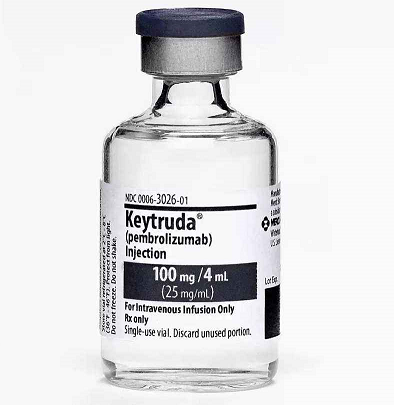
Keytruda is a PD-(L)1 cancer immunotherapy that helps detect and combat tumor cells by enhancing the body’s immune system. Keytruda activates potential effects by blocking the interaction between PD-1 and its ligands, PD-L1 and PD-L2, therebyTumorT lymphocytes of cells and healthy cells.
To date, multiple PD-(L)1 cancer immunotherapies have been approved globally, with Keytruda leading the field and having received approval for more than 20 therapeutic indications. MSD boasts the industry’s largest immuno-oncology clinical development program, currently comprising over 1,000Clinical TrialsInvestigating Keytruda in multiple typesTumorand its role in the treatment context. The Keytruda clinical program aims to understand the drug’s role in cancer and identify factors that may predict patient benefit from Keytruda therapy, including exploring several differentBiomarkers。
It is worth noting that in late November this year, Keytruda received approval from China’s National Medical Products Administration (NMPA) for use in combination with carboplatin and paclitaxel as a first-line treatment for metastatic squamous non-small cell lung cancer (NSCLC). Notably, this marks the third first-line approval for Keytruda in the treatment of NSCLC within less than a year. The drug is now approved in China for use in combination with chemotherapy as a first-line treatment for both squamous and non-squamous NSCLC, as well as for monotherapy in NSCLC (Tumorthe first anti-PD-1 therapy for tumors with a Tumor Proportion Score (TPS) ≥1%. Previously, Keytruda had also been approved by the NMPA for the treatment of unresectable or metastatic disease that has progressed after first-line therapy.Melanomatreatment. (Bioon.com)