

ONO and BMSKK Submit Supplemental Application for Approval of Opdivo and Yervoy Combination Therapy for First-Line Treatment of PD-L1-Positive NSCLC in Japan
Dec 27, 2019 09:45
CST Updated
09:45

Ono
Innovative Drug Developer
Bristol-Myers Squibb
Biopharmaceutical and Nutritional Product R&D and Sales

December 27, 2019 /BioonBIOON/ -- Ono Pharmaceutical Co., Ltd. and Bristol-Myers Squibb K.K. (BMSKK) recently announced jointly that they have submitted a supplemental application in Japan to request changes to certain approved items in the manufacturing and marketing approvals for the anti-PD-1 monoclonal antibody Opdivo (Chinese brand name: Oudivo; generic name: nivolumab) intravenous infusion and the anti-CTLA-4 monoclonal antibody Yervoy (ipilimumab) injection. The changes include expanding the indication for the Opdivo plus Yervoy combination therapy to cover first-line treatment of unresectable, advanced or recurrent non-small cell lung cancer (NSCLC).
This application is primarily based on the results from Part 1 of the phase III CheckMate-227 trial evaluating Opdivo as first-line treatment for NSCLC. This is a global, multi-part, open-label, randomized trial conducted by Ono Pharmaceutical Co., Ltd in collaboration with Bristol-Myers Squibb Company in patients with stage IV or recurrent NSCLC who had not previously received chemotherapy (chemotherapy-naïve). Part 1 consists of: (1) Part 1a, comparing Opdivo plus low-dose Yervoy, Opdivo monotherapy, and chemotherapy in patients whose tumors express PD-L1; (2) Part 1b, comparing Opdivo plus low-dose Yervoy, Opdivo plus chemotherapy, and chemotherapyTumorPatients who do not express PD-L1.
Results announced at the end of September this year showed that Part 1a of the study met the co-primary endpoint of overall survival (OS): In first-line treatment of patients with non-small cell lung cancer (NSCLC) whose tumors express PD-L1 ≥1%, the Opdivo plus low-dose Yervoy combination regimen demonstrated superiority in OS compared with chemotherapy (HR=0.72, 97.72% CI: 0.65-0.96). Furthermore, exploratory analyses indicated thatTumorIn NSCLC patients with PD-L1 expression <1%, the Opdivo plus low-dose Yervoy combination regimen also improved OS (HR=0.62, 95% CI: 0.48-0.78). Among patients receiving the Opdivo plus low-dose Yervoy combination regimen, the 2-year survival rate was 40% in both the PD-L1 ≥1% and PD-L1 <1% subgroups. In the chemotherapy control group, the 2-year survival rates were 33% and 23% for patients with PD-L1 ≥1% and PD-L1 <1%, respectively.
These results represent the first instance of a dual immunotherapyTumorImmuno-oncology (I-O) therapy as first-line treatment for NSCLC demonstrates superior efficacy in overall survival (OS) compared to chemotherapy. The safety profile of the Opdivo plus low-dose Yervoy combination regimen is consistent with previous NSCLC studies, with no new safety signals observed.
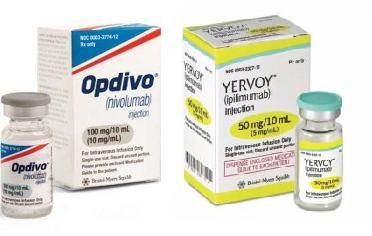
Opdivo and Yervoy are both cancer immunotherapies (I-O) that target different regulatory components of the immune system, harnessing the body’s own immune system to combatTumor, in which Opdivo targets and blocks the PD-1/PD-L1 pathway, while Yervoy targets and blocks CTLA-4.
To date, the Opdivo + Yervoy immunotherapy combination has been approved for: (1) the treatment of unresectable or metastaticMelanoma; (2) patients with intermediate- or high-risk advanced renal cell carcinoma (RCC) in the first-line setting; (3) pediatric patients aged 12 years and older and adult patients with microsatellite instability-high (MSI-H) or mismatch repair-deficient (dMMR) metastatic colorectal cancer (mCRC).
In February this year, Bristol-Myers Squibb (BMS) also announced the interim analysis results of the Phase II clinical trial CheckMate-650 evaluating the Opdivo plus Yervoy combination for the treatment of metastatic castration-resistant prostate cancer (mCRPC). The data demonstrated robust efficacy evidence for the Opdivo/Yervoy combination in treating mCRPC, positioning it as the first immunotherapy to show strong efficacy in this refractory patient population.TumorImmuno-oncology (I-O/I-O) combination therapy.
Opdivo was first approved in Japan in July 2014, becoming the world’s first approved PD-1 immunotherapy, with indications for the treatment ofMelanoma. By utilizing the human bodyAutoimmunitySystemic Cancer Treatment: Opdivo Has Become a Key Therapeutic Option for Multiple Cancers.
In Japan, Ono Pharmaceutical Co., Ltd. launched Opdivo in September 2014 for the treatment of unresectable melanoma. Since then, Opdivo has been successively approved in Japan for multiple cancer indications, including: (1) unresectable, advanced or recurrent non-small cell lung cancer; (2) unresectable or metastatic renal cell carcinoma; (3) recurrent or refractory classical Hodgkin lymphoma; (4) recurrent or metastatic head and neck cancer; (5) unresectable advanced or recurrent gastric cancer that has progressed after chemotherapy; (6) unresectable advanced or recurrent malignant pleural mesothelioma that has progressed after chemotherapy; (7) adjuvant therapyMelanoma。
In addition, Ono Pharmaceutical Co., Ltd. has submitted supplemental applications for Opdivo in the treatment of microsatellite instability-high (MSI-H) colorectal cancer and esophageal cancer, and is conducting clinical development programs for a variety of cancers, including esophageal cancer, esophagogastric junction cancer, small cell lung cancer, hepatocellular carcinoma, glioblastoma, urothelial carcinoma, ovarian cancer, bladder cancer, colorectal cancer, pancreatic cancer, and biliary tract cancer.
Ono Pharmaceutical Co., Ltd. is the original developer of Opdivo. In 2011, the company entered into a collaboration with Bristol-Myers Squibb, granting Bristol-Myers Squibb the rights to develop and commercialize Opdivo in all regions except Japan, South Korea, and Taiwan, China. In July 2014, the two parties further expanded their strategic partnership to develop and commercialize multiple immunotherapies (including monotherapies and combination therapies) for cancer patients in Japan, South Korea, and Taiwan, China. To date, Opdivo has been approved in more than 65 countries and regions, including Japan, South Korea, China, the United States, and the European Union. (Bioon.com)
Original Source: ONO and BMSKK Submit Supplemental Application forapproval of Opdivo and Yervoy Combination Therapy to Expand the Use for First-Line Treatment of Unresectable, Advanced or Recurrent Non-Small Cell Lung Cancer in Japan