

ZhiRui Pharma Transforms 'Big Data' into Actionable Insights for Efficient Hit Compound Discovery

DM Intelligence
AI-based New Drug R&D Company
As the biopharmaceutical industry has evolved, new technologies have continually emerged. In the realm of drug screening alone, there has been a succession of models, ranging from Shennong’s empirical tasting of herbs to manual screening, high-throughput screening, and virtual screening. However, the harsh reality is that the cost of new drug development continues to rise year by year, leading to growing calls from R&D professionals for innovative technological solutions. With the gradual implementation of artificial intelligence (AI) in other sectors, drug screening has become one of the new frontiers for the comprehensive application of AI.
Dr. Xie Weidong, CEO of DM Intelligence, previously engaged in academic work in the fields of immunology and molecular biology at several prestigious institutions in Canada and the United States. Upon returning to China, he joined multiple renowned Chinese pharmaceutical companies, where he held positions focused on technical R&D and clinical translation. He brings over thirty years of experience in the biopharmaceutical industry.
With years of in-depth expertise in the biopharmaceutical sector, Dr. Xie possesses profound and unique insights into drug screening. He stated, “Twenty years ago, we could not give birth to ‘big data healthcare’ because our pharmaceutical data and computational capabilities were not yet ready. Today, however, with technological advancements, the accumulation of medical data and the accessibility of hardware infrastructure (such as supercomputers) have laid the necessary groundwork. At DM Intelligence, we are committed to transforming ‘large volumes of data’ into true ‘big data,’ thereby making AI-driven new drug development genuinely feasible.”
DM Intelligence was founded with the original mission of leveraging big data and algorithms to empower drug discovery, improve the accuracy of drug screening, shorten development timelines, and reduce R&D costs.
Currently, drug development incurs enormous costs. First, the timeline is excessively long, with some drugs taking up to 14 years to reach the market. Second, R&D expenses are prohibitively high, with the average cost from compound discovery to market approval reaching billions of US dollars. Furthermore, the drug development process is fraught with challenges. To identify a compound with potential inhibitory effects, pharmaceutical companies must sequentially verify its physicochemical properties, in vivo distribution, absorption, metabolism, and toxicity. If any of these criteria fail to meet standards, the drug candidate requires re-engineering.
Developing Algorithms to Efficiently Identify Hit Compounds
As the pharmaceutical R&D industry has evolved, obtaining hit compounds has become increasingly challenging. Screening natural products and compound libraries through random methods, such as manual screening and high-throughput screening, is a time-consuming and labor-intensive process. Meanwhile, the quality of candidate drugs often determines the success or failure of subsequent preclinical and clinical development.
Ideally, during the initial stages of drug development, assessments and predictions are made regarding the physicochemical properties, pharmacokinetics, and toxic side effects of lead compounds/candidate drugs, thereby reducing the workload of drug R&D, shortening the development cycle, saving research costs, and improving the success rate of development. The emergence of virtual molecular docking has made this "ideal scenario" achievable: by establishing geometric positional matching functions and energy functions between small molecules and protein targets, it predicts the interactions between small molecules and proteins, and on this basis, screens for hit compounds that bind to the protein targets.
DM Intelligence has compiled foundational data on marketed drugs, investigational new drugs, and synthetic compounds from both domestic and international sources, along with publicly accessible protein data from major databases, research literature, and patents. Based on these resources, the company has established multiple specialized databases, including a 3D structure database of nearly 100 million compounds and a 3D structure database of 130,000 proteins. Furthermore, for specific targets, it has developed compound databases stratified by activity levels, ranging from high to inactive.
Following the completion of the preliminary database construction, the company independently developed a drug screening model based on compound molecular data and target protein data. By leveraging deep convolutional neural network (CNN) models, the system hierarchically decomposes complex concepts into numerous simple local features and employs various feature extraction techniques to effectively capture structural characteristics. This model can simultaneously analyze millions of sites within a three-dimensional structure or millions of parameters within a single model during protein structure analysis. The system efficiently collects multi-dimensional data, performs rapid and comprehensive statistical analysis of various metrics, accelerates the drug R&D process, and enhances prediction accuracy.
Among the various scenarios where AI empowers the pharmaceutical industry, DM Intelligence focuses on small-molecule compound discovery. The company’s independently developed deep learning algorithm system can build drug screening models based on compound molecular data and target protein data.
ForHit Compound, this algorithmic system can optimize the structure and function of compounds based on target proteins.
ForSpecific Proteins, the new drug screening system can design compounds with specific functions.
Furthermore, DM Intelligence’s drug discovery platform supports concurrent multi-user operations and allows access to data results from multiple endpoints. The platform integrates various artificial intelligence algorithms to establish a multi-dimensional scoring system for evaluating molecule-protein binding, while incorporating comprehensive tools for drug molecule design and optimization.
Four Target Screening Models Have Been Established
Leveraging its comprehensive AI-driven drug discovery platform, DM Intelligence has developed four core pipelines: a phosphatase inhibitor screening model, a kinase inhibitor screening model, an antiviral drug screening model, and an antibacterial drug screening model.
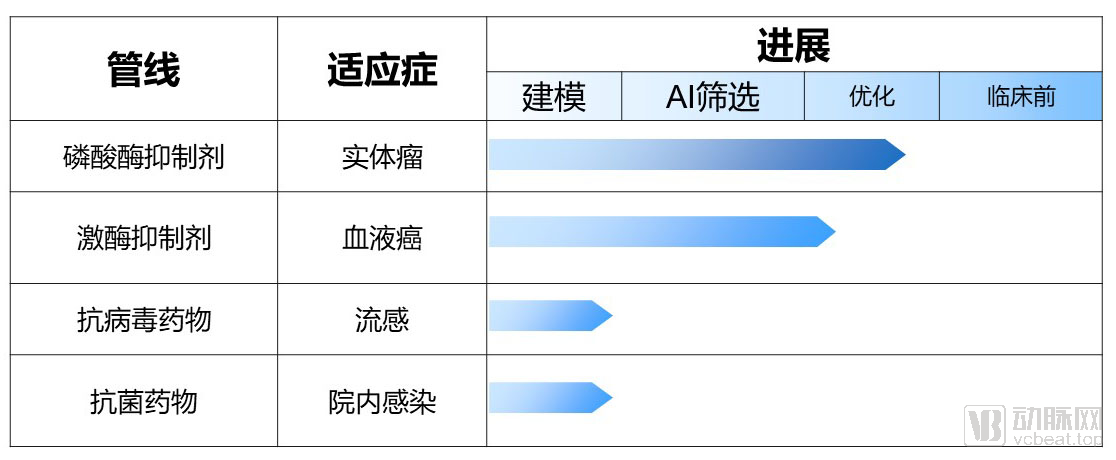
DM Intelligence's Product Pipeline
Currently, the phosphatase inhibitor pipeline is advancing most rapidly. A batch of hit compounds has already been identified and is now undergoing optimization. This product plays a crucial role in treating various forms of cancer and modulating the immune system, thereby enabling the treatment of solid tumors. Furthermore, no inhibitors targeting this same mechanism have yet been approved for market launch.
Another anticancer drug development pipeline is the kinase inhibitor screening model. This product can inhibit the proliferation and differentiation of tumor cells or promote their apoptosis by suppressing the activation of relevant pathways, with hematologic malignancies as its primary indication. Currently, multiple related inhibitors have been marketed, but resistance has commonly emerged. DM Intelligence has obtained a batch of hit compounds.
In addition to its two core pipelines in the field of anticancer drugs, DM Intelligence is also engaged in the research and development of antiviral and antibacterial drugs. The drug screening models for these two areas have been developed, and multiple batches of hit compounds are currently undergoing further testing.
Leveraging DM Intelligence’s drug screening and R&D platform, the time required for drug screening can be reduced from the original 2–3 years to just 2–3 months, cutting R&D costs by at least two orders of magnitude while significantly improving screening accuracy. The company has already established collaborative research partnerships with the University of Melbourne in Australia, the University of Leicester in the UK, and Sun Yat-sen University, and is currently negotiating cooperative development partnerships with pharmaceutical companies both domestically and internationally, such as Boji Medicine and Takeda.
In terms of business models, DM Intelligence will first apply for patent protection for compounds that have been preliminarily screened and verified to have inhibitory effects, and then proceed with licensing, transfer, or joint development of these compounds. The second business model involves DM Intelligence providing screening services based on the needs of pharmaceutical companies to develop drugs targeting specific points, with the pharmaceutical companies covering the costs.
Regarding the future, the CEO of DM Intelligence stated that the company will focus on drugs targeting phosphatases, secure patent protection for the identified hit compounds, and actively seek opportunities for licensing and development. In addition, DM Intelligence will expand its global business operations and seek multiple partners both domestically and internationally.
It is reported that DM Intelligence has completed a seed financing round in the millions and is currently seeking pre-A round financing.