

YaoLing MedTech: AI-Powered Real-World Evidence for Full Drug Lifecycle Management

LONGLEDING TECHNOLOGY
AI-type CRO Service Provider
No. 1 Document of the National Medical Products Administration in 2020 was issued for real-world research.
Since the release of the draft for public consultation in April 2019, this industry, which had already been thriving abroad for several years, rapidly gained prominence in China within less than a year. Countless enterprises, eyeing what appeared to be a ready-made market, sought to carve out a share by leveraging data or technology.
However, real-world studies are not as straightforward as they may appear. The imperfections of electronic medical record systems in China, coupled with the complexity of Chinese medical terminology, have made data structuring a significant challenge for real-world studies. This issue is further exacerbated in the field of traditional Chinese medicine.
There will always be those who break through in challenging fields. LONGLEDING TECHNOLOGY is leveraging its powerful natural language processing system to handle complex case information, starting from clinical trials to assist in the full-lifecycle management of pharmaceuticals.
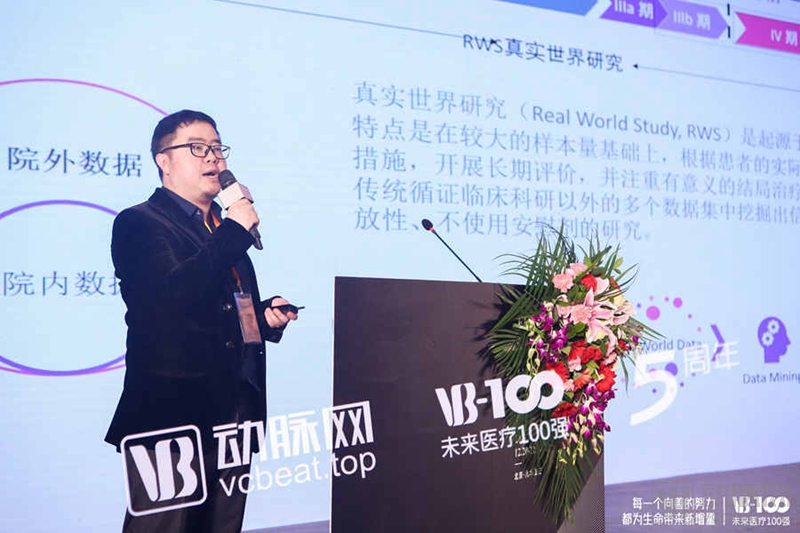
Hu Qitong, CTO of LONGLEDING TECHNOLOGY
At VCBeat’s “2019 Future Healthcare Top 100” Innovative Drugs Forum, Hu Qitong, CTO of LONGLEDING TECHNOLOGY, delivered an insightful presentation titled “AI + Real-World Studies Empowering Full Lifecycle Management of Pharmaceuticals.” Building on this presentation, VCBeat conducted an in-depth interview with Hu Qitong to explore how the full lifecycle management of pharmaceuticals has evolved with the integration of artificial intelligence.
LONGLEDING TECHNOLOGY is a data-driven, technology-oriented contract research organization (CRO) specializing in clinical research services, dedicated to integrating artificial intelligence (AI) and other advanced information technologies into the field of clinical research. Leveraging large-scale clinical data as its foundation, real-world studies employ AI-assisted data structuring and algorithmic analysis to help pharmaceutical companies gain in-depth insights into patient benefits derived from the actual use of their drugs.
Hu Qitong summarized the value of real-world studies (RWS) on drugs for pharmaceutical companies in his speech: “On one hand, it strengthens academic research; on the other, it creates commercial value. Academic value includes studying precision medication, expanding indications, and developing diagnostic prediction models, all of which can help improve data for drug review and approval processes. Commercial value aids in market promotion by increasing doctors’ confidence in the drugs, thereby enabling more patients to receive the correct medication. Real-world studies can perfectly unify these two objectives.”
From Abroad to China: Real-World Studies Have Become an Essential Choice for Pharmaceutical Companies in Drug R&D, Thanks to Their Comprehensive Support in Full-Lifecycle Drug Management
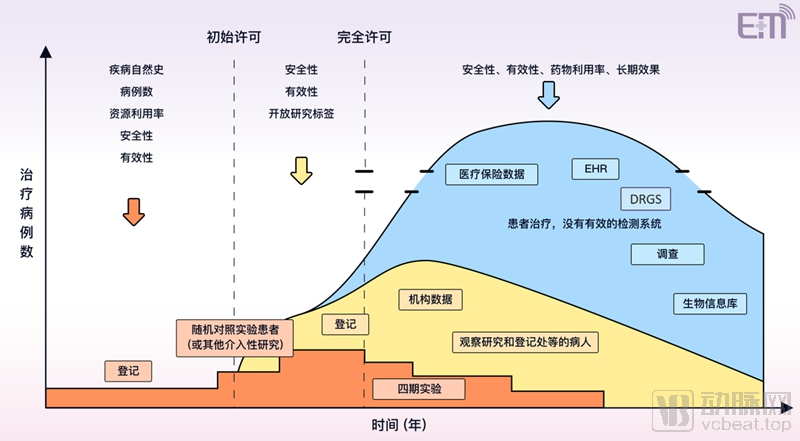
Integrating Real-World Studies into Specific Stages of Drug Development
The fundamental characteristics of real-world studies determine their unique role in post-marketing drug research.
Post-marketing clinical studies of pharmaceuticals involve long-term follow-up and efficacy monitoring, generating substantial amounts of data. Comprehensive analysis of such data is challenging using conventional clinical trial methods, and the increased volume of data collection leads to a rapid rise in clinical trial costs.
Artificial intelligence technologies employed in real-world studies possess inherent advantages in processing large-sample datasets. Meanwhile, the data collection methods used in real-world studies are more akin to those of retrospective cohorts, helping pharmaceutical companies control costs.
Currently, the scope of real-world studies (RWS) is expanding rapidly, gradually extending from post-marketing research to earlier stages. “In our previous understanding, RWS was more closely associated with Phase IV post-marketing surveillance (PMS). However, among the new clients we have recently engaged, we are clearly observing certain trends. Many new drugs entering the Chinese market from abroad need to conduct research on the corresponding disease spectrum and clinical pathways in China prior to launch, in order to determine their subsequent market strategies. On the other hand, we are also seeing that more pharmaceutical products are seeking to establish their true clinical value within broader real-world settings during Phase III clinical trials,” said Hu Qitong.
From preclinical studies on the natural history of diseases, to open-label trials in pre-market clinical development, and post-marketing studies on drug utilization and long-term effectiveness, real-world studies now cover the entire lifecycle of drug development.
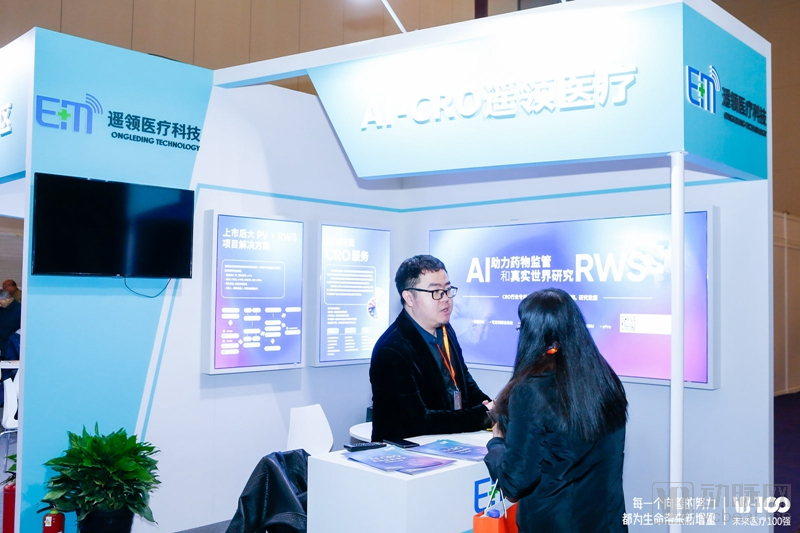
Future Healthcare Top 100 Exhibition - LONGLEDING TECHNOLOGY Booth
“Most of the founding team at LONGLEDING TECHNOLOGY come from a clinical research background. I am somewhat different; my background is in artificial intelligence, with a specialization in NLP, or Natural Language Processing.” Hu Qitong’s expression reflects the logical rigor characteristic of technical professionals. As the CTO of LONGLEDING TECHNOLOGY, he defines the company’s technological core.
Despite its strong technical capabilities, LONGLEDING TECHNOLOGY is not merely a technology company; it primarily engages with the healthcare industry as a CRO, leveraging AI and other advanced technologies to help pharmaceutical companies conduct clinical research more effectively.
LONGLEDING TECHNOLOGY has established a comprehensive suite of solutions encompassing all aspects of full-lifecycle pharmaceutical management. For new drugs, particularly innovative therapies, its service scope covers the entire spectrum from initial study design and protocol execution to data statistical analysis, report writing, and manuscript submission, as well as certain government relations maintenance activities.
Hu Qitong believes that when artificial intelligence enters clinical trials, it is essential to first clarify the target users: “Hospitals, physicians, and pharmaceutical companies all have different needs for AI, and currently, there is no one-size-fits-all solution. Based on its positioning, LONGLEDING TECHNOLOGY primarily engages with personnel involved in clinical trial operations, such as Clinical Research Coordinators (CRCs), Clinical Research Associates (CRAs), Project Managers (PMs), and Data Managers (DMs). Therefore, LONGLEDING’s work focuses more on enhancing the efficiency of these professionals by providing intelligent assistance or automation tailored to their workflow habits. As a result, our approach is more focused and better aligned with the needs of clinical trials.”
In real-world studies, the industry’s focus has centered on data structuring. Much of this structuring relies on keyword matching, an approach that struggles to handle Chinese, particularly clinical descriptions in Traditional Chinese Medicine (TCM). Compared with English, Chinese text is more loosely structured, making it difficult to ultimately present in a structured format.
This is precisely where LONGLEDING TECHNOLOGY holds its advantage. The technical team led by Hu Qitong is leveraging state-of-the-art Natural Language Processing (NLP) technologies to address this challenge, thereby enhancing their understanding of medical cases. NLP has made significant strides in the past two years, particularly since the introduction of the BERT model in 2018. Innovations such as Huawei’s Nezha system, developed based on BERT, have greatly advanced Chinese natural language processing. By harnessing these cutting-edge technologies, LONGLEDING TECHNOLOGY has established specialized language models within the healthcare sector to facilitate a deeper comprehension of medical records.
Electronic medical record (EMR) systems represent one of the most significant challenges in data structuring and are also a key factor underpinning LONGLEDING’s strategic position. While most big data companies focus primarily on converting unstructured data into relatively structured electronic medical records, LONGLEDING has taken this process a step further. By leveraging Machine Reading Comprehension (MRC) technology, LONGLEDING enables artificial intelligence to thoroughly comprehend relevant content within patient cases, extract pertinent information, and populate it into the corresponding data fields.
Over the past two years, LONGLEDING TECHNOLOGY has continuously accumulated its knowledge graph and established comprehensive data standards. These efforts are facilitating improved performance in medical coding. Coupled with the introduction of advanced technologies, Hu Qitong believes that the challenges associated with data structuring are becoming increasingly manageable for the company.
Real-world studies related to traditional Chinese medicine are a featured component of LONGLEDING’s services.
For traditional Chinese medicine (TCM), most products have been on the market for an extended period. Therefore, pharmaceutical companies’ demand for real-world studies (RWS) is primarily driven by the desire to supplement their drugs with additional robust evidence of efficacy, thereby further demonstrating their therapeutic effectiveness to external stakeholders.
There are many challenges in conducting clinical research on traditional Chinese medicine (TCM). Most TCM products with research needs have been on the market for many years, involving massive amounts of data in their studies. Meanwhile, TCM tends to take effect relatively slowly, making it difficult to quickly assess improvements in patients' conditions through hospital-based indicator testing. Instead, greater attention must be paid to patients' subjective experiences and long-term follow-up outcomes. These characteristics—large data volume and extended study duration—are highly suitable for real-world studies.
Many traditional Chinese medicines (TCMs) are already seeking new directions through real-world studies. For instance, Dong-E E-Jiao and Taiji Huoxiang Zhengqi Oral Liquid have both established large-scale real-world study cohorts in China. Although these products have been used for decades or even centuries, the leaders of these companies demonstrate a more forward-looking vision and a more rigorous approach, using data to verify which patient populations truly benefit from their medications, rather than relying solely on word-of-mouth reputation.
“On the other hand, traditional Chinese medicine (TCM) enterprises should not be overly hasty. Although there is a wealth of existing retrospective data available on the market, these data were not collected in accordance with the requirements of clinical studies, and thus may fall far short of the needs of real-world studies. Moreover, much of the existing data features non-standardized terminology and diagnostic criteria, which can significantly impact data processing,” said Hu Qitong.
LONGLEDING adopts more customized strategies for real-world studies related to traditional Chinese medicine (TCM) to better synergize with TCM and Traditional Chinese Medicine practices. Based on client needs, LONGLEDING develops a relatively standardized Case Report Form (CRF) specifically tailored for TCM real-world research, integrating TCM knowledge.
Structuring data related to traditional Chinese medicine (TCM) is more challenging than for Western medicine. As a leader in real-world studies of TCM, LONGLEDING TECHNOLOGY is also striving to promote higher standardization within the industry.
LONGLEDING TECHNOLOGY is collaborating with relevant committees on real-world studies (RWS) of Traditional Chinese Medicine (TCM) to explore standardized methodologies for TCM RWS. “In terms of IT technology, we find the content of TCM more challenging. From the perspective of Named Entity Recognition (NER), Western medicine indicators are relatively easier to identify. How artificial intelligence can understand the expressive content of TCM also poses a challenge for us. Therefore, TCM RWS resembles the domain of reinforcement learning, where continuous rewards are obtained during the research process to ensure the maximization of cumulative rewards at the endpoint,” said Hu Qitong.