

BMS Submits sBLA for Opdivo Plus Yervoy as First-Line Immune Therapy in NSCLC, Demonstrating Significant Overall Survival Benefit
Jan 16, 2020 10:55
CST Updated
10:31
Bristol-Myers Squibb
Biopharmaceutical and Nutritional Product R&D and Sales
FDA
U.S. Food and Drug Administration

January 16, 2020 /BioValleyBIOON/ -- Bristol-Myers Squibb (BMS) recently announced that the U.S. Food and Drug Administration (FDA) has accepted a supplemental Biologics License Application (sBLA) submitted and granted Priority Review, with the Prescription Drug User Fee Act (PDUFA) date set for May 15, 2020. This sBLA seeks approval for the combination therapy of Opdivo (nivolumab) and Yervoy (ipilimumab) as a first-line treatment for patients without EGFR or ALK genomicTumorPatients with metastatic or recurrent non-small cell lung cancer (NSCLC) harboring alterations.
Clinical data show that, in previously untreated NSCLC patients, the dual immunotherapy regimen of Opdivo combined with low-dose Yervoy significantly prolonged overall survival (OS) compared with chemotherapy. In October 2019, BMS also announced the results of the pivotal Phase III CheckMate -9LA trial evaluating Opdivo plus low-dose Yervoy plus chemotherapy as first-line treatment for advanced NSCLC, regardless of PD-L1 expression and histology. The results demonstrated that the study had met its primary endpoint of overall survival (OS) in a prespecified interim analysis, with comprehensive assessment data to be presented at future medicalMeetingpublished above.
This application is primarily based on the results from Part 1 of the Phase III CheckMate-227 trial evaluating Opdivo as first-line treatment for NSCLC. This was a global, multi-part, open-label, randomized trial conducted in patients with Stage IV or recurrent NSCLC who had not previously received chemotherapy (chemotherapy-naïve). The study comprised two parts: (1) Part 1: Cohort 1a compared Opdivo plus low-dose Yervoy, Opdivo monotherapy, and chemotherapy in patients with PD-L1–expressing tumors; Cohort 1b compared Opdivo plus low-dose Yervoy, Opdivo plus chemotherapy, and chemotherapyTumorPatients not expressing PD-L1; (2) Part 2: Comparison of Opdivo combined with chemotherapy versus chemotherapy alone, regardless of PD-L1 expression.
Results announced in late September 2019 showed that the first part of the study met the co-primary endpoint of overall survival (OS): in patients with previously untreated non-small cell lung cancer (NSCLC) whose tumors expressed PD-L1 ≥1%, the combination regimen of Opdivo plus low-dose Yervoy demonstrated superiority in OS compared with chemotherapy (HR=0.72, 97.72% CI: 0.65–0.96). Furthermore, exploratory analyses indicated thatTumorIn NSCLC patients with PD-L1 expression <1%, the Opdivo plus low-dose Yervoy combination regimen also improved OS (HR=0.62, 95% CI: 0.48–0.78). Among patients treated with the Opdivo plus low-dose Yervoy combination regimen, the 2-year survival rate was 40% in both the PD-L1 ≥1% and PD-L1 <1% subgroups. In the chemotherapy control group, the 2-year survival rates were 33% and 23% for patients with PD-L1 ≥1% and PD-L1 <1%, respectively.
These results represent the first instance of dual immunotherapyTumorImmuno-oncology (I-O) therapy as first-line treatment for NSCLC demonstrates superior efficacy over chemotherapy in terms of overall survival (OS). The safety profile of the Opdivo plus low-dose Yervoy combination regimen is consistent with previous NSCLC studies, with no new safety signals observed.
With a minimum follow-up of 29.3 months, the duration of response (DoR) for patients treated with Opdivo plus low-dose Yervoy was nearly four times longer than that for patients receiving chemotherapy, regardless of PD-L1 expression levels. In patients with PD-L1 ≥1%, the objective response rate (ORR) was 35.9% (95% CI: 31.1–40.8) in the Opdivo plus low-dose Yervoy group (complete response rate [CR]: 5.8%), compared with 30.0% (95% CI: 25.5–34.7) in the chemotherapy group (CR: 1.8%); the median DoR was 23.2 months in the combination therapy group versus 6.2 months in the chemotherapy group. In patients with PD-L1 <1%, the ORR was 27.3% (95% CI: 30.7–45.4) in the Opdivo plus low-dose Yervoy group (CR: 2.1%), compared with 23.1% (95% CI: 17.3–29.8) in the chemotherapy group (CR: 1.1%); the median DoR was 18 months in the combination therapy group versus 4.8 months in the chemotherapy group.
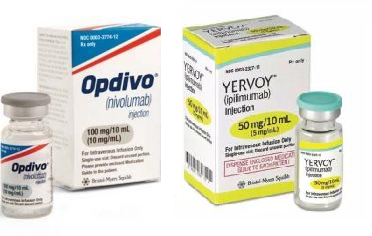
Opdivo and Yervoy are both cancer immunotherapies (I-O) that leverage the body’s own immune system to fight by targeting different regulatory components of the immune system.Tumor, in which Opdivo targets and blocks the PD-1/PD-L1 pathway, while Yervoy targets and blocks CTLA-4.
To date, the Opdivo + Yervoy immunotherapy combination has been approved for: (1) the treatment of unresectable or metastaticMelanoma; (2) patients with intermediate- or high-risk advanced renal cell carcinoma (RCC) in the first-line setting; (3) pediatric patients aged 12 years and older and adult patients with microsatellite instability-high (MSI-H) or mismatch repair-deficient (dMMR) metastatic colorectal cancer (mCRC).
Currently, the supplemental application for Opdivo + Yervoy immunotherapy combination (OY) as second-line treatment for advanced hepatocellular carcinoma (HCC) is under review by the U.S.FDApriority review, with a PDUFA target date of March 10, 2020. The application is based on data from the ongoing Phase I/II CheckMate-040 study OY cohort, which is evaluating the OY combination in patients with advanced hepatocellular carcinoma (HCC) who have previously been treated with sorafenib. The data were presented at the 2019 American Society of Clinical OncologyTumorpresented at the American Society of Clinical Oncology (ASCO) Annual Meeting. The results showed that with a minimum follow-up of 28 months, the objective response rate (ORR) for the OY combination was 31%, and the median duration of response (DoR) was 17.5 months.
Opdivo was first approved in Japan in July 2014, becoming the world’s first approved PD-1 immunotherapy. By harnessing the human body’sAutoimmunitySystemic Cancer Therapy: Opdivo Has Become an Important Treatment Option for Various Cancers. (Bioon.com)