

Astellas' Second-Generation FLT3 Inhibitor Xospata Approved in Canada for Relapsed/Refractory FLT3-Mutated AML
Jan 16, 2020 10:29
CST Updated
10:29

Astellas
Pharmaceutical R&D Manufacturer

Health Canada
Health Canada

January 16, 2020 News /BioonBIOON/ -- Japanese pharmaceutical company Astellas recently announced that Health Canada has approved the targeted anticancer drug Xospata (gilteritinib). This once-daily oral medication is approved as a monotherapy for the treatment of relapsed (disease recurrence) or refractory (drug-refractory) acute myeloid leukemia harboring FLT3 mutations (FLT3mut+).Leukemia(AML) adult patients. Xospata has the potential to improve outcomes in AML patients harboring the two most common types of mutations—FLT3 internal tandem duplication (ITD) in the juxtamembrane domain and FLT3 tyrosine kinase domain (TKD) mutations.
Notably, Xospata is the first and only targeted therapy approved by Health Canada for patients with relapsed or refractory acute myeloid leukemia (AML) harboring FLT3 mutations. The approval of Xospata also marks Astellas’ entry into the field of hematologic cancer treatment in Canada.
Dr. Andre Schuh, a hematologist and clinical researcher at the Princess Margaret Cancer Centre in Toronto, Canada, stated, “AML is a life-threatening cancer with an overall five-year survival rate of only about 20% in Canada. Retreatment of relapsed AML is particularly challenging, especially in cases with FLT3 mutations. The approval of Xospata represents one of the few advances in AML treatment over the past 40 years, offering a new option for patients with FLT3 mutations that may lead to disease remission and significantly prolonged survival.”
Acute myeloid leukemia (AML) is a cancer that affects the blood and bone marrow, and it progresses rapidly if left untreated. Treatment options are very limited once patients experience relapse or become refractory to medication. The incidence of AML increases with age; in 2016, the most recent year for which data are available, the median age at diagnosis was 68.5 years. AML is associated with various genetic mutations, and FLT3 mutations are detectable in approximately 30% of patients. However, the FLT3 mutation status in AML patients may change during the course of treatment, even after relapse. Given the poor prognosis associated with FLT3-mutated AML, determining the patient’s mutation status is essential to help identify the optimal treatment approach.
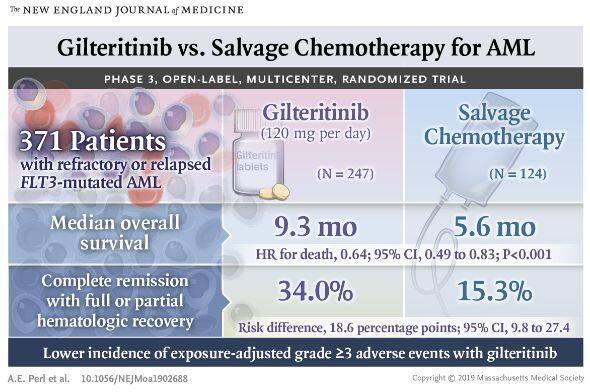
This approval is based on the results of the Phase III ADMIRAL trial, which evaluated the efficacy and safety of Xospata versus salvage chemotherapy in patients with relapsed or refractory FLT3-mutated acute myeloid leukemia (FLT3mut+ AML). The results demonstrated that, compared with the salvage chemotherapy group, patients treated with Xospata had a significantly prolonged overall survival (OS) (median OS: 9.3 months vs. 5.6 months; HR=0.64 [95% CI: 0.49–0.83]; p=0.0004), a doubled one-year survival rate (37% vs. 17%), and a doubled complete remission rate with full or partial hematologic recovery (34.0% vs. 15.3%). Regarding safety, the most common Grade ≥3 adverse event in the Xospata treatment group was febrile neutropenia (45.9%).Anemia(40.7%), thrombocytopenia (22.8%).
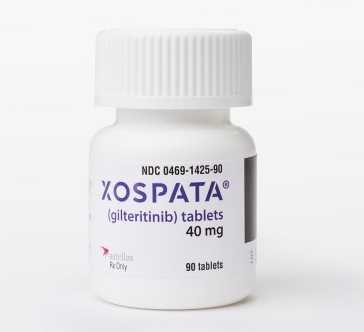
Xospata is a second-generation FLT3 inhibitor that inhibits two distinct types of mutations: internal tandem duplications (ITD) in the FLT3 juxtamembrane domain and mutations in the FLT3 tyrosine kinase domain (TKD). FLT3-ITD mutations affect approximately 30% of patients with acute myeloid leukemia (AML) and are associated with poorer disease-free survival and overall survival. FLT3-TKD mutations affect approximately 7% of AML patients. Although the clinical impact of these mutations is not fully understood, they are associated with treatment resistance.
Xospata was discovered through a research collaboration with Kotobuki Pharmaceutical Co., Ltd. Astellas holds exclusive global rights for the development, manufacturing, and potential commercialization of Xospata. Xospata has been granted orphan drug designation in the United States, Japan, and the European Union; it has also received Fast Track designation in the United States and SAKIGAKE designation in Japan.
In October 2018, Xospata was first approved in Japan for the treatment of adult patients with relapsed or refractory acute myeloid leukemia (AML) harboring FLT3 mutations. In late November 2018, Xospata received approval from the U.S. FDA, becoming the first FLT3-targeted therapy for patients with relapsed or refractory AML, marking Astellas’ entry into the field of hematologic cancer treatment in the United States. In May 2019,FDAApproved a supplemental new drug application (sNDA) for Xospata, updating the US product label to include final overall survival (OS) data from the Phase III ADMIRAL trial. In the European Union, Xospata was approved in October 2019 as monotherapy for adult patients with relapsed or refractory acute myeloid leukemia (AML) harboring FLT3 mutations (FLT3mut+).
FLT3 Inhibitors,NovartisThe targeted anticancer drug Rydapt (midostaurin) was approved in April 2017FDAApproved for the treatment of adult patients with newly diagnosed FLT3 mutation-positive AML, becoming the world’s first targeted therapy for first-line treatment of FLT3 mutation-positive AML.
In June 2019, Daiichi Sankyo’s targeted anticancer drug Vanflyta (quizartinib, a second-generation FLT3 inhibitor) was approved in Japan for the treatment of adult patients with relapsed or refractory FLT3-ITD acute myeloid leukemia (AML). However, Vanflyta was denied approval in both the United States and the European Union. In the pivotal Phase III QuANTUM-R clinical trial, oral monotherapy with quizartinib significantly reduced the risk of death by 24% compared with salvage chemotherapy (HR=0.76, p=0.0177, 95% CI: 0.58–0.98) and significantly prolonged overall survival (median OS: 6.2 months [two-sided 95% CI: 5.3–7.2] vs. 4.7 months [two-sided 95% CI: 4.0–5.5]). The estimated one-year survival rate was 27% in the quizartinib group versus 20% in the salvage chemotherapy group. (Bioon.com)