

Janssen Submits Applications in U.S. and Europe to Expand SPRAVATO® (esketamine) Nasal Spray Use for Rapid Reduction of Depressive Symptoms in Adults with Major Depressive Disorder and Acute Suicidal Ideation
Jan 17, 2020 10:24
CST Updated
10:24

Johnson & Johnson
Healthcare Product Manufacturers, Health Service Providers

Janssen Pharmaceuticals
Pharmaceutical R&D Developer

European Medicines Agency
The European Medicines Agency (EMA) is a decentralized agency of the European Union (EU), located in London. It began operations in 1995. The agency is responsible for the scientific evaluation, supervision, and safety monitoring of medicines developed by pharmaceutical companies for use in the EU. By ensuring that all medicines available on the EU market are safe, effective, and of high quality, the EMA protects public and animal health in the 28 EU Member States and countries of the European Economic Area.

January 17, 2020 /BioonBIOON/ -- Janssen Pharmaceuticals, a subsidiary of Johnson & Johnson, recently announced that it has submitted to the European Medicines Agency (EMA)DepressionClass II Variation Application for the New Drug Spravato (esketamine) Nasal Spray. This application aims to expand the use of Spravato beyond its current indications, as an acute short-term treatment medication, in combination with oral antidepressants, for patients experiencing moderate to severeDepressionSevere episodes with suicidal ideationDepression(MDD) Adult Patients, Rapid ReductionDepressionstatus. If approved, Spravato would become the first drug for patients with severe illness who are typically excluded from antidepressant treatment studies. In the United States, Janssen Pharmaceuticals submitted an application in October 2019 toFDAA supplemental New Drug Application (sNDA) was submitted to seek approval of Spravato for the same indications mentioned above.
Spravato is the first antidepressant with a novel mechanism of action to be approved in over 30 years. In the United States and the European Union, Spravato was approved in March 2019 and December 2019, respectively, in combination with an oral antidepressant, for the treatment of adult patients with treatment-resistant depression (TRD).
Patients with major depressive disorder (MDD) assessed as having an imminent risk of suicide constitute a psychiatric emergency requiring immediate intervention. Although currently available antidepressants are effective in treating depression, they typically require several weeks (4–6 weeks) to achieve their full therapeutic effect. This delay poses potential dangers, particularly because the risk of suicide is highest during the early stages of treatment. Compared with standard oral medications, Spravato offers the advantage of rapid onset of action through intranasal administration.
This Class II variation application is based on the positive results from two pivotal Phase III clinical studies (ASPIRE I & II). Both studies were double-blind, randomized, placebo-controlled, multicenter trials that enrolled a total of 456 adult patients with moderate-to-severe major depressive disorder (MDD), among whom over 85% were assessed by clinicians as having moderate to extreme suicidal ideation. In these studies, all patients received comprehensive standard of care (SOC), including initial hospitalization and newly initiated and/or optimized antidepressant treatment regimens. Patients were randomized to receive either Spravato plus SOC or placebo plus SOC. The primary efficacy endpoint was the reduction in depressive symptoms 24 hours after the first dose, as measured by the Montgomery-Åsberg Depression Rating Scale (MADRS). The secondary endpoint was the improvement in suicide severity 24 hours after the first dose, as measured by the Clinician Global Impression of Severity of Suicide – Revised (CGI-SS-R).
Notably, ASPIRE I & II were the first global clinical studies conducted in patients with this severe condition, a population typically excluded from antidepressant treatment trials. The results of both studies were presented in September 2019 at the 32nd Annual Congress of the European College of Neuropsychopharmacology (ECNP), held in Copenhagen, Denmark.The results showed that Spravato nasal spray, when combined with comprehensive standard of care (SOC), rapidly reduced depressive symptoms in this high-risk patient population compared to placebo.
The specific results were as follows: Both studies met their respective primary efficacy endpoints—compared with the placebo + SOC treatment group, the Spravato 84 mg intranasal spray + SOC treatment group demonstrated a statistically significant advantage in rapidly reducing depressive symptoms of MDD (p=0.006).
Data on the reduction of depressive symptoms:In the two studies, MADRS assessments conducted 24 hours after the initial dose showed mean differences of 3.8 and 3.9 points, respectively, between the Spravato + SOC treatment group and the placebo + SOC treatment group. Furthermore, Spravato + SOC demonstrated significant efficacy in alleviating MDD symptoms as early as 4 hours post-initial dose. From 4 hours to Day 25, both the Spravato and placebo groups continued to show improvement, with the magnitude of difference between the two groups remaining largely stable throughout the 25-day double-blind period. At the end of the double-blind phase, remission rates (defined as a MADRS score ≤12) in the Spravato treatment groups were 54% and 47%, respectively, across the two studies. The clinical improvements observed in both treatment groups during the double-blind period were maintained during the subsequent 9-week follow-up period.
Secondary endpoint: Improvement in suicide severity:There was no statistically significant difference in treatment outcomes between the two groups, which may be due toClinical TrialThe substantial benefits of the comprehensive SOC used, including the dispersive effect of inpatient treatment for hospitalized psychiatric patients on acute suicidal crises in both treatment groups.
In both studies, the Spravato + SOC regimen was well tolerated, with no new safety signals identified. The safety profile observed in the treatment of patients with major depressive disorder (MDD) and intense suicidal ideation across the two studies was consistent and aligned with previous clinical studies evaluating Spravato for treatment-resistant depression (TRD). In the Spravato + SOC treatment group, the most commonAdverse Reactions(>10%) were dizziness, dissociation, nausea, somnolence, blurred vision, vomiting, paresthesia, increased blood pressure, and sedation, with an incidence more than twice that of the placebo + SOC group.
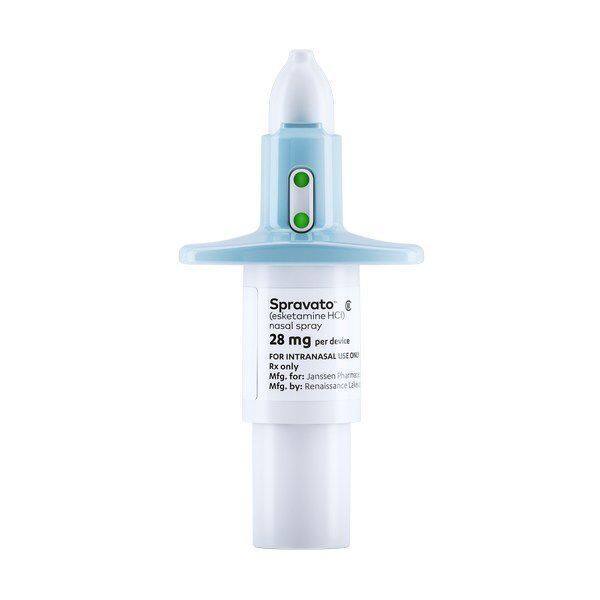
Globally, major depressive disorder (MDD) is the leading cause of disability and can affect individuals across all age groups. Patients with depression, including MDD, endure significant disease burden that substantially impairs physical functioning and all aspects of daily life. Although currently available antidepressants are effective for many patients, they typically require 4 to 6 weeks to take effect, and approximately one-third of patients do not respond to existing treatments.
The active pharmaceutical ingredient in Spravato is esketamine, a non-competitive, subunit-nonselective, activity-dependent N-methyl-D-aspartate (NMDA) receptor antagonist with a novel and unique mechanism of action that differs from other currently available antidepressant medications. NMDA receptors are a subtype of ionotropic glutamate receptors and play a critical role in synaptic plasticity and neuronal communication. In depression, blockade of NMDA receptors is believed to enhance brain plasticity and strengthen synaptic connections.
In the United States, Spravato was approved in March 2019 for use in combination with an oral antidepressant for the treatment of adult patients with treatment-resistant depression (TRD). Previously,FDASpravato has been granted Breakthrough Therapy designation for the treatment of patients with TRD and for the treatment of patients with MDD accompanied by imminent suicide risk.
In the European Union, Spravato was approved in December 2019 for the following indication: in combination with a selective serotonin reuptake inhibitor (SSRI) or a serotonin-norepinephrine reuptake inhibitor (SNRI), for the treatment of adult patients with treatment-resistant depression (TRD). According to the approval, TRD is defined as a lack of response to at least two different antidepressant treatments during the current moderate to severe depressive episode. This European Commission approval is valid in all 28 EU Member States and the countries of the European Economic Area (EEA) (Norway, Iceland, and Liechtenstein). (Bioon.com)