

BMS and Acceleron's First-in-Class Erythroid Maturation Agent Reblozyl Receives Third Orphan Drug Designation from FDA for Myelofibrosis
Jan 18, 2020 16:17
CST Updated
16:17

Bristol-Myers Squibb
Biopharmaceutical and Nutritional Product R&D and Sales

Acceleron Pharma
Developer and Producer of Novel Biologic Therapeutics

FDA
U.S. Food and Drug Administration

January 18, 2020 /BioValleyBIOON/ -- Reblozyl (luspatercept), an erythroid maturation agent co-developed by Bristol-Myers Squibb (BMS) and Acceleron Pharma, Inc., was recently granted orphan drug designation (ODD) by the U.S. Food and Drug Administration (FDA) for the treatment of myelofibrosis. Notably, this marks the third ODD awarded by the FDA for this drug. Previously,FDALuspatercept Granted for the Treatment of β-ThalassemiaAnemiaand Orphan Drug Designation (ODD) for myelodysplastic syndromes (MDS).
Orphan Drug refers to drugs used for the prevention, treatment,DiagnosisOrphan drugs, while rare diseases are a collective term for conditions with extremely low prevalence, also known as “orphan diseases.” In the United States, rare diseases refer to those affecting fewer than 200,000 individuals. Incentives for orphan drug development include various clinical development incentives, such as tax credits related to clinical trial costs,FDAUser fee waiver,Clinical TrialIn DesignFDAassistance, as well as a 7-year market exclusivity period for the approved indications after the drug is launched.

Reblozyl is an erythroid maturation agent that was approved in the United States in November 2019FDAApproved for the treatment of anemia in adult patients with beta-thalassemia who require regular red blood cell transfusions.
Notably, Reblozyl is the firstFDAApproved for the treatment of anemia associated with beta-thalassemia, it is also the first erythroid maturation agent approved by the FDA, representing a novel class of therapies that help patients reduce their red blood cell transfusion burden by regulating the late stages of erythroid maturation. It should be noted that Reblozyl is not indicated as a substitute for red blood cell transfusions in patients requiring immediate correction of anemia.
Currently, the Biologics License Application (BLA) for Reblozyl in the treatment of MDS-associated anemia is under reviewFDAFollowing review, the BLA seeks approval of Reblozyl for the treatment of anemia in adult patients with very low- to intermediate-risk MDS who have ring sideroblasts (RS+) on bone marrow smear and require regular red blood cell (RBC) transfusions. The Prescription Drug User Fee Act (PDUFA) target date is April 4, 2020. In Europe, the Marketing Authorization Application (MAA) for Reblozyl for the treatment of anemia in adults with β-thalassemia and MDS is under review by the European Medicines Agency (EMA).
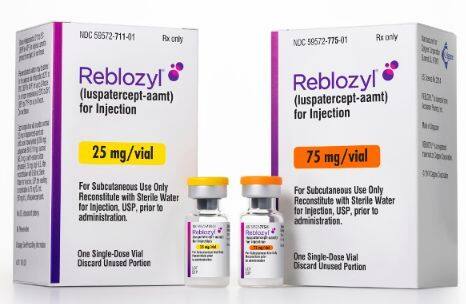
The active pharmaceutical ingredient of Reblozyl is luspatercept, a first-in-class erythroid maturation agent (EMA) that modulates late-stage erythroid maturation.
This drug is a soluble fusion protein composed of the Fc domain of human IgG1 fused to the extracellular domain of the activin receptor type IIB (ActRIIB). Acting as a ligand trap, it targets and binds specific ligands of the transforming growth factor (TGF)-β superfamily that regulate late-stage erythrocyte maturation, thereby reducing activation of the Smad2/3 signaling pathway, ameliorating ineffective erythropoiesis, promoting the maturation of late-stage erythroid cells, and increasing hemoglobin levels.
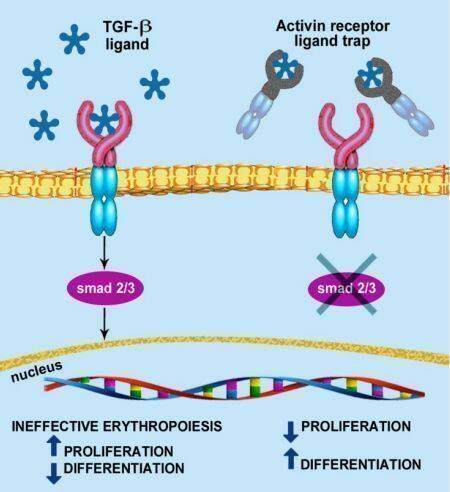
Mechanism of Action of Luspatercept
Luspatercept is being developed globally through a collaboration between Celgene (acquired by BMS) and Acceleron Pharma. Currently, both parties are also evaluating the potential of luspatercept for the treatment of erythropoiesis-stimulating agent (ESA)-naïve, lower-risk MDS patients (Phase III COMMANDS study), non-transfusion-dependent β-thalassemia (Phase II BEYOND study), and myelofibrosis. The industry holds strong optimism regarding the commercial prospects of luspatercept. Late last year, EvaluatePharma released its report “Vantage 2019 Preview,” which highlighted the top 20 most valuable R&D projects worldwide, with luspatercept ranking 18th with a net present value (NPV) of $3.1 billion.
Previously, analysts at the prominent Wall Street investment bank Jefferies pointed out that if anemia associated with myelodysplastic syndromes (MDS) also receivesFDAApproved, Reblozyl's annual peak sales are projected to reach $2 billion. (Bioon.com)
Reference Source: United StatesFDAOrphan Drug Public Database, Bristol-Myers Squibb