

Janssen Submits Application to EMA for Imbruvica (Ibrutinib) Plus Rituximab as First-Line Treatment for Chronic Lymphocytic Leukemia
Jan 21, 2020 14:48
CST Updated
14:48

Johnson & Johnson
Healthcare Product Manufacturers, Health Service Providers

Janssen Pharmaceuticals
Pharmaceutical R&D Developer

European Medicines Agency
The European Medicines Agency (EMA) is a decentralized agency of the European Union (EU), located in London. It began operations in 1995. The agency is responsible for the scientific evaluation, supervision, and safety monitoring of medicines developed by pharmaceutical companies for use in the EU. By ensuring that all medicines available on the EU market are safe, effective, and of high quality, the EMA protects public and animal health in the 28 EU Member States and countries of the European Economic Area.

January 21, 2020 /BioonBIOON/ -- Janssen Pharmaceuticals, a subsidiary of Johnson & Johnson (JNJ), recently announced that it has submitted a Class II variation application to the European Medicines Agency (EMA), seeking to expand the label for Imbruvica (ibrutinib) to include: the combination regimen of Imbruvica with rituximab (IR) as first-line treatment for chronic lymphocyticLeukemia(CLL) patients.
In the United States, AbbVie submitted a supplemental new drug application (sNDA) to the U.S. Food and Drug Administration (FDA) in November 2019, seeking approval for the IR regimen as first-line treatment for chronic lymphocytic leukemia (CLL) or small lymphocytic lymphoma (SLL) in younger patients (≤70 years). Currently, the sNDA is underFDAreal-timeTumorreviewed under the Real-Time Oncology Review pilot program, which allows the FDA to review data before the applicant formally submits the application. The purpose of the program is to explore a more efficient review process to ensure that patients can access safe and effective therapeutic drugs as soon as possible, while maintaining the quality of the review. If approved, this milestone will markFDAThe 11th approval of Imbruvica across six different disease areas.
Imbruvica is a first-in-class, once-daily oral Bruton’s tyrosine kinase (BTK) inhibitor, jointly developed and commercialized by Pharmacyclics, an AbbVie company, and Janssen Biotech, Inc., a Johnson & Johnson company.
In the United States and the European Union, both the sNDA and the Class II variation application are based on the results of the Phase III E1912 study (NCT02048813). This study evaluated a total of 529 patients with chronic lymphocytic leukemia (CLL) who were aged ≤70 years and previously untreated. In the study, these patients were randomly assigned to receive either Imbruvica plus rituximab (n=354) or chemoimmunotherapy with FCR (fludarabine, cyclophosphamide, and rituximab; n=175). The primary endpoint was progression-free survival (PFS), and the secondary endpoint was overall survival (OS).
The primary results of this study were published in The New England Journal of Medicine (NEJM). The results demonstrated that, compared with the FCR treatment group, the Imbruvica plus rituximab treatment group showed significantly improved progression-free survival (PFS) and overall survival (OS). The safety data from the study were consistent with the known safety profile of Imbruvica.
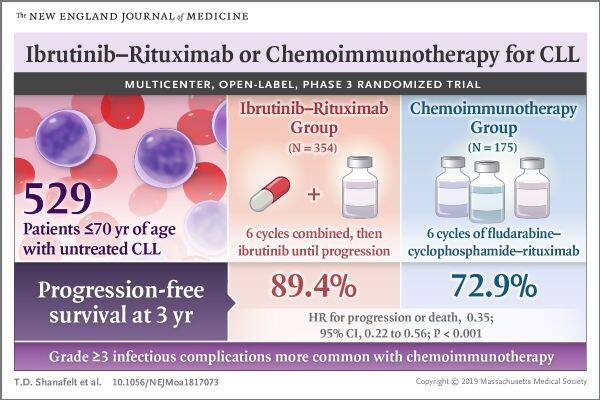
The four-year follow-up results of this study were presented at the 2019 American Society of Hematology (ASH) Annual Meeting. With a median follow-up of 48 months, 73% of patients in the IR regimen group were still receiving Imbruvica treatment, with a median treatment duration of 43 months (range: 0.2–61 months). The median time to disease progression or death after discontinuation of Imbruvica was 23 months.
Compared with the FCR regimen group, the IR regimen group demonstrated a sustained and superior PFS benefit (HR=0.39 [95% CI: 0.26–0.57], p<0.0001). Furthermore, compared with the FCR regimen group, the IR regimen group demonstrated a sustained and superior OS benefit (HR=0.34; 95% CI: 0.15–0.79; p=0.009).
Regarding safety, the proportions of patients experiencing grade 3 or higher treatment-emergent adverse events (TEAEs) in the IR regimen group and the FCR regimen group were 70% and 80%, respectively (odds ratio [OR]=0.56; 95% CI: 0.34-0.90; p=0.013).
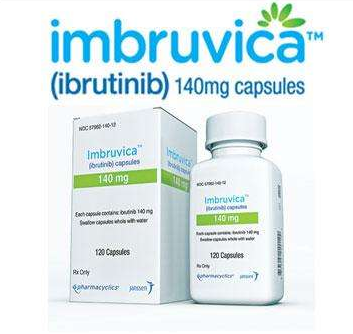
Imbruvica is a small-molecule drug administered orally once daily, which exerts its anticancer effects primarily by inhibiting Bruton’s tyrosine kinase (BTK), an enzyme essential for the proliferation and metastasis of cancer cells. BTK is a key signaling molecule within the B-cell receptor signaling complex and plays a critical role in the survival and metastasis of malignant B cells, as well as in various other severe debilitating diseases.
Imbruvica blocks the signaling pathways that mediate the uncontrolled proliferation and dissemination of B cells, helping to kill cancer cells and reduce their numbers, thereby delaying cancer progression. InClinical Trials, monotherapy and combination therapies targeting a broad spectrum of hematologic malignanciesTumorDemonstrated robust efficacy.
Since its market launch in 2013, Imbruvica has obtained 10 approvals across a total of six indications, including five B-cell hematologic malignancies and chronic graft-versus-host disease (cGVHD).FDAApproved: Chronic lymphocytic leukemia (CLL) with or without 17p deletion mutation (del17p), small lymphocytic lymphoma (SLL) with or without 17p deletion mutation (del17p), Waldenström macroglobulinemia (WM), previously treated mantle cell lymphoma (MCL), marginal zone lymphoma (MZL) requiring systemic therapy and having received at least one prior anti-CD20 therapy, and chronic graft-versus-host disease (cGVHD) refractory to one or more systemic therapies.
Currently, AbbVie and Johnson & Johnson are advancing a large-scale Imbruvica clinicalTumorDevelopment Projects. The industry holds a very optimistic view of the commercial prospects for Imbruvica. In June 2019, the pharmaceutical market research firm EvaluatePharma released a report stating that Imbruvica’s global sales reached $4.454 billion in 2018, and with continuous market penetration and an expanding range of indications, global sales are projected to reach $9.514 billion by 2024. Recently, an article published in the prestigious international journal Nature predicted that Imbruvica’s sales would reach $6.818 billion in 2020, making it the eighth best-selling drug worldwide! (Bioon.com)