


On January 29, Novartis announced its 2019 financial results, reporting total annual revenue of $47.445 billion, a 6% year-on-year increase. This performance was achieved after Novartis formally completed the spin-off of its eye care business unit, Alcon, in 2019. The results included $37.7 billion in revenue from Innovative Medicines (+8%) and $9.7 billion from the Sandoz generics business unit (-1%).
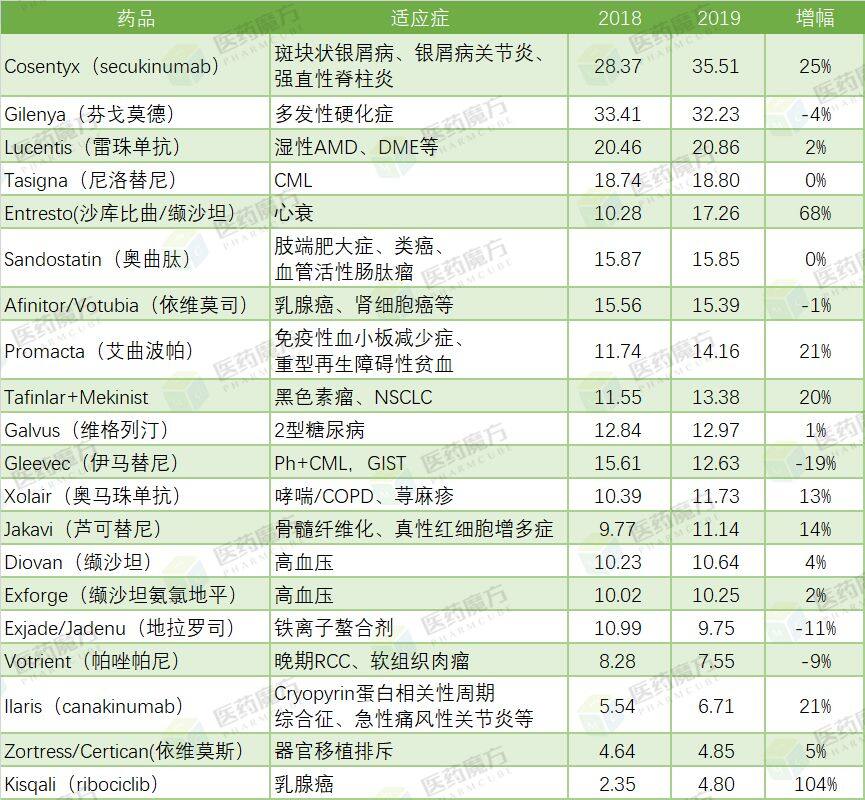
The growth of Novartis’s innovative medicines business was primarily driven by the psoriasis drug Cosentyx ($3.551 billion, +26%), the heart failure drug Entresto ($1.726 billion, +68%), the newly launched gene therapy Zolgensma ($361 million), the oncology drug Promacta ($1.416 billion, +21%), and the breast cancer drug Kisqali ($480 million, +104%).
Novartis' Main Drug Sales in 2019 (in billions of USD)
Although Novartis spun off its eye care business unit, Alcon, its commitment to innovative ophthalmic drugs has not waned. On May 9, 2019, Novartis announced the acquisition of Xiidra, a first-in-class novel drug for dry eye disease, from Takeda for $5.3 billion. This drug generated $192 million in revenue for Novartis in 2019. Furthermore, Novartis has strengthened its portfolio in oncology radiopharmaceuticals. In early October 2018, it acquired Advanced Accelerator Applications, thereby obtaining Lutathera, a radiopharmaceutical for the treatment of somatostatin receptor-positive gastroenteropancreatic neuroendocrine tumors (GEP-NETs). Lutathera generated $441 million in revenue for Novartis in 2019, representing a 164% increase.
In fact, Novartis was the biggest global winner in terms of innovative drug approvals in 2019, with six new drugs receiving FDA approval. Apart from Egaten, which is used to treat fascioliasis (a tropical disease), the remaining five new molecular entities (NMEs) all have blockbuster potential, as reflected in the product sales figures disclosed in the financial report for 2019 (as shown in the table below).
Novartis: Sales Performance of Products Approved for Launch in 2019 (USD billion)
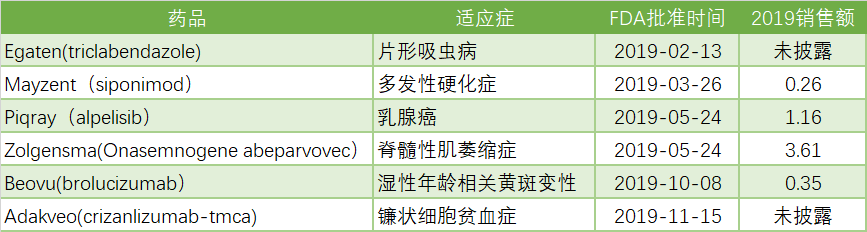
Particularly notable is Zolgensma, the sky-high-priced gene therapy that has sparked significant pricing controversy. Within just six months of its launch, it generated $361 million in revenue, demonstrating the support of the U.S. market and healthcare payment environment for this revolutionary therapy with substantial clinical benefits. Zolgensma has adopted flexible payment policies, currently achieving up to 97% coverage among patients with commercial insurance in the United States, and over 50% coverage among those enrolled in Medicaid. Sixteen U.S. states have already implemented newborn screening for spinal muscular atrophy (SMA), covering 36% of newborns nationwide, aiming to facilitate early detection and timely treatment with Zolgensma.
The new breast cancer drug Piqray targets patients with HR+/HER2- advanced breast cancer harboring PIK3CA mutations, which occur in up to 40% of such cases. As the first and currently only therapy approved for this specific mutation, Piqray generated $116 million in sales revenue within just six months of its launch. Beovu, indicated for the treatment of wet age-related macular degeneration (AMD), requires injections only once every three months after the initial loading dose, making it the most convenient anti-VEGF ophthalmic therapy currently available. It achieved $35 million in revenue in less than three months following its market introduction.
It is worth noting that although Egaten is primarily donated for use by the WHO and thus may contribute little to Novartis’s sales revenue, Novartis secured two valuable Priority Review Vouchers in 2019 thanks to the approval of Egaten and Zolgensma. If sold, these vouchers could generate at least $200 million in revenue.
CAR-T therapy is also a area of significant interest. In December 2019, it was reported that Novartis had internally decided to temporarily abandon its CAR-T cell immunotherapy research program for solid tumors. However, in the field of hematologic malignancies, the CAR-T product Kymriah remains a strong performance driver for Novartis, achieving sales revenue of $278 million in 2019 and showing momentum for volume growth. According to information disclosed by Novartis, the growth of Kymriah is mainly attributed to its penetration into the European and American markets. Currently, there are more than 200 medical centers in Europe and America qualified to conduct CAR-T therapy, and Kymriah has been approved for at least one indication in over 20 countries worldwide.
From a geographical perspective, the growth of Novartis’s Innovative Medicines division has been driven in part by contributions from the Chinese market. As China deepened reforms in its drug registration and approval processes as well as national reimbursement access policies, Novartis secured 25 new drug approvals (including new indications) between 2015 and 2019, with 13 new molecular entities launched in China for the first time. Since 2017, a total of 22 Novartis novel drugs have been included in the National Reimbursement Drug List. Novartis anticipates that more than 50 new drug applications (including new indications) will be approved in China between 2020 and 2024.
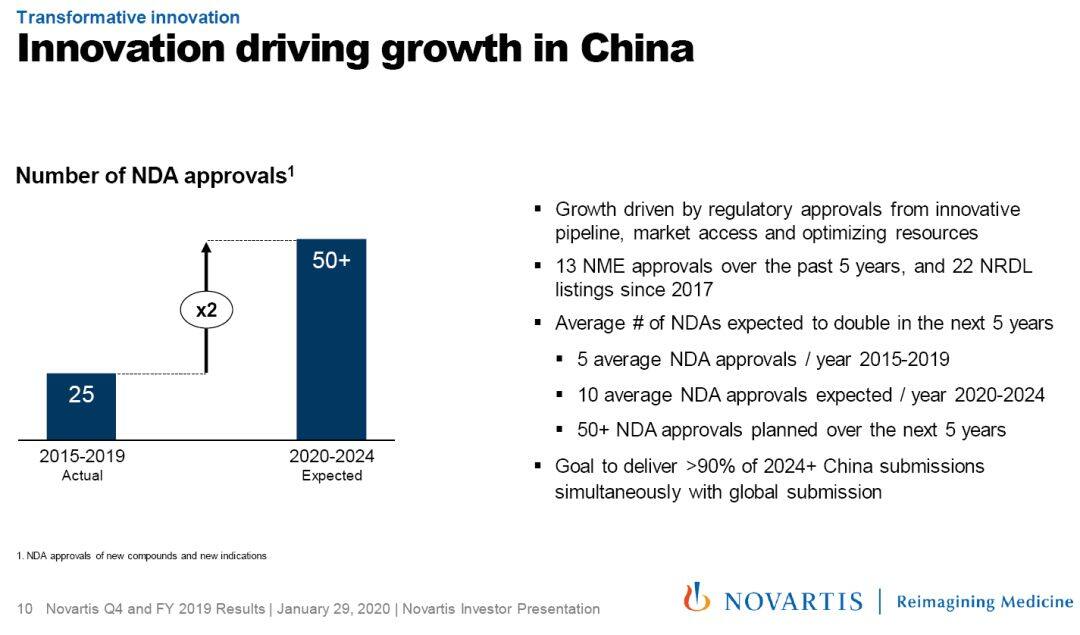
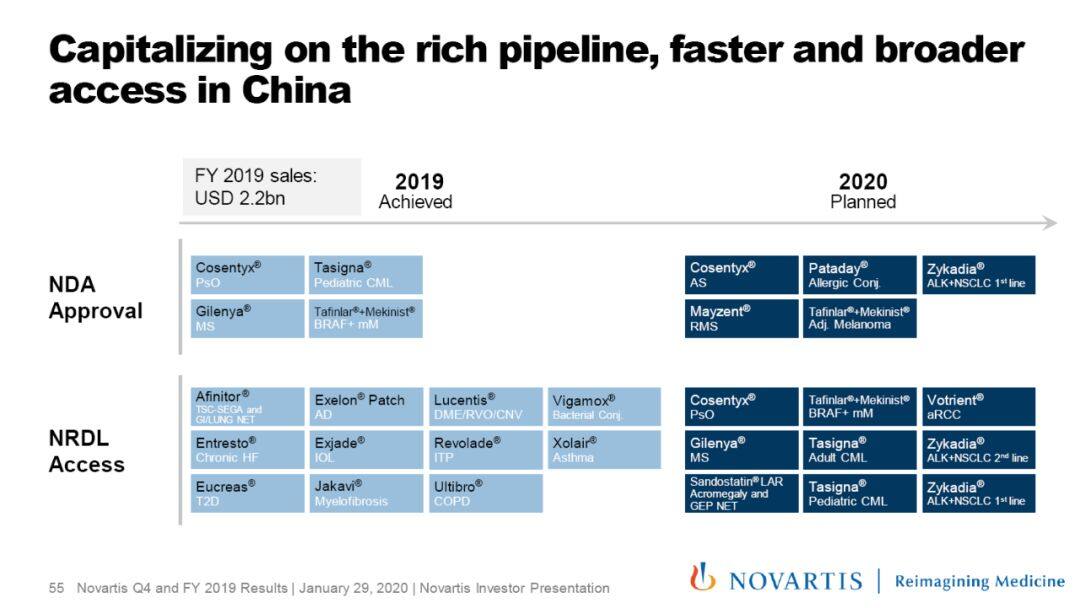
Thanks to a robust pipeline of new drug approvals and market access opportunities, Novartis generated $2.2 billion in revenue in China in 2019. In 2020, Novartis expected five additional blockbuster new drugs to be approved and nine to gain reimbursement listing under China’s National Reimbursement Drug List. According to Novartis management’s projections, the company’s revenue in China is maintaining strong double-digit growth and is poised to double by 2024.

In 2019, Novartis also submitted several blockbuster new drug marketing applications, including the lipid-lowering RNA interference therapy inclisiran (acquired through The Medicines Company), the c-Met inhibitor capmatinib for non-small cell lung cancer, a new indication for ofatumumab in multiple sclerosis, and a new indication for Cosentyx in radiographic-negative axial spondyloarthritis. Additionally, Novartis expected to release 30 sets of key clinical data in 2020 to support marketing applications for candidate drugs or advance them to Phase III trials. These are the key events worth watching for Novartis in 2020.
These key events underpin the confidence and momentum behind Novartis’s continued high-speed growth in global performance, driven by its substantial R&D investment over consecutive years. In 2019, Novartis’s R&D expenditure amounted to USD 9.402 billion, representing a year-on-year increase of 10.76%.