

Merck and Pfizer’s Immuno-Oncology Combination Keytruda + Inlyta Approved as First-Line Therapy for Advanced Renal Cell Carcinoma
Feb 03, 2020 11:28
CST Updated
Jan 31, 08:45

MSD
Pharmaceutical R&D and Manufacturer

Health Canada
Health Canada
January 30, 2020 News /BioValleyBIOON/ -- Merck & Co. recently announced that Health Canada has approved the anti-PD-1 therapy Keytruda (brand name: Keytruda; generic name: pembrolizumab) in combination withPfizerTyrosine kinase inhibitor Inlyta (axitinib) is indicated for the first-line treatment of patients with advanced renal cell carcinoma (RCC). In the United States and the European Union, the Keytruda plus Inlyta combination therapy was approved in April 2019 and September 2019, respectively, for the first-line treatment of patients with advanced RCC. This approval applies to all International Metastatic Renal Cell Carcinoma Database Consortium (IMDC) risk categories (favorable, intermediate, and poor risk).
Advanced RCC is one of the most lethal cancer types, with most patients initiallyDiagnosisdeath within the subsequent 5 years. The Keytruda + Inlyta combination regimen will provide an important first-line treatment option for patients with advanced RCC.
This approval is based on the results of the pivotal Phase 3 clinical study KEYNOTE-426 (NCT02853331), which demonstrated that, in patients with advanced renal cell carcinoma (RCC), the Keytruda + Inlyta regimen reduced the risk of death by 47% (HR=0.53 [95% CI: 0.38, 0.74], p=0.00005), reduced the risk of disease progression or death by 31% (HR=0.69 [95% CI: 0.5–0.82], p=0.00012), and significantly improved the objective response rate (ORR) (59% vs. 36%, p<0.0001) compared with Sutent (sunitinib), the standard-of-care first-line therapy for advanced RCC.
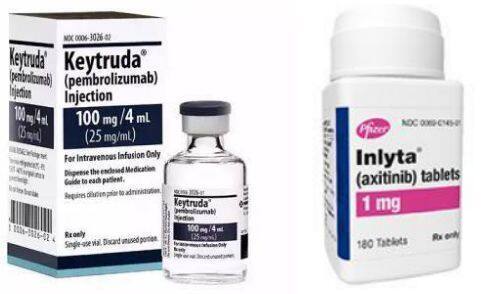
Keytruda belongs to the class of PD-(L)1 tumor immunotherapies, which are currently garnering significant attention. This class of therapies aims to harness the body’s own immune system to combat cancer by blocking the PD-1/PD-L1 signaling pathway, thereby inducing cancer cell death, and holds potential for treating various types of tumors. Inlyta is Pfizer’s next-generation targeted therapy for renal cell carcinoma; it inhibits tyrosine kinases, including vascular endothelial growth factor (VEGF) receptors 1, 2, and 3, which may promote tumor growth, angiogenesis, and cancer progression.Tumordiffusion). Sutent, also developed by Pfizer, is a multi-receptor tyrosine kinase inhibitor and has been the standard-of-care first-line therapy for RCC over the past decade.
Renal cell carcinoma (RCC) is by far the most common type of kidney cancer, accounting for approximately 80% of all kidney cancer cases. In patients with advanced RCC, the cancer has spread to other parts of the body beyond the kidneys. Currently, although the 5-year survival rate for patients with stage I RCC is relatively high (currently estimated at 81%), the 5-year survival rate for patients with advanced (stage IV) RCC is only 8%. In 2018, there were approximately 403,000 newly diagnosed cases of kidney cancer worldwide, with about 175,000 deaths. Known risk factors for kidney cancer include smoking,Hypertension, obesity, and occupational exposure to certain chemicals. (Bioon.com)
Original Source: Health Canadaapproves KEYTRUDA (pembrolizumab) as First-Line Treatment for Patients with Advanced Renal Cell Carcinoma (RCC)