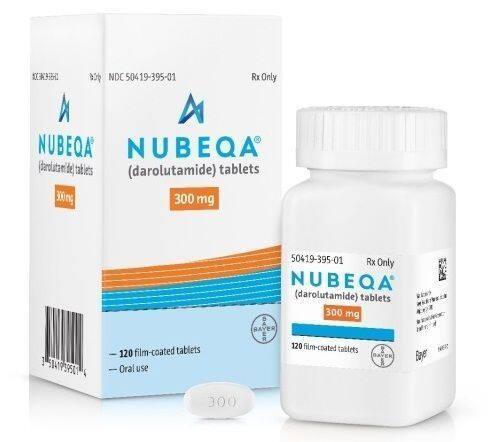
February 05, 2020 /BIOON/ -- German pharmaceutical giant Bayer recently announced that the Committee for Medicinal Products for Human Use (CHMP) of the European Medicines Agency (EMA) has issued a positive opinion, recommending the approval of Nubeqa (darolutamide) for the treatment of patients with non-metastatic castration-resistant prostate cancer (nmCRPC). The CHMP’s opinion will now be submitted to the European Commission (EC) for review, which is expected to make a final decision within the coming months.
Nubeqa, co-developed by Bayer and the Finnish pharmaceutical company Orion, is an oral non-steroidal androgen receptor (AR) inhibitor with a unique chemical structure. It binds to the receptor with high affinity and exhibits potent antagonistic activity, thereby inhibiting receptor function and the growth of prostate cancer cells. Currently, Nubeqa has been approved in the United States, Brazil, and Japan, with applications in other regions either underway or planned.
Bayer is responsible for the global commercialization of Nubeqa, which is co-promoted by Bayer and Orion in certain European markets (such as France, Germany, Italy, Spain, the United Kingdom, Scandinavia, and Finland). In addition to nmCRPC, the two companies are also advancing another Phase III clinical study, ARASENS, to evaluate the efficacy and safety of darolutamide in the treatment of metastatic hormone-sensitive prostate cancer (mHSPC).
The CHMP’s positive opinion is based on data from the pivotal Phase III ARAMIS study. The results demonstrated that, in patients with non-metastatic castration-resistant prostate cancer (nmCRPC), darolutamide plus androgen deprivation therapy (ADT) significantly prolonged metastasis-free survival (median MFS: 40.4 months vs. 18.4 months; p < 0.0001) and reduced the risk of metastasis or death by 59% compared with placebo plus ADT. Furthermore, at the time of the final MFS analysis, darolutamide plus ADT showed advantages over placebo plus ADT across multiple secondary endpoints, including overall survival (OS), time to pain progression, time to initiation of first cytotoxic chemotherapy, and time to first symptomatic skeletal event (SSE).
In this study, the darolutamide + ADT regimen demonstrated a favorable safety profile compared with placebo + ADT. The most common adverse reactions with an absolute increase of ≥2% were fatigue/asthenia (16% vs. 11%), extremity pain (6% vs. 3%), and rash (3% vs. 1%). The rate of treatment discontinuation due to adverse events was 9% in both groups, and quality-of-life outcomes were similar.
Dr. Scott Z. Fields, Senior Vice President and Head of Oncology Development at Bayer, stated: “For patients with typical asymptomatic non-metastatic castration-resistant prostate cancer (nmCRPC), it is crucial to have treatment options that can delay disease metastasis while limiting the burden of side effects. The CHMP’s positive opinion on Nubeqa marks an important step forward in providing a potential new treatment option that has the potential to extend metastasis-free survival (MFS) in nmCRPC patients and also limit the impact of side effects, thereby addressing the unmet medical needs within this patient population.”
Globally, prostate cancer is the second most common malignant tumor in men. In 2018, an estimated 1.2 million men were diagnosed with prostate cancer, and 358,000 died from the disease. Prostate cancer is the fifth leading cause of cancer-related deaths in men, primarily affecting those over the age of 50, with risk increasing as age advances.
Castration-resistant prostate cancer (CRPC) refers to prostate cancer that continues to progress despite androgen deprivation therapy (ADT) reducing testosterone levels in the body to very low levels. In Europe, based on 2018 prostate cancer incidence data, it is estimated that more than 67,000 men were diagnosed with CRPC. Approximately one-third of patients with non-metastatic CRPC (nmCRPC) develop metastases within two years. Patients with nmCRPC are typically asymptomatic; in such cases, the primary treatment goal is to delay the spread of prostate cancer and limit treatment-related side effects. Nubeqa will provide an important new therapeutic option for this patient population, significantly extending metastasis-free survival (MFS).
Nubeqa possesses a unique chemical structure that binds to the receptor with high affinity, exhibiting potent antagonistic activity, thereby inhibiting receptor function and the growth of prostate cancer cells. Unlike other existing treatments for nmCRPC, Nubeqa does not cross the blood-brain barrier, resulting in fewer potential drug interactions and central nervous system side effects (such as seizures, falls, and cognitive impairment).
In addition to nmCRPC, Bayer and Orion are also advancing another Phase III clinical trial, ARASENS, to evaluate the efficacy and safety of darolutamide in the treatment of metastatic hormone-sensitive prostate cancer (mHSPC). (Bioon.com)