


On February 4, Gilead Sciences announced its 2019 financial results, reporting total annual revenue of $22.449 billion, a 1.5% increase compared to 2018. Among this, HIV product sales reached $16.438 billion, representing a 12% year-over-year growth and accounting for 73.32% of the company's total revenue, making it Gilead's core business segment. Meanwhile, hepatitis C drugs, which once dominated half of Gilead's business, continued their decline, with 2019 sales totaling $2.936 billion, marking another 20% year-over-year decrease.
With its approval in China, the hepatitis B drug Vemlidy has unlocked the world’s largest market, driving a 52% increase in sales. Gilead Sciences projects that Vemlidy will achieve $1 billion in revenue in 2022, fueled by deeper penetration in the U.S. market and strong demand from China.
Gilead’s Major Drug Sales in 2019 (in USD 100 millions)
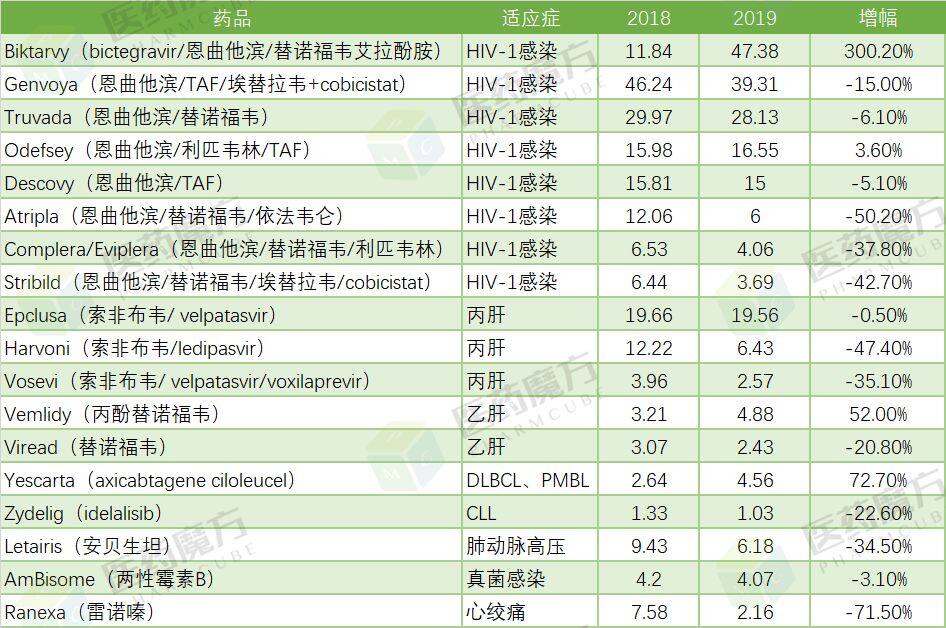
Gilead’s antiviral drug portfolio continues to be upgraded and iterated, even as it faces competition from GSK. Looking back at its 2019 performance, the company’s overall stability was almost entirely sustained by its four-in-one HIV medication, Biktarvy, which single-handedly offset declines across its other products. Beyond its HIV franchise and the hepatitis B drug Vemlidy, Gilead’s biggest surprise was its cell therapy Yescarta, which, despite entering the market later than competitors, seized the lead and maintained its market-leading position. This performance was driven not only by an expanding patient population in the U.S. market but also by breakthroughs in the European Union market. In 2019, Yescarta generated $83 million in revenue in Europe, compared to just $1 million in 2018.
Another source of market growth for Gilead comes from China. Since 2017, Gilead has had eight drugs approved by China’s National Medical Products Administration (NMPA), with four new medicines included in the National Reimbursement Drug List: the hepatitis B drug Vemlidy, the hepatitis C drugs Epclusa and Harvoni, and the HIV medication Genvoya.
With its hepatitis C business now a thing of the past, Gilead Sciences is primarily focusing on four key areas: antivirals, inflammatory diseases, oncology, and fibrotic diseases. On March 1, 2019, Daniel O’Day, former CEO of Roche Pharmaceuticals, officially assumed the role of CEO at Gilead Sciences and began implementing the company’s established strategic plan.
The most immediate change was in personnel. Daniel implemented a major overhaul of Gilead’s core senior leadership team, with the CSO, CPO, COO, and HRD positions all filled by new appointees (see: “Major Shake-up in Gilead’s Senior Leadership”). The restructuring of Gilead’s new executive team was not completed until October 2019, when Merdad Parsey was appointed as Global Chief Medical Officer. Gilead regarded this series of personnel changes as one of its key strategic moves in 2019.
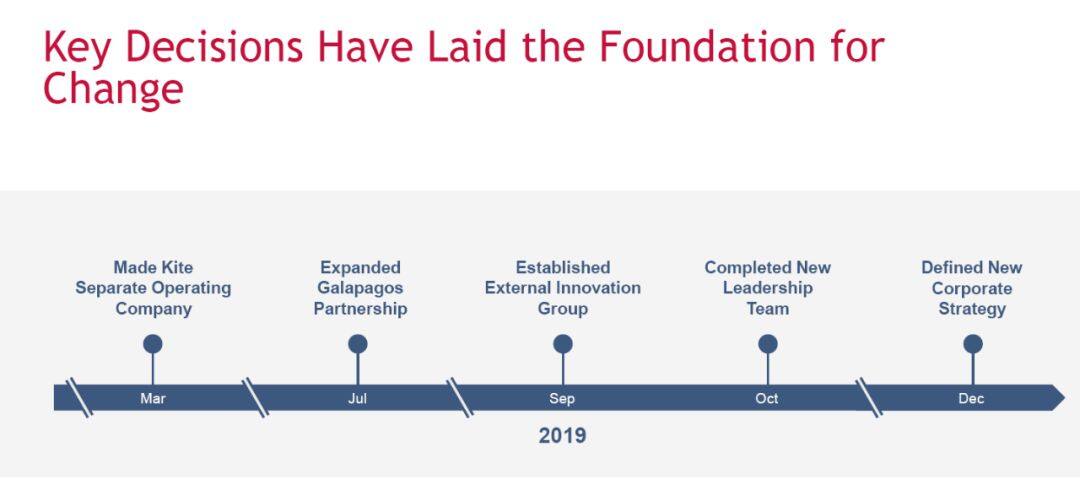
In addition, other significant moves by Gilead in 2019 included spinning off Kite Pharma as an independently operated entity and appointing Christi Shaw, former head of Eli Lilly’s biopharmaceutical business, as CEO of Kite. Furthermore, Gilead expanded its collaboration with Galapagos NV, establishing a 10-year R&D partnership (see: $5.05 Billion! Gilead’s Ten-Year Deal with Galapagos). Through this partnership, Gilead gained access to GLPG1690, an investigational drug for idiopathic pulmonary fibrosis then in Phase III clinical trials.
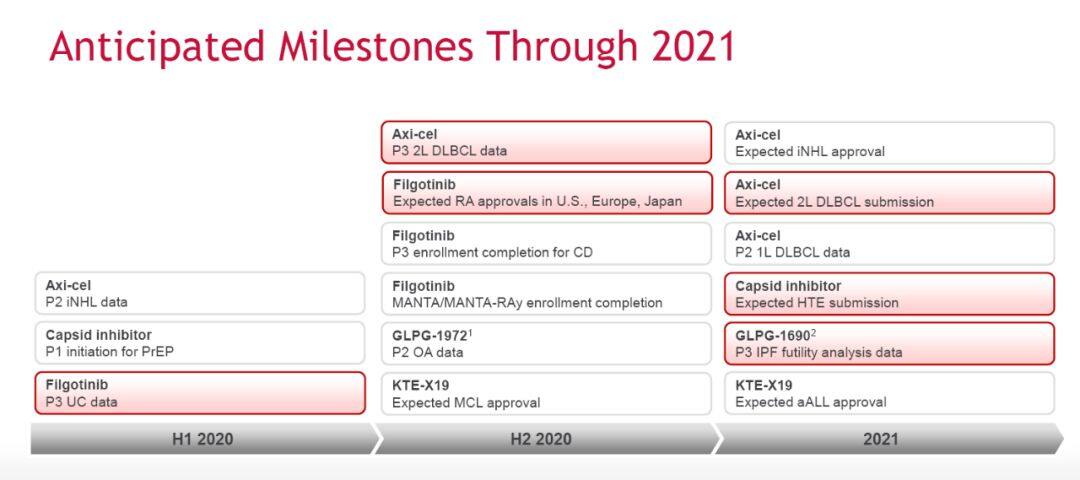
In terms of its R&D pipeline, Gilead’s three most important products over the next two years are filgotinib, a JAK1 inhibitor acquired from Galapagos, and Yescarta (axicabtagene ciloleucel, or Axi-cel) and KTE-X19, both acquired through the Kite Pharma acquisition. Filgotinib is expected to report Phase III data for ulcerative colitis in the first half of this year and receive FDA approval in the second half. Phase II data for Axi-cel in non-Hodgkin lymphoma (NHL) will also be released in the first half of the year. Meanwhile, KTE-X19, designated as a breakthrough therapy for mantle cell lymphoma, is anticipated to gain FDA approval in the second half of the year. These three products represent new growth drivers for Gilead and serve as cornerstones of its strategic transformation. Particularly given that other oncology candidates are still in early-stage development, CAR-T therapies act as the pivotal lever for Gilead’s expansion into the oncology sector.
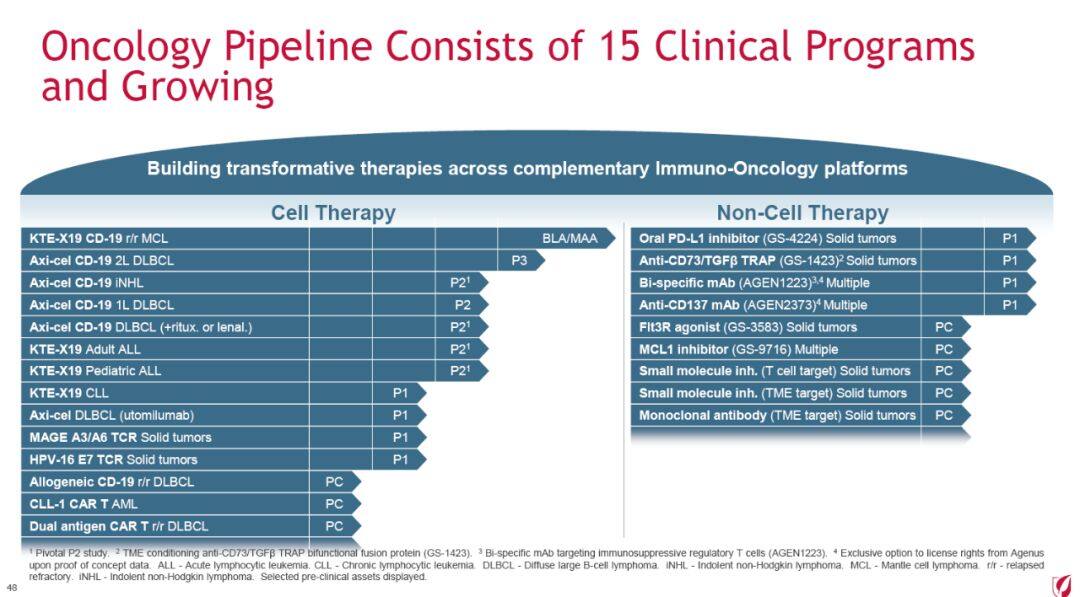
In the field of inflammatory diseases, Gilead has built a robust drug pipeline through its collaboration with Galapagos. In oncology, after experiencing setbacks with the small-molecule drug Zydelig, Gilead is currently relying on cell therapies to gain market traction. However, in addition to cell therapies, Gilead’s oncology pipeline also includes a reserve of small-molecule and antibody drugs based on tumor immunotherapy, such as the oral PD-L1 inhibitor GS-4224. Although still in the early stages, this indicates that oncology will remain a key business area for Gilead to focus on in the future.
As of December 31, 2019, Gilead Sciences, Inc. held $25.84 billion in cash and cash equivalents, including marketable debt securities, on its balance sheet. This strong financial position enabled the company to continue pursuing external project collaborations and merger and acquisition opportunities aligned with its strategic positioning in 2020.