

GSK's Belantamab Mafodotin (GSK2857916) Receives EMA Accelerated Assessment as First-in-Class BCMA-Targeted Therapy for Relapsed/Refractory Multiple Myeloma
Feb 07, 2020 14:47
CST Updated
14:47

GSK
Pharmaceutical R&D Manufacturer

European Medicines Agency
The European Medicines Agency (EMA) is a decentralized agency of the European Union (EU), located in London. It began operations in 1995. The agency is responsible for the scientific evaluation, supervision, and safety monitoring of medicines developed by pharmaceutical companies for use in the EU. By ensuring that all medicines available on the EU market are safe, effective, and of high quality, the EMA protects public and animal health in the 28 EU Member States and countries of the European Economic Area.

February 07, 2020 /BioValleyBIOON/ --GlaxoSmithKline(GSK) recently announced that the European Medicines Agency (EMA) has accepted a Marketing Authorization Application (MAA) submitted by the company. This MAA seeks approval for the B-cell maturation antigen (BCMA)-targeting antibody-drug conjugate (ADC) belantamab mafodotin (GSK2857916, at a dose of 2.5 mg/kg) for the treatment of patients with relapsed or refractory multiple myeloma (R/R MM) who have previously received multiple therapies, including an immunomodulatory agent, a proteasome inhibitor, and an anti-CD38 antibody.
Currently, the European Medicines Agency’s Committee for Medicinal Products for Human Use (CHMP) has initiated an accelerated assessment of belantamab mafodotin. Accelerated assessment may be granted for a medicinal product if the CHMP determines that it is of major public health interest and represents a therapeutic innovation. In 2018, more than 48,000 people in the European Union wereDiagnosisFor MM.
Belantamab mafodotin has the potential to become the first anti-BCMA therapy to be marketed. In 2017, belantamab mafodotin received U.S.FDAGranted Breakthrough Therapy Designation (BTD) and Priority Medicines (PRIME) designation by the European Medicines Agency (EMA), becoming the first BCMA-targeted therapy to receive both BTD and PRIME designations. These designations are intended to facilitate the development of investigational drugs with clinical potential in areas of significant unmet medical need.
Belantamab mafodotin'sBoth the BLA and MAA are based on data from the pivotal clinical study DREAMM-2 (NCT03525678) evaluating monotherapy for relapsed/refractory multiple myeloma (R/R MM), with relevant results published in The Lancet.TumorThe Lancet Oncology. This was a randomized, open-label, two-arm Phase II study that enrolled 196 heavily pretreated patients with relapsed/refractory multiple myeloma (R/R MM). These patients experienced disease progression despite receiving current standard-of-care therapy, had received a median of seven prior lines of treatment, were refractory to immunomodulatory drugs and proteasome inhibitors, and were refractory and/or intolerant to anti-CD38 antibodies. In the study, patients were randomized into two groups to receive belantamab mafodotin at a dose of 2.5 mg/kg or 3.4 mg/kg once every three weeks.

(Image source: DOI: https://doi.org/10.1016/S1470-2045(19)30788-0)
The results showed that the study met its primary endpoint: in this refractory patient population, the overall response rate (ORR) was 31% (n=30/97) in the belantamab mafodotin 2.5 mg/kg dose group and 34% (n=34/99) in the 3.4 mg/kg dose group, with data being clinically meaningful. In the 2.5 mg/kg dose group, among the 30 patients who achieved a response, 18 attained a very good partial response (VGPR) or better (≥VGPR), including 3 who achieved a stringent complete response (sCR). With a median follow-up of 6 months, the median duration of response (DoR) had not been reached, and overall survival (OS) had also not been reached.
In this study, the safety and tolerability of belantamab mafodotin were consistent with those observed in the first-in-human clinical trial DREAMM-1; the most common grade 3 or 4 adverse events in the 2.5 mg/kg groupAdverse Reactionsfor corneal disorders (27%), thrombocytopenia (20%), andAnemia(20%). Overall, patients in the DREAMM-2 study had more severe disease and worse prognosis and outcomes compared with those in the DREAMM-1 study. Moreover, patients in the DREAMM-2 study had received a greater number of prior treatment regimens than those in the DREAMM-1 study. The results of the DREAMM-2 study were consistent with those observed in the comparable patient subset of the DREAMM-1 study.
Treatment options are limited and prognosis is poor for patients with relapsed/refractory multiple myeloma (R/R MM) whose disease continues to progress despite currently available therapies. Data from the DREAMM-2 study indicate that, if approved, belantamab mafodotin would provide an important new treatment option for these patients.
The DREAMM-1 and DREAMM-2 studies are part of the DREAMM clinical development program, which comprises 10 clinical trials (DREAMM-1 through DREAMM-10) evaluating the efficacy and safety of belantamab mafodotin as monotherapy and in combination regimens for first-line, second-line, and later-line treatment of multiple myeloma (MM).
In March 2019, GSK announced updated data from the DREAMM-1 study, the first-in-human clinical trial evaluating belantamab mafodotin, designed to investigate the drug in patients with relapsed/refractory multiple myeloma (R/R MM) and other advanced hematologic malignancies expressing BCMA.TumorEfficacy and Safety in Patients. The results showed that the overall response rate (ORR) of belantamab mafodotin treatment reached 60% in BCMA-positive R/R MM patients.
Multiple Myeloma (MM) is the second most common hematologic malignancy, after non-Hodgkin lymphoma.Tumor. In recent years, despite significant advances in chemotherapy, proteasome inhibitors, immunomodulatory thalidomide derivatives, and CD38-targeted antibodies, nearly all patients eventually experience relapse. Therefore, there is an urgent need for new therapeutic regimens. The multiple myeloma (MM) market was valued at nearly $14 billion in 2017 and is projected to reach approximately $29 billion by 2027.
BCMA is an extremely important B-cellBiomarkers, widely expressed on the surface of MM cells, has become a focus in recent years for MM and other hematologic malignanciesTumora highly popular immune therapy target. Currently, there are over 20 immunotherapies developed targeting BCMA, mainly divided into three categories: chimeric antigen receptor T-cell therapy (CAR-T, Celgene/Bluebird Bio,Novartisas representatives), bispecific antibodies (BsAbs, represented by Amgen), antibody-drug conjugates (ADCs,GlaxoSmithKlineas a representative).
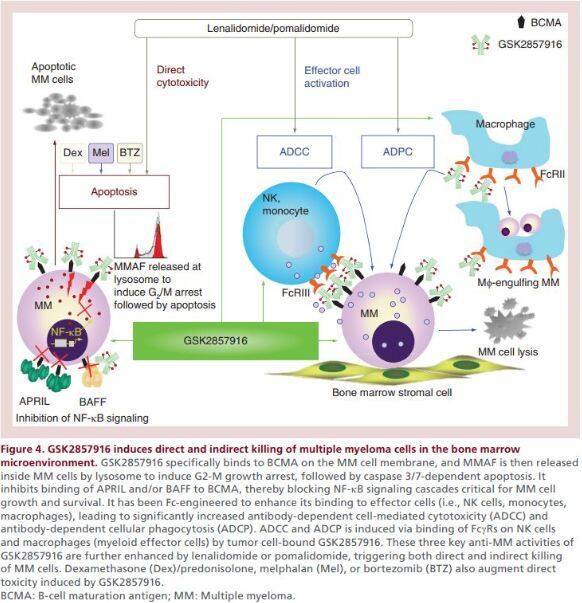
Belantamab mafodotin is a novel humanized Fc-engineered anti-BCMA monoclonal antibody conjugated to the cytotoxic agent MMAF (monomethyl auristatin-F) via a non-cleavable linker (drug-linker technology from SeattleHeredity(licensed) ADC drug conjugated. Belantamab mafodotin targets and binds to BCMA on the surface of MM cells via an anti-BCMA monoclonal antibody, is rapidly internalized by MM cells, degraded in lysosomes, and releases non-permeable MMAF within MM cells to exert its effect. MMAF is a mitotic inhibitor and an anti-tubulin compound that inhibits cell division by blocking microtubule polymerization, which can causeTumorCells arrested at the G2/M phase and induced caspase-3-dependentApoptosis. Furthermore, belantamab mafodotin can induce NK cell-mediated ADCC (antibody-dependent cell-mediated cytotoxicity), while also inducing macrophage-mediated ADCP (antibody-dependent cell-mediated phagocytosis).
Belantamab mafodotin selectively targets multiple myeloma (MM) cells through multiple cytotoxic mechanisms, holding promise as a highly potential next-generation immunotherapy option for this type of cancer. Currently, belantamab mafodotin is under clinical development for the treatment of relapsed/refractory MM and other advanced hematologic malignancies expressing BCMA.TumorPatient Treatment. (Bioon.com)
Original Source: GSK announces European Medicines Agency (EMA) accepted marketing authorisationapplication for belantamab mafodotin for the treatment of relapsed or refractory multiple myeloma