


On February 7, Roche announced the China cohort data from the IMbrave150 study evaluating Tecentriq plus bevacizumab versus sorafenib as first-line treatment for patients with hepatocellular carcinoma (HCC).
The IMbrave150 study employed a global, multicenter, open-label design, in which 501 patients with unresectable hepatocellular carcinoma (HCC) who had not previously received systemic therapy were randomized in a 2:1 ratio. Among the 194 Chinese patients enrolled in the study (137 from the global IMbrave150 trial and 57 from the China expansion cohort), 133 patients were randomly assigned to receive Tecentriq plus bevacizumab, and 61 patients received sorafenib.
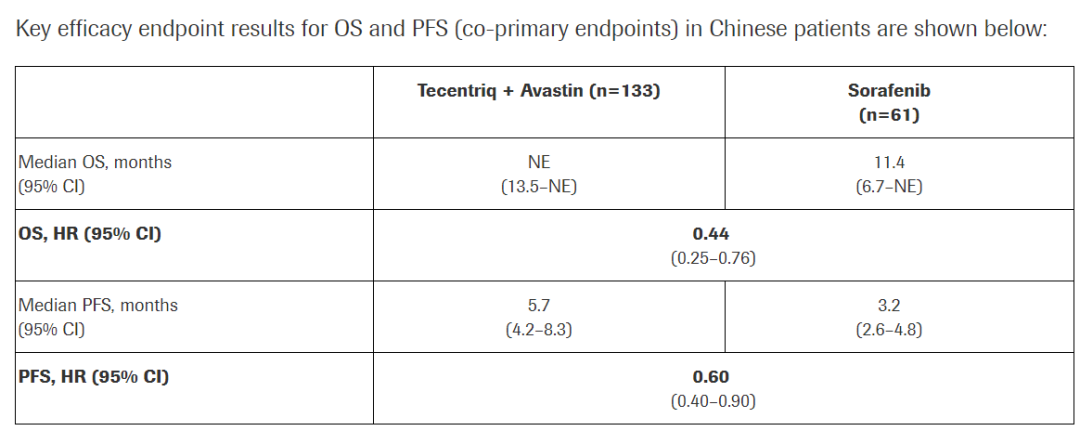
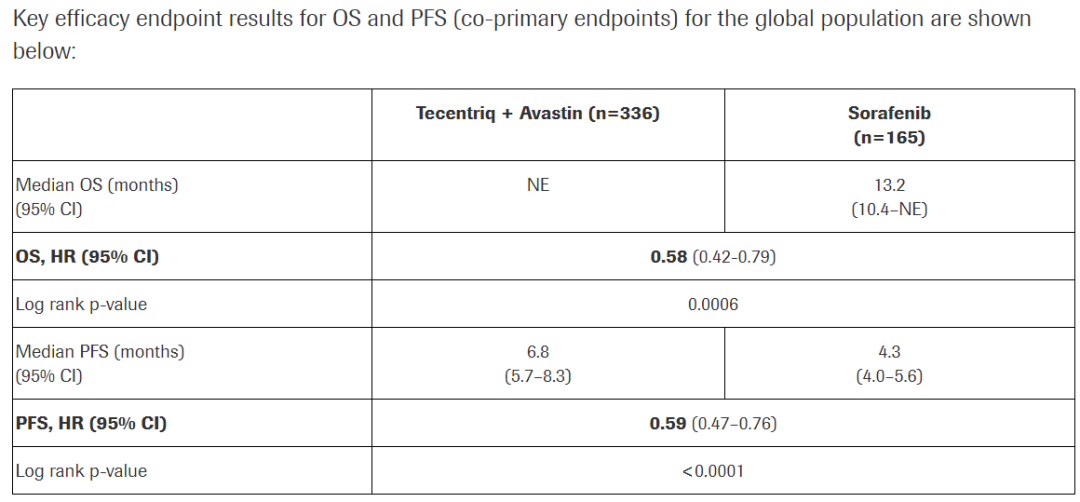
The results showed that, in patients with unresectable hepatocellular carcinoma who had not previously received systemic therapy, Tecentriq plus Avastin as a first-line treatment significantly prolonged overall survival (OS) in Chinese patients compared with sorafenib (median OS not mature vs. 11.4 months), reducing the risk of death by 56% (hazard ratio [HR] = 0.44; 95% confidence interval [CI]: 0.25–0.76). It also significantly prolonged progression-free survival (PFS) (5.7 vs. 3.2 months), reducing the risk of disease progression by 40% (HR = 0.60; 95% CI: 0.40–0.90). These data are consistent with the global findings from the IMbrave150 study.
In terms of safety, Tecentriq plus bevacizumab was generally well tolerated, with manageable toxicity consistent with known data.
Dr. Levi Garraway, Chief Medical Officer and Global Head of Product Development at Roche, stated, “Patients with hepatocellular carcinoma in China account for approximately half of the global patient population. Compared with current standard-of-care therapies, Tecentriq plus bevacizumab significantly prolonged overall survival, which is highly encouraging. We have been in close communication with the National Medical Products Administration of China, which has recently accepted our supplemental Biologics License Application (sBLA) for this combination therapy. We hope to make this treatment available to patients in China as soon as possible.”
Hepatocellular carcinoma (HCC) is a common, high-incidence cancer and a leading cause of cancer-related mortality worldwide. There are approximately 750,000 new cases of HCC diagnosed annually, with China accounting for nearly half of the global incidence. Currently, first-line standard therapies for liver cancer primarily consist of sorafenib-targeted therapy or the FOLFOX chemotherapy regimen containing oxaliplatin; however, their efficacy is limited. In particular, patients with unresectable hepatocellular carcinoma have a poor prognosis, with a one-year survival rate of less than 50% following diagnosis.
For more than a decade since the approval of sorafenib, no drug has defeated sorafenib in “head-to-head” trials as first-line therapy. Opdivo and Keytruda were both granted accelerated approval as second-line therapies for hepatocellular carcinoma; however, their post-marketing confirmatory studies failed to meet prespecified endpoints, ultimately resulting in failure.
The Tecentriq plus Avastin combination regimen has broken the decade-long stalemate in first-line treatment for hepatocellular carcinoma, delivering the best efficacy demonstrated to date in Phase III clinical studies of first-line systemic therapy for unresectable hepatocellular carcinoma. It is also the first novel therapy in over ten years to surpass the existing standard of care, sorafenib, in a clinical study.