


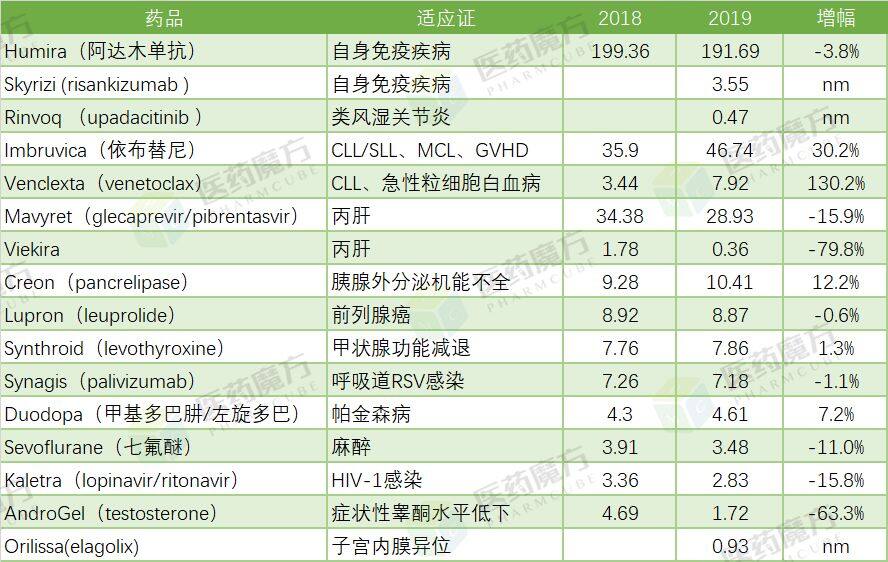
On February 7, AbbVie announced its 2019 financial results, reporting net revenues of $33.266 billion, a year-over-year increase of 1.6%. The primary focus was on the market performance of Humira, globally known as the “blockbuster drug king.” Compared to 2018, Humira’s revenue declined only slightly by 3.8%, reaching $19.169 billion, thereby helping AbbVie maintain its core business stability.
Over the past year, headline news related to Humira has been continuous. The FDA successively approved the marketing of adalimumab biosimilars from Samsung Bioepis and Pfizer, bringing the number of competitors for Humira in the U.S. market to five. However, AbbVie was not concerned, having already reached a patent litigation settlement with Pfizer in December 2018. What provided AbbVie with relief was that Boehringer Ingelheim, which had previously been the most determined and protracted challenger in the patent lawsuits, finally agreed to a settlement in May 2019, ensuring that Humira’s patent protection in the U.S. market would be definitively extended until January 2023.
However, price competition for Humira in the European market has become fiercely intense. With the expiration of patent protection, the European market was opened to all adalimumab biosimilars starting October 16, 2018. In early April 2019, it was reported that AbbVie responded by reducing the price of Humira in the European market by 89%. This impact was reflected in its financial performance: Humira’s revenue in the U.S. market reached $14.864 billion, representing an 8.6% growth, whereas its international market revenue amounted to $4.305 billion, marking a significant decline of 31.1%.
AbbVie’s 2019 Sales of Major Drugs (in USD 100 million)
Humira’s market environment in China has also undergone significant changes. With the launch of two domestically produced adalimumab biosimilars from Bio-Thera Solutions and Hisun Pharmaceutical, as well as the commencement of a new round of national medical insurance negotiations, Humira has finally adopted a more modest stance by pursuing a low-price strategy in China, reducing its price from approximately RMB 7,200 per pre-filled syringe to RMB 1,290 per pre-filled syringe.
Although the market environment appears to be gradually deteriorating, with a $20 billion blockbuster drug facing the patent cliff, the emergence of successors is slowly weakening Humira’s pillar status within AbbVie. In 2019, AbbVie launched two new drugs in the autoimmune disease field: the anti-IL-23 monoclonal antibody Skyrizi (risankizumab) and the JAK1 inhibitor Rinvoq (upadacitinib). These two drugs are complementary in terms of drug type (one monoclonal antibody and one small molecule) and collectively contributed $402 million in revenue. AbbVie expects the revenue from these two drugs to reach $1.7 billion in 2020, which can basically offset the risk of AbbVie’s overall performance decline caused by the shrinkage of Humira’s revenue. IL-23 and JAK1 are also current hot targets, and the trend of replacing TNF-α biologics is obvious. It is expected that a smooth transition with Humira can be achieved by 2023.
Imbruvica (ibrutinib) has long been AbbVie’s most prominent product in the oncology sector, generating $4.674 billion in sales revenue in 2019. Since its acquisition in 2015, it has cumulatively contributed $13.423 billion in revenue to AbbVie. At this pace, the $21 billion acquisition cost is projected to be recouped by the end of 2021.
Another AbbVie product worthy of close attention is Venclexta (venetoclax), the only Bcl-2 inhibitor currently marketed worldwide. By specifically inhibiting the Bcl-2 protein, it activates the endogenous mitochondrial apoptosis pathway, thereby inducing rapid apoptosis of tumor cells. In April 2016, venetoclax was approved by the FDA for the treatment of chronic lymphocytic leukemia with deletion of chromosome 17p, marking a significant breakthrough in the development of novel anticancer drugs targeting apoptosis in recent years. After a modest first year on the market, Venclexta began to experience doubledigit growth, reaching $792 million in 2019. This performance demonstrated its blockbuster potential and finally earned it widespread recognition. Venclexta may once again draw significant industry attention, spurring renewed interest in the research and development of new apoptosis-based therapies.
AbbVie’s most high-profile development in 2019 was its June announcement of the $63 billion acquisition of Allergan, a transaction expected to close in the first quarter of 2020. Consequently, the impact on AbbVie’s revenue was not reflected in its 2019 financial statements.