

Teva's Austedo (Deutetrabenazine) Fails to Meet Primary Endpoint in Phase II/III and III Registration Trials for Tourette Syndrome
Feb 21, 2020 11:04
CST Updated
11:04

Teva
Drug Developer
February 21, 2020 /BIOON/ -- Teva Pharmaceutical Industries Ltd. recently announced the results of the Phase II/III ARTISTS 1 and Phase III ARTISTS 2 trials. Conducted in pediatric patients with moderate-to-severe Tourette syndrome (TS), these trials demonstrated that Austedo (deutetrabenazine, tablets) failed to meet the primary endpoint of reducing motor and vocal tics, as assessed by the Yale Global Tic Severity Scale-Total Tic Score (YGTSS-TTS), compared with placebo.
In the data received this week, the most commonly reported adverse events in the ARTISTS 1 and ARTISTS 2 studies were headache, somnolence, and fatigue. No new safety signals inconsistent with the known safety profile of Austedo were identified in these patients.
Tourette Syndrome (TS) is a neurodevelopmental disorder with onset before the age of 18, characterized by motor and vocal tics persisting for more than one year. Symptoms of TS typically first appear in early childhood, with the most severe symptoms occurring around the age of 10. Most patients with TS experience improvement in symptoms during late adolescence and adulthood.
Dr. Hafrun Fridriksdottir, Executive Vice President of Global R&D at Teva, stated, “The results of these trials are deeply disappointing, particularly given the significant unmet medical needs within the pediatric population with Tourette syndrome. We are currently evaluating the next steps for this drug program, and we extend our sincere gratitude to the investigators, patients, and families who participated in these studies.”
Austedo: The World's First Deuterated Drug
The active pharmaceutical ingredient of Austedo is deutetrabenazine, a small-molecule oral inhibitor targeting vesicular monoamine transporter 2 (VMAT2), which regulates the levels of neurotransmitters such as dopamine, serotonin, epinephrine, and norepinephrine in the brain. Deutetrabenazine is the deuterated form of tetrabenazine, an approved medication for Huntington’s disease. Deuteration improves its pharmacokinetic profile and significantly prolongs its half-life, thereby enabling the use of lower therapeutic doses.
Austedo is the first deuterated drug approved globally. In the United States, Austedo received FDA approval in April 2017 for the treatment of chorea associated with Huntington’s disease. In August 2017,FDAApproval of a New Indication for Austedo for the Treatment of Tardive Dyskinesia in Adults
Teva: A Pioneer in the Field of Deuteration
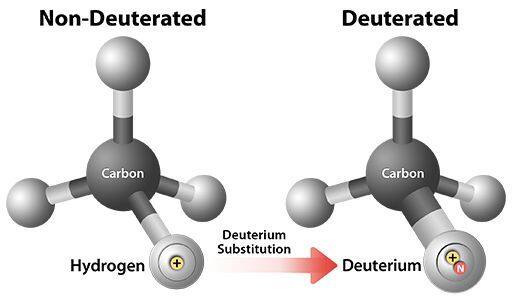
Deuteration Technology
Deuterium (D) is abundant in nature and can form stable molecular bonds with other elements. The average amount of D in an adult human body is approximately 2 g. Although D and hydrogen (H) differ at the atomicIn terms of size and shapeAlthough fundamentally similar, deuterium (D) and hydrogen (H) differ in that D contains an additional neutron. Consequently, the chemical bond formed between D and carbon (C) is more stable than that formed between H and C. Typically, the stability of the D–C bond is 6–9 times greater than that of the H–C bond, which has significant implications for drug development, as drug metabolism often involves the cleavage of H–C bonds.
Traditional drug discovery methods are time-consuming and have high failure rates. In contrast, deuterium chemistry approaches typically start from already marketed drugs, offering higher development efficiency and lower costs. Deuteration (deuterium substitution) can enhance certain drug properties: because deuterium (D) forms more stable chemical bonds with carbon (C), deuteration can, in some cases, alter drug metabolism, including improving metabolic stability, reducing the formation of toxic metabolites, increasing the formation of desired active metabolites, or a combination of these effects. Compared to their corresponding non-deuterated analogs, deuterated compounds exhibit prolonged half-lives and increased systemic exposure in vivo, properties that may confer therapeutic benefits such as improved safety, efficacy, tolerability, and convenience.
Typically, deuterated compounds are expected to retain biochemical potency and selectivity similar to their hydrogenated analogs. The impact of deuterium substitution on metabolic properties is highly dependent on the specific molecular position where deuterium replaces hydrogen. However, the metabolic effects of deuterium substitution, if any, are unpredictable, even among compounds with similar chemical structures.
Currently, multiple pharmaceutical companies are developing deuterated versions of existing drugs. For instance, Concert Pharmaceuticals utilized deuterium chemistry technology to develop CTP-543, a new product derived from the JAK1/JAK2 inhibitor ruxolitinib, which has demonstrated robust efficacy in the treatment of alopecia areata. Ruxolitinib is approved in the United States under the brand name Jakafi for the treatment of various hematologic disorders. Deuterium modification of ruxolitinib can alter its human pharmacokinetics, thereby enhancing its utility as a therapy for alopecia areata. (Bioon.com)
Original Source: