

Bayer's Precision Oncology Drug Vitrakvi Demonstrates High Response Rates and Durable Remissions Up to 3 Years in TRK Fusion Cancers
Feb 29, 2020 17:04
CST Updated
17:04
Bayer
Pharmaceutical Product R&D Developer
February 29, 2020 News /BioValleyBIOON/ -- Recently, "The LancetTumor(The Lancet Oncology) published online the largest dataset to date of patients with TRK fusion cancers. This dataset provides for the assessment ofBayerPrecisionTumorLatest clinical data on the treatment of TRK fusion cancer in adult and pediatric patients with the drug Vitrakvi (larotrectinib). The article is titled:Larotrectinib in patients with TRK fusion-positive solid tumours: a pooled analysis of three phase 1/2 clinical trials。
The results showed that, as of the data cutoff date (February 19, 2019), among 153 evaluable patients,The overall response rate (ORR) for Vitrakvi treatment was 79%.(95% CI: 72–85), with a complete response rate of 16% (n=24) and a partial response rate of 63% (n=97). Among these, in the evaluableThe ORR in adult patients was 73%.(n=74/102), evaluableThe ORR in pediatric patients was 92%(n=47/51). Among patients with confirmed remission (n=108), the remission was durable,Median duration of response approaches 3 years(DOR: 35.2 months, 95% CI: 22.8–NE). In the pooled dataset (n=159),Median progression-free survival (mPFS) was 28.3 months(95%CI:22.1-NE)、Median overall survival was 44.4 months (95% CI: 36.5–NE), 88% (95% CI: 83-94) of patients remained alive one year after initiation of treatment.In a subgroup analysis from the integrated dataset, Vitrakvi in patients withSolid tumor patients with brain metastases (n=12) showed a high response rate, with an ORR of 75%.Due to the blood-brain barrier, CNSTumoror brain metastases and refractory tumors. Data show that Vitrakvi has high clinical efficacy in this patient population.
The safety data encompass the entire safety dataset of 260 cancer patients (regardless of TRK fusion status) treated with Vitrakvi, providing additional evidence supporting its safety profile, including in patients receiving long-term treatment. Most adverse events were Grade 1 or 2. No Grade 3/4 treatment-related adverse events with an incidence >3% were reported, and no treatment-related deaths were reported.
Dr. Lynley Marshall, Advisor to the Oak Foundation for Children and Young People’s Cancer Drug Development at The Royal Marsden, stated: “The latest data on Vitrakvi provide highly valuable follow-up efficacy data for adult and pediatric patients with TRK fusion cancers. Published in The Lancet”Tumordata published in the Journal, we can see that Vitrakvi demonstrated clinically meaningful response rates in TRK fusion cancers, and its safety profile was generally manageable even in very young children. This expansion of the initial dataset further underscores the therapeutic potential of Vitrakvi to deliver high response rates in eligible cancer patients.”
Dr. Melissa Rowe, Medical Affairs Director for Specialty Medicines at Bayer UK, stated: “We continue to see that in patients with various... receiving Vitrakvi treatment”TumorVitrakvi has demonstrated high response rates in pediatric and adult patients with TRK fusion cancers, underscoring the importance of testing and identifying cancer patients with genomic alterations. The latest data on Vitrakvi from the largest patient dataset to date are encouraging. We will continue to work with regulatory authorities to make this treatment available to eligible cancer patients who may benefit.”
NTRK gene fusions are aberrant genetic alterations present in a wide range of tumor types, leading to dysregulated tropomyosin receptor kinase (TRK) signaling and tumor growth. Accumulating evidence indicates that the NTRK genes, which encode TRK proteins, may fuse with other genes, generating signals that can drive cancer growth at multiple sites throughout the body. TRK fusion cancers are overall rare, affecting no more than a few thousand patients annually in Europe. TRK fusions can occur in both children and adults, and across differentTumorOccurs at varying frequencies among the types.
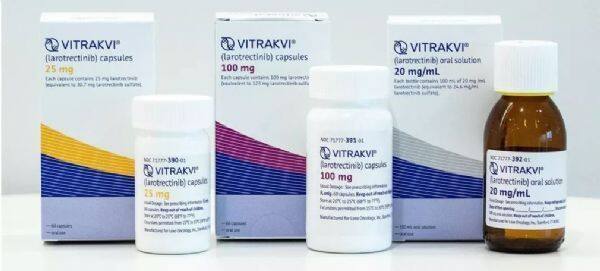
The active pharmaceutical ingredient of Vitrakvi is larotrectinib, a potent, oral, selective tropomyosin receptor kinase (TRK) inhibitor designed to directly target TRKs (including TRKA, TRKB, and TRKC), thereby shutting down the signaling pathways that drive tumor growth in TRK fusion cancers. TRK fusion cancers are overall rare, affecting no more than a few thousand patients annually in Europe. The disease can affect both children and adults and occurs with varying frequency across different tumor types. In clinical studies, Vitrakvi was investigated for the treatment of 29 different histological subtypes of solid tumors. Results demonstrated that Vitrakvi exhibits significant and durable antitumor activity against TRK fusion tumors, including primary central nervous system (CNS) tumors and brain metastases, regardless of patient age andTumorHow is the histology?
Vitrakvi is a first-in-class oral TRK inhibitor specifically developed for the treatment of tumors harboring NTRK gene fusions. The drug demonstrates high response rates and durable responses in pediatric and adult patients with TRK fusion cancers, including those with primary central nervous system (CNS) involvement.Tumorand brain metastases.
Vitrakvi is the first orally administered TRK inhibitor to be marketed globally, having received approval in the United States in November 2018 and in the European Union in September 2019 for the treatment of pediatric and adult patients with advanced solid tumors harboring NTRK gene fusions. Additionally, Vitrakvi has been approved in Brazil and Canada. Regulatory submissions in other regions are either ongoing or planned. In February 2019Eli LillyFollowing the acquisition of Loxo Oncology, Bayer secured exclusive global rights, including in the U.S. market, to develop and commercialize Vitrakvi and the investigational TRK inhibitor selitrectinib (BAY 2731954, formerly LOXO-195). (Bioon.com)
Original Source: Updated data on Vitrakvi (larotrectinib) confirm clinical efficacy with high response rates and durable responses, as well as a favorable safety profile to date in children and adults with TRK fusion cancer