

AbbVie Announces Phase 3 VIALE-C Trial of VENCLEXTA® (venetoclax) Plus Low-Dose Cytarabine Fails to Meet Primary Endpoint in Previously Untreated AML
Feb 29, 2020 17:03
CST Updated
17:03

AbbVie
Innovative Drug Developer

February 29, 2020 News /BioValleyBIOON/ -- AbbVie recently announced the use of its targeted anticancer drug Venclexta/Venclyxto (venetoclax) in combination with low-dose cytarabine (LDAC) as a first-line treatment for acute myeloidLeukemiaUpdated Results of the Phase III VIALE-C (M16-043) Study in Acute Myeloid Leukemia (AML).This is a randomized, double-blind, placebo-controlled study conducted in patients with newly diagnosed acute myeloid leukemia (AML) who are ineligible for intensive chemotherapy. In the study, patients were randomly assigned to receive venetoclax plus low-dose cytarabine (LDAC) (n=143) or placebo plus LDAC (n=68). The primary efficacy endpoint was the comparison of overall survival (OS) between the two groups.
The results showed that the studyThe primary endpoint of significantly improving OS was not achieved: Compared with the placebo + LDAC treatment group, the venetoclax + LDAC treatment group25% Reduction in Mortality Risk(HR=0.75 [95% CI: 0.52-1.07], p=0.11). In the initial analysis (median follow-up of 12 months), the median OS was 7.2 months in the venetoclax + LDAC treatment group and 4.1 months in the placebo + LDAC treatment group. A post hoc analysis after an additional 6 months of follow-up showed that the median OS was 8.4 months in the venetoclax + LDAC treatment group and 4.1 months in the placebo + LDAC treatment group (HR=0.70 [95% CI: 0.50-0.99]).
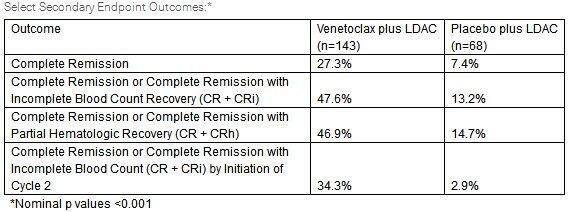
In terms of secondary endpoints, compared with the placebo + LDAC treatment group, the venetoclax + LDAC treatment groupSignificant Increase in Complete Remission Rate(CR:27.3% vs 7.4%), significantly increased rates of complete remission or complete remission with incomplete hematologic recovery (CR+CRi:47.6% vs 13.2%), complete remission or complete remission with partial hematologic recovery (CR+CRh:46.9% vs 14.7%), the CR+CRi rate at the initiation of the second treatment cycle was significantly increased (34.3% vs 2.9%),P values were all < 0.001.
In the study, the safety profile of the venetoclax + LDAC combination supports the U.S. Food and Drug Administration (FDA) consistent with the safety results reported in the Phase I/II study approving the combination. The study results will be presented at the upcoming medicalMeetingpublished above. Currently, the indications for venetoclax remain unchanged.
Neil Gallagher, M.D., Chief Medical Officer and Vice President of Development at AbbVie, stated, “We remain committed to advancing research in AML and other hematologic cancers.”Although the results of the VIALE-C study did not reach statistical significance, they demonstrated that the venetoclax + LDAC regimen has clinically meaningful efficacy.”
Acute myeloid leukemia (AML) is one of the most aggressive and difficult-to-treat hematologic malignancies, characterized by low survival rates and very limited treatment options. AML originates in the bone marrow, leading to an increased number of abnormal white blood cells in the blood and bone marrow. The disease typically progresses rapidly; however, not all patients are eligible for intensive chemotherapy. Age and comorbidities are common factors that limit the use of intensive chemotherapy. Only approximately 28% of patients survive for five years or longer.
In November 2018, the U.S. Food and Drug Administration (FDA) Accelerated approval of venetoclax (U.S. brand name: Venclexta) in combination with azacitidine, decitabine, or low-dose cytarabine (LDAC) for the treatment of adult patients with newly diagnosed acute myeloid leukemia (AML) who are aged ≥75 years or have comorbidities that preclude the use of intensive induction chemotherapy. This approval is based on results from Phase I/II studies, and continued approval for this indication will be contingent upon ongoingClinical TrialsVerification and Description of Clinical Benefits.
AbbVie Has Submitted the Results of VIALE-C to the United StatesFDAand other regulatory authorities worldwide, and will continue to collaborate with regulatory agencies to ensure that venetoclax remains an appropriate treatment option for patients with acute myeloid leukemia (AML). The companyA large-scale clinical research program in acute myeloid leukemia (AML) is underway, with multiple studies continuing to explore the potential of venetoclax and other investigational agents in AML, including the Phase III VIALE-A study, which in newDiagnosisconducted in AML patients ineligible for intensive chemotherapy, comparing the venetoclax plus azacitidine regimen with the placebo plus azacitidine regimen.
Venclexta/Venclyxto is a first-in-class drug whose active pharmaceutical ingredient, venetoclax, is an oral B-cell lymphoma-2 (BCL-2) inhibitor. BCL-2 plays a role inApoptosis(Programmed cell death) plays an important role, can inhibit the apoptosis of some cells (including lymphocytes), and is overexpressed in certain types of cancer, which is associated with the development of drug resistance. Venetoclax is designed to selectively inhibit the function of BCL-2, restore cellular communication systems, and induce cancer cells to self-destruct for therapeutic purposes.Tumorthe purpose of.
Venetoclax was co-developed by AbbVie and Roche. The two companies share responsibility for the drug’s commercialization in the U.S. market (brand name: Venclexta), while AbbVie handles commercialization in markets outside the U.S. (brand name: Venclyxto). To date, venetoclax has been approved in more than 50 countries worldwide for the treatment of adults with chronic lymphocytic leukemia (CLL), small lymphocytic lymphoma (SLL), and acute myeloid leukemia (AML). (Bioon.com)