

XINSORB Bioresorbable Sirolimus-Eluting Coronary Scaffold Receives NMPA Approval for Market Launch in China

Huaan
Research and Development, Production of Cardiovascular Stent Products
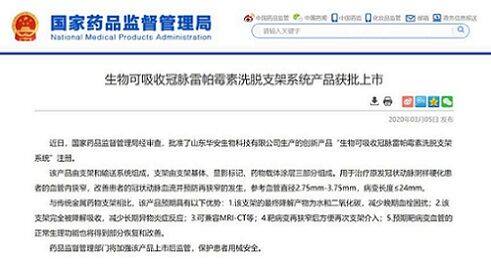
On March 5, Academician Ge Junbo of the Chinese Academy of Sciences led his team in developing a proprietary product after more than ten years of dedicated research.Intellectual PropertyThe bioresorbable sirolimus-eluting coronary stent—XINSORB stent—has been approved for market launch by the National Medical Products Administration. This is the first bioresorbable stent independently developed in China.
Since 2005, Ge Junbo has led the research team at Zhongshan Hospital, Fudan University, in collaboration with Shandong Huaan Biotechnology Co., Ltd., to undertake the research and development of bioresorbable stents. In that same year, they obtained a key patent: “Preparation Method for Bioresorbable Drug-Eluting Polymer Stents.” Subsequently, through repeated optimization of the polymer formulation and iterative prototyping, preclinical evaluation was initiated in February 2010.
In September 2013, as the first bioresorbable scaffold in China to enter clinical trials, the first patient was successfully enrolled in its First-in-Man (FIM) study. Subsequently, randomized controlled clinical trials were conducted at 17 clinical medical centers across China, with a total of 395 patients enrolled. By May 2016, a total of 798 patients had been enrolled in the studies. In the same month, the XINSORB scaffold entered the innovativeMedical DevicesSpecial Approval Procedure. At this point, all pre-market clinical stent implantations for the XINSORB stent have been completed, and all subjects have entered the follow-up phase.
To date, the first patient treated with the XINSORB bioresorbable scaffold has completed the 5-year follow-up. Over the past five years, the patient has experienced no adverse events; repeated angiographic reviews have demonstrated patency at the original stent implantation site, with the scaffold nearly completely resorbed.
Overall, the XINSORB FIM study has completed 5-year follow-up, with results showing a TLF incidence rate of 13.3%, consistent withAbbottThe results were comparable to those of the Abbott BVS. The XINSORB RCT study has completed a 4-year follow-up, showing that the incidence of target lesion failure (TLF) with the XINSORB stent was 5.3%, the incidence of major adverse cardiac events (MACE) was 4.2%, the incidence of ischemia-driven target lesion revascularization (ID-TLR) was 4.8%, and the incidence of stent thrombosis was 1.0%. These results are comparable to those of conventional metallic drug-eluting stents.
Regarding the duration of dual antiplatelet therapy for bioresorbable scaffolds, Ge Junbo proposed that it should not be evaluated based on the standards for traditional metallic stents. He recommended that patients receiving bioresorbable scaffold implantation should appropriately extend the duration of dual antiplatelet therapy, ideally until the scaffold is completely absorbed.
Currently, Ge Junbo has led his team to initiate the research and development of the second-generation bioresorbable stent, which has completed long-term animal follow-up studies. Following the market launch of the XINSORB stent, post-marketing clinical studies will continue to be conducted.
Regarding the vision for medical device innovation, Ge Junbo emphasized that independent innovation is crucial. One should not simply purchase products from developed countries for replication due to the lengthy development timeline and slow realization of economic benefits associated with independent R&D. Instead, it is essential to encourage the approach of “introduction, digestion, absorption, and re-innovation,” persist in researching core technologies throughout this process, and simultaneously strengthen “zero-to-one” breakthroughs.Basic ResearchWork, addressing technical challenges in the medical field through collaborative innovation. (Bio ValleyBioon.com)