

Gilead's Long-Acting HIV-1 Capsid Inhibitor GS-6207 Demonstrates Significant Viral Load Reduction After a Single Subcutaneous Injection
Mar 15, 2020 10:05
CST Updated
10:05

Gilead Sciences
Antiviral Drug Developer
March 15, 2020/BioonBIOON/--Gilead Sciences recently announced at the 2020 Conference on Retroviruses and Opportunistic Infections (CROI) held in Boston, MassachusettsMeeting(CRIO) announced the latest clinical and preclinical study data on GS-6207, a drug that is aNovel, Selective, First-in-Class HIV-1 Capsid Function Inhibitor, is being developed as a potential long-acting therapy. Results from the Phase Ib proof-of-concept study of the subcutaneous formulation demonstrated that GS-6207 exhibits potent antiviral activity, with rapid reduction in viral load following a single subcutaneous injection: on Day 10 post-dosing, HIV-1 RNA levels were significantly reduced in patients across all GS-6207 dose groups (20–75 mg) compared with placebo (all p < 0.0001).
Additional data presented at the conference provided further insights into the potential applications of GS-6207, supporting its continued development. Phase I study data in healthy volunteers demonstrated that oral tablets of GS-6207 were safe and well tolerated, with pharmacokinetic results supporting once-weekly dosing regardless of food intake. The conference also featured preclinical study results evaluating the impact of resistance-associated mutations on the in vitro antiviral activity of GS-6207. In this in vitro study, GS-6207 activity was not affected by gag cleavage site mutations or by mutations associated with resistance to the four major classes of antiretroviral drugs.
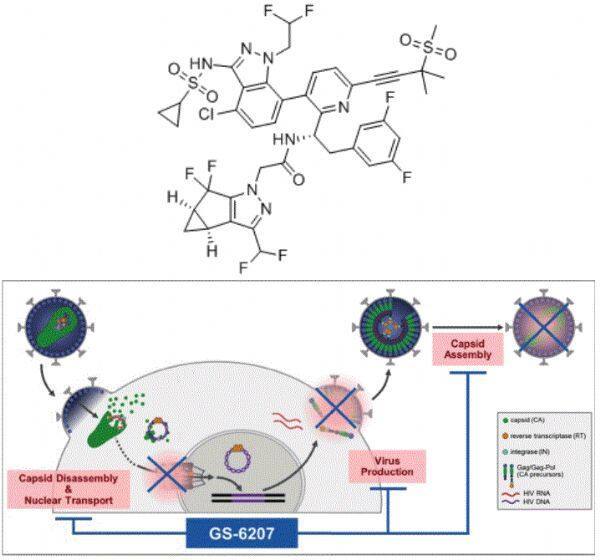
GS-6207 is an investigational drug being developed as part of a long-acting regimen.GS-6207 disrupts the HIV capsid, a polymeric shell essential for viral replication, at multiple stages of the viral life cycle.Previously, the U.S. FDA had granted Breakthrough Therapy Designation to GS-6207 for use in combination with other antiretroviral agents for the treatment of heavily pretreated individuals with multidrug-resistant HIV infection.
Phase I study data presented at the 17th European AIDS Conference (EACS) held in Basel, Switzerland, in 2019 showed thatGS-6207 demonstrates potent antiviral activity, with a subcutaneous dosing interval of up to once every six months. Additional in vitro virology studies indicate that GS-6207 is suitable for a broad population of individuals living with HIV, regardless of their treatment history.
Eric S. Daar, Professor of Medicine at the University of California, Los Angeles (UCLA) and Director of HIV Services at the Lundquist Institute for Biomedical Innovation, commented: “The antiviral activity and safety demonstrated in these early preclinical and clinical studies reveal the potential of GS-6207 as a long-acting therapy for individuals living with HIV, including those with multi-class drug resistance. For people living with HIV who are unable to take daily oral medications, long-acting therapy may represent an important option. These findings are an encouraging step toward ensuring a broader range of treatment options to meet the diverse needs of people living with HIV.”
Diana Brainard, M.D., Senior Vice President of HIV and Emerging Viruses at Gilead Sciences, stated: “Over the past 30 years, there have been significant advances in HIV treatment, but for some people living with HIV, freedom from daily medication is an important priority. By developing regimens that maintain viral suppression regardless of adherence to oral medications, our goal is to help people living with HIV achieve lifelong viral suppression. These promising early data are part of Gilead’s commitment to addressing the real-world needs of people living with HIV.”
The following are key abstracts presented at the CROI 2020 conference:
(1) Dose-Response Relationship of the Subcutaneous Long-Acting HIV-1 Capsid Inhibitor GS-6207:This randomized, double-blind, phase Ib dose-response study evaluated the safety, antiviral activity, and pharmacokinetics (PK) of GS-6207 in individuals with HIV. Thirty-nine participants with HIV were randomized into two groups: one receiving subcutaneous injections of GS-6207 (20, 50, 150, 450, or 750 mg) and the other receiving placebo. The primary endpoint was the maximum reduction in plasma HIV-1 RNA levels by day 10 post-dosing.
Results from the 20–450 mg dose groups were presented at the conference, while patient enrollment for the 750 mg dose group is ongoing. Data showed that, compared with the placebo group, all patients in the 20–450 mg cohorts treated with GS-6207 experienced a significant reduction in HIV-1 RNA by Day 10 (p<0.0001). The maximum reduction in HIV-1 RNA on Day 10 ranged from 0.8 to 3.0 log10 copies/mL. The predicted maximum reduction (Emax) in HIV-1 RNA was 2.2 log10 copies/mL. GS-6207 was generally safe and well tolerated. The most common adverse events were injection-site reactions, which were mostly mild and transient.
(2) Pharmacokinetics (PK), Food Effect, and Safety of the Oral Novel HIV-1 Capsid Inhibitor GS-6207:This randomized, placebo-controlled Phase I study evaluated the safety, pharmacokinetics (PK), and food effect of oral GS-6207 in HIV-negative individuals. In the first cohort, 40 subjects were randomized to receive a single oral dose of GS-6207 (50, 300, 900, or 1800 mg) or placebo. In the second cohort, 16 subjects received a single 300-mg dose of GS-6207 following either a high-fat meal or a light meal.
Interim results were presented at the conference for Day 35 post-dosing (in the 300 mg and 900 mg fasting cohorts) or Day 8 (in the remaining cohorts). All subjects completed dosing. GS-6207 was generally safe and well-tolerated, with single oral doses up to 1800 mg. The most commonAdverse ReactionsThe adverse events were back pain and headache. The half-life of GS-6207 is approximately 12 days, and high- or low-fat meals have no effect on its pharmacokinetics (PK). These data support the development of GS-6207 as an oral once-weekly regimen, without the need to consider food effects.
(3) No phenotypic resistance to GS-6207 was observed at the HIV gag cleavage site or in other mutations:This preclinical study investigated the impact of Gag cleavage site mutations, which emerge with the use of protease inhibitors (PIs) and maturation inhibitors, on the antiviral activity of GS-6207. The study also evaluated the effects of mutations associated with resistance to four major classes of HIV drugs: nucleoside reverse transcriptase inhibitors (NRTIs), non-nucleoside reverse transcriptase inhibitors (NNRTIs), PIs, and integrase strand transfer inhibitors (INSTIs).
The results showed that,The in vitro antiviral activity of GS-6207 is not affected by mutations at the HIV gag cleavage site or by four major classes of resistance-associated mutations to HIV drugs. This finding supports the evaluation of GS-6207 in individuals infected with multidrug-resistant HIV. (Bioon.com)