



Just one year after acquiring Biosensors International, the world’s fourth-largest cardiac stent manufacturer, listed company Bluesail Medical has further increased its investment in the cardiac device market. On June 18, Bluesail Medical (SZ.002382) announced that the company and several senior executives jointly invested RMB 101.6 million to acquire a stake in Suzhou BrioHealth Solutions Co., Ltd. (hereinafter referred to as “BrioHealth”), a developer of artificial hearts. Upon completion of the transaction, they will hold a 10.16% equity interest in BrioHealth. The two parties will collaborate to advance the clinical trials, regulatory registration, and market development of the fully magnetically levitated artificial heart “CH-VAD” in the global market.
Artificial Heart: The Crown Jewel of Medical Devices
Artificial hearts are a remarkable life-saving invention, primarily used in clinical settings to treat patients with end-stage, refractory heart failure.
Heart failure is known as the "cancer of heart disease," claiming hundreds of thousands of lives globally each year. Public data shows that there are currently 26 million people worldwide living with heart failure. Once diagnosed, approximately 50% of patients die within 5 years; after progressing to advanced-stage (NYHA Class III and IV) heart failure, about 50% die within 2 years.
Announced at the 2018 China International Heart Failure Conference, there are at least 10 million heart failure patients in China, making it one of the countries with the largest population of heart failure patients in the world. Heart failure is not an independent disease but rather the terminal stage of various cardiac diseases. Currently, heart transplantation is widely recognized as the only effective treatment for patients with end-stage heart failure; however, the severe shortage of donor hearts greatly limits the performance of such surgeries. Data shows that approximately 300 heart transplants are performed annually in China. Even in the United States, where the highest number of heart transplant procedures are conducted, only slightly more than 2,000 surgeries are performed each year. Meanwhile, hundreds of thousands of new heart failure cases emerge annually. Therefore, heart transplantation cannot serve as a widely accessible medical solution for the general public.
The advent of artificial hearts has brought hope for a new lease on life to many patients with end-stage heart failure. As one of the most complex and sophisticated medical devices, artificial hearts are often referred to as the “crown jewel of medical devices” due to the significant technical challenges involved in their development. The capability to develop such devices also serves as an indicator of a country’s technological prowess in high-end medical equipment.
Artificial hearts have currently become one of the standardized treatments for heart failure recommended by international guidelines. They assist or replace the pumping function of the natural heart by delivering blood into the human circulatory system via a mechanical pump. Most patients with heart failure present with left ventricular dysfunction, and many require only left ventricular assist device (LVAD) support to effectively bridge the waiting period for heart transplantation or to achieve long-term survival with the device. In some cases, after a period of mechanical circulatory support, native cardiac function may fully recover, allowing for the explantation of the artificial heart.
Fully Magnetically Levitated Artificial Heart: The Frontier of Current Artificial Heart Technology
International research and development of artificial heart technology began in the 1950s, undergoing a transformation from pulsatile blood pumps marketed in the 1990s to rotary blood pumps introduced since the turn of the 21st century. Due to severe damage to blood cellular components, high rates of hemolysis and thrombosis, bulky device size, and poor durability, pulsatile blood pumps are now rarely used in clinical practice.
Rotary blood pumps are characterized by their rotor support mechanisms and have evolved from mechanical contact bearings to hydrodynamic bearings, and finally to fully magnetically levitated bearings. Mechanical contact bearings, submerged in blood, transmit supporting forces to the impeller rotor through direct mechanical contact. This causes severe damage to blood components at the bearing site and results in a high incidence of intrapump thrombosis, necessitating emergency surgical replacement of the pump. Hydrodynamic bearings utilize specifically designed surfaces (bearing pairs) on both the impeller rotor and the pump housing. When the impeller reaches a certain rotational speed, a thin layer of blood is drawn into the clearance of the bearing pair, establishing a hydrodynamic lubrication mechanism that eliminates mechanical contact between the rotor and the pump housing. However, the blood serving as the lubricant is subjected to shear stresses far exceeding normal physiological levels, causing significant hemolysis and leading to a higher incidence of stroke in patients.
Fully magnetically levitated blood pumps employ a series of magnets and energized coils arranged within the rotor and pump housing, leveraging magnetic forces to achieve stable rotor levitation. This support mechanism eliminates the need for blood as a lubricant and enables significantly larger levitation gaps than those achievable with hydrodynamic bearings, thereby substantially reducing shear stress levels experienced by blood cells. However, fully magnetically levitated blood pumps involve complex multidisciplinary technologies, posing considerable challenges in design optimization, particularly regarding miniaturization. Since the 1980s, although numerous institutions worldwide have invested efforts in their development, the vast majority abandoned their projects midway. To date, only Abbott’s Thoratec Corporation and BrioHealth Solutions have persistently pursued the development of ultra-compact, fully magnetically levitated artificial hearts, ultimately achieving success through their respective proprietary foundational patents and advancing to clinical application.
In October 2018, Abbott’s Thoratec launched the HeartMate 3, a fully magnetically levitated artificial heart, in the United States. Two-year follow-up results from clinical trials demonstrated that the HeartMate 3 offers significant clinical advantages over the HeartMate II, the world’s best-selling artificial heart device that utilizes mechanical contact bearings, positioning it as the successor to the HeartMate II. Furthermore, extensive clinical studies have shown that the HeartMate 3 also holds significant advantages over the HVAD, produced by Medtronic’s HeartWare subsidiary, which employs hydrodynamic bearings. Consequently, the HeartMate 3 has emerged as a novel and powerful therapeutic option for refractory end-stage heart failure, fully showcasing the performance benefits of full magnetic levitation technology.
"China Heart" CH-VAD, the World's Most Advanced Artificial Heart
Due to the high technical barriers associated with fully magnetically levitated artificial hearts, which require long-term technological accumulation, currently only Abbott and BrioHealth Solutions have developed technologies mature enough for clinical application worldwide. It is expected that they will not face challenges from other developers for at least the next five years. BrioHealth Solutions holds complete independent intellectual property rights for its product, CH-VAD.
The advancements of artificial hearts are mainly reflected in aspects such as blood compatibility, surgical invasiveness, anti-infection performance of percutaneous cables, and device reliability. Compared to HeartMate 3, CH-VAD features a smaller blood pump volume, resulting in lower surgical invasiveness. The percutaneous cable contains fewer wires and is thinner, thereby reducing the risk of infection and enhancing product reliability. Additionally, compared to HeartMate 3, CH-VAD exhibits higher magnetic levitation stiffness and superior flow field quality (low shear stress and adequate flow flushing). In vitro tests have demonstrated better blood compatibility, suggesting that CH-VAD may offer improved blood compatibility; however, these advantages ultimately require validation through clinical trials. Therefore, based on the R&D achievements of CH-VAD, BrioHealth Solutions has become the only company worldwide capable of technologically competing with Abbott in the latest generation of artificial hearts, with a high likelihood of launching more advanced products.
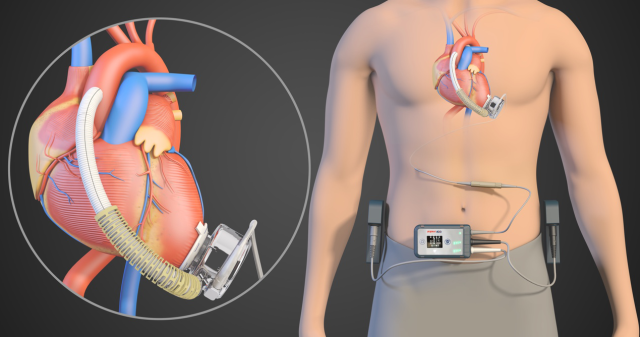
CH-VAD
In 2016, the “CH-VAD” product entered the national “green channel” for special approval of innovative medical devices, while its registration with the U.S. FDA was also being advanced concurrently.
Between June and October 2017, the team led by Academician Hu Shengshou at Fuwai Hospital obtained ethical approval via humanitarian exemption and consecutively employed the CH-VAD to treat three critically ill patients, achieving successful outcomes in all cases. The first patient has been living with the artificial heart for two years, maintaining a normal quality of life. The second patient underwent successful heart transplantation after five months of mechanical circulatory support. The third patient achieved complete native heart recovery after five and a half months of support, allowing for the successful explantation of the device. These three cases, each representing a distinct therapeutic strategy for artificial heart use, set historical precedents in China’s application of ventricular assist devices. The clinical success fully demonstrates the superior performance of the CH-VAD.
“CH-VAD” received clinical trial approval from the National Medical Products Administration (NMPA) at the end of 2018. In March 2019, the first subject was successfully enrolled. Four clinical cases have been completed at Beijing Fuwai Hospital and Central China Fuwai Hospital; all four patients have been discharged and are in good condition.
Industry Giants Invest Heavily to Capture the Artificial Heart Market
Since merging with Biosensors International last year, Bluesail Medical has established a development strategy focused on deepening its presence in the cardiovascular and cerebrovascular fields. Bluesail Medical has been strategically positioning itself in both the high-value consumables and the low-to-mid-value consumables segments. The high-value consumables segment primarily offers cardiac stents and interventional cardiac surgery-related devices, operated through Biosensors International based in Singapore. This business operates in over 90 countries worldwide and ranks fourth globally in the cardiac stent market. The low-to-mid-value consumables segment mainly features a medical protection product line including medical gloves, health protective gloves, first aid kits, and medical dressings, with its flagship PVC gloves holding a 22% global market share. This investment in BrioHealth Solutions will further expand Bluesail Medical’s technological frontier in the cardiac sector, enrich its product portfolio, and enable early entry into the heart failure market, which holds significant growth potential.

Bluesail Medical (SZ.002382)
For decades, very few implantable artificial hearts have advanced to clinical trials. Among existing companies in the implantable artificial heart sector, only Thoratec (under Abbott) and HeartWare (under Medtronic) have products approved for market authorization by the U.S. FDA, and these two companies collectively hold over 90% of the global market share. Both Abbott and Medtronic have invested heavily to enter this market.
In July 2015, St. Jude Medical, recognizing the potential of the HeartMate 3, which was then undergoing European CE clinical trials, announced its acquisition of Thoratec, a manufacturer of cardiac-related medical devices, for approximately $3.4 billion in cash. Subsequently, after failing to outbid St. Jude for Thoratec, Medtronic acquired HeartWare in June 2016 for a total transaction value of approximately $1.1 billion to maintain its overall competitiveness in the cardiovascular device industry. Shortly thereafter, Abbott acquired St. Jude Medical for $25 billion, expanding its scope to cover every key segment of the cardiovascular market. This move reshaped the global cardiovascular landscape, propelling Abbott to second place in the cardiovascular market, closely trailing Medtronic.
Today, Abbott, through its subsidiary Thoratec, owns the older-generation mechanical contact-bearing artificial heart, HeartMate II, and the newer-generation fully magnetically levitated artificial heart, HeartMate 3. Medtronic’s HeartWare only possesses the hydrodynamic bearing-based artificial heart, HVAD.
Sales of the HeartMate II and HVAD reached nearly $1 billion, demonstrating remarkable market potential. Following the launch of Abbott’s fully magnetically levitated artificial heart, the HeartMate 3, in October 2018, its heart failure business achieved double-digit growth. The first-quarter report of 2019 showed that revenue from its heart failure business amounted to $184 million, representing a significant increase of 20.9%, making it the fastest-growing segment within Abbott’s cardiovascular portfolio. It is evident that the market prospects for fully magnetically levitated artificial hearts are substantial.
BrioHealth Solutions is the only company in the world, apart from Abbott, that possesses mature fully magnetically levitated artificial heart technology. The development cycle—from R&D and product finalization to animal trials and fatigue testing—is exceptionally long, and the technology is extremely complex, requiring continuous exploration. Due to a lack of necessary comprehensive technological accumulation, other companies find it difficult to enter this field or surpass these advancements in the near term. BrioHealth Solutions can not only challenge Abbott’s technological monopoly but also has the capacity for sustained technological innovation, thereby maintaining its position at the international technological forefront.
Undoubtedly, Bluesail Medical’s investment in BrioHealth Solutions will accelerate the global market expansion of Chinese-made fully magnetically levitated artificial hearts, positioning China at the forefront of global technological advancements in this field, while also providing Bluesail Medical with a new growth driver.