

Janssen Submits New Drug Application to U.S. FDA for Ponesimod in Relapsing Multiple Sclerosis, Demonstrating Superior Efficacy Over Aubagio
Mar 19, 2020 13:55
CST Updated
13:55

Johnson & Johnson
Healthcare Product Manufacturers, Health Service Providers

Janssen Pharmaceuticals
Pharmaceutical R&D Developer

FDA
U.S. Food and Drug Administration

March 19, 2020/BioonBIOON/--Janssen Pharmaceuticals, a subsidiary of Johnson & Johnson (JNJ), recently announced that it has submitted to the U.S. Food and Drug Administration (FDA) submitted a New Drug Application (NDA) seeking approval for ponesimod for the treatment of adult patients with relapsing forms of multiple sclerosis (RMS). Earlier this month, Janssen Pharmaceuticals also submitted a Marketing Authorization Application (MAA) to the European Medicines Agency (EMA) for ponesimod for the same indication.
In the United States, there are nearly 1 million adult patients with multiple sclerosis (MS), approximately 85% of whom initiallyDiagnosiswas diagnosed with RMS. Although progress has been made in recent years, there remains an unmet medical need in this field. Compared with currently available therapies, ponesimod demonstrates superior efficacy, particularly in reducing new inflammatory lesions and disability accumulation. If approved for marketing, ponesimod will provide an important new oral medication for adult patients with RMS.
Ponesimod is a novel, oral, selective sphingosine-1-phosphate receptor 1 (S1P1) modulator that functionally inhibits S1P protein activity and sequesters lymphocytes within lymph nodes, thereby reducing the number of circulating lymphocytes capable of crossing the blood-brain barrier. In patients with multiple sclerosis (MS), lymphocytes enter the brain and damage myelin. Myelin is a protective sheath that insulates nerve cells. Damage to myelin can slow or block nerve conduction, resulting in the neurological symptoms and signs of multiple sclerosis.
This application is based on the results of the head-to-head Phase III OPTIMUM study (NCT02425644). The study was conducted in adult patients with RMS, comparing the efficacy, safety, and tolerability of ponesimod with Aubagio (Chinese brand name: Aubagio; generic name: teriflunomide). Aubagio is an oral medication from Sanofi, which was approved in the United States as early as September 2012.FDAApproved for the treatment of relapsing forms of multiple sclerosis (RMS), this drug is an industry-leading oral MS medication that has been launched in more than 70 countries and regions worldwide. In China, Aubagio (奥巴捷) was approved for marketing in July 2018, becoming the first oral disease-modifying therapy (DMT) approved in the country for the treatment of multiple sclerosis.
Notably, the OPTIMUM study is the first large-scale, controlled, head-to-head study comparing two oral medications for the treatment of relapsing multiple sclerosis (RMS). The data demonstrated that ponesimod (20 mg, once daily) was superior to Aubagio (14 mg, once daily) in terms of the primary endpoint and multiple secondary endpoints.
Specific data are as follows: (1) For the primary endpoint, from baseline to Week 108 of treatment, the annualized relapse rate (ARR) was statistically significantly reduced by 30.5% in the ponesimod group compared with the Aubagio group (ARR: 0.202 vs. 0.290; p=0.0003). (2) For the key secondary endpoint, based on the results of the Fatigue Symptoms and Impact Questionnaire–Relapsing Multiple Sclerosis (FSIQ-RMS) at Week 108, fatigue symptoms were statistically significantly reduced in the ponesimod group compared with the Aubagio group (mean difference: -3.57; p=0.0019). (3) For other secondary endpoints, the number of combined unique active lesions (CUAL) in the brain was significantly reduced by 56% in the ponesimod group compared with the Aubagio group (p<0.0001). (4) The safety profile of ponesimod observed in this study was consistent with that reported in previous studies and with the known safety profiles of other sphingosine-1-phosphate (S1P) receptor modulators. The most common treatment-emergent adverse events (TEAEs) in the ponesimod group were elevated alanine aminotransferase (ALT), nasopharyngitis, headache, and upper respiratory tract infection.
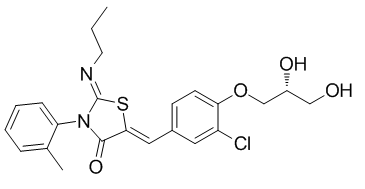
Molecular Structure of Ponesimod (Image Source: MedChemExpress)
Multiple Sclerosis (MS) is a chronic central nervous systemAutoimmunityMultiple sclerosis (MS) is a chronic inflammatory disease affecting 2.3 million people worldwide, with a higher prevalence in women than in men. The disease is characterized by demyelination and axonal loss, leading to neurological impairment and severe disability. The main subtype of MS is relapsing multiple sclerosis (RMS), which accounts for 85% of MS patients and includes clinically isolated syndrome (CIS), relapsing-remitting multiple sclerosis (RRMS), and active secondary progressive multiple sclerosis (SPMS). A relapse is defined as new, worsening, or recurrent neurological symptoms lasting more than 24 hours, in the absence of fever or infection. Relapses may fully resolve within days or weeks, or they may result in persistent deficits and the accumulation of disability.
Currently, sphingosine-1-phosphate (S1P) receptors have become an important target for new drug development in the field of multiple sclerosis (MS). In March 2019,NovartisMayzent (siponimod) approved in the United StatesFDAApproved for the treatment of adult patients with RMS, including active secondary progressive multiple sclerosis (SPMS), relapsing-remitting multiple sclerosis (RRMS), and clinically isolated syndrome (CIS). Notably, Mayzent is the first therapy specifically approved for the treatment of patients with active SPMS in the past 15 years. The active pharmaceutical ingredient of Mayzent is siponimod, a next-generation, selective sphingosine-1-phosphate (S1P) receptor modulator that selectively binds to S1P receptor 1 (S1P1) and receptor 5 (S1P5).
The regulatory application for the oral S1P receptor modulator ozanimod, from Celgene (acquired by Bristol-Myers Squibb), for the treatment of RMS is under review in the United States.FDAand the review by the European Medicines Agency (EMA), this drug can selectively bind to S1P1 and S1P5 with high affinity, with a mechanism of action similar toNovartisSimilar to Mayzent. Ozanimod selectively binds to S1P1, which is believed to inhibit the migration of a specific subset of activated lymphocytes to inflammatory sites, reduce the levels of circulating T and B lymphocytes—thereby exerting anti-inflammatory effects—and alleviate immune-mediated attacks on neural myelin. Due to ozanimod’s unique mechanism of action, patients’ immune surveillance functions are preserved. Furthermore, ozanimod’s binding to S1PR5 activates specialized cells within the central nervous system, promoting myelin regeneration and preventing synaptic defects, ultimately protecting against neural damage. Through the combined effects of these two mechanisms—"reducing damage" and "enhancing repair"—ozanimod has the potential to improve symptoms in various immune-mediated diseases.
It should be noted that ozanimod was previously in February 2018 by the United StatesFDARefusal to approve, on the grounds that the nonclinical and clinical pharmacology sections of the New Drug Application (NDA) were insufficient for a comprehensive review. This regulatory setback dealt a severe blow to the ozanimod program, leaving competitorsNovartisSecured an opportunity to overtake. In March 2019, Celgene resubmitted its New Drug Application (NDA) to the U.S. FDA and simultaneously filed a Marketing Authorization Application (MAA) with the European Medicines Agency (EMA). Regarding U.S. regulatory matters,FDAThe final review decision will be made on March 25 this year.
If approved, ozanimod will face competition from multiple oral medications, such asNovartisNovartis’s Gilenya and Mayzent, Sanofi’s Aubagio, Biogen’s Tecfidera and Vumerity, Merck’s Mavenclad, and Roche’s Ocrevus, an antibody drug requiring only two infusions per year. In addition to multiple sclerosis, ozanimod is currently being developed for various immune-inflammatory indications, including ulcerative colitis (UC) and Crohn’s disease (CD). (Bioon.com)