

Pfizer Announces Success of Abrocitinib in Three Phase 3 Trials for Moderate-to-Severe Atopic Dermatitis
Mar 19, 2020 13:59
CST Updated
13:55

Pfizer
Pharmaceutical R&D Developer

March 19, 2020/Bio ValleyBIOON/--PfizerPfizer recently announced that the Phase III JADE COMPARE study (B7451029, NCT03720470), evaluating the oral JAK1 inhibitor abrocitinib (PF-04965842) for the treatment of adults with moderate-to-severe atopic dermatitis (AD), met its co-primary efficacy endpoints, demonstrating improvements in skin clearance, disease extent and severity, and pruritus.
Abrocitinib is an oral small molecule that selectively inhibits Janus kinase 1 (JAK1). Inhibition of JAK1 is believed to modulate multiple cytokines involved in the pathophysiology of atopic dermatitis (AD), including interleukin (IL)-4, IL-13, IL-31, and interferon gamma. In the United States,FDABreakthrough Therapy Designation (BTD) for abrocitinib in the treatment of moderate-to-severe AD was granted in February 2018.
Notably, the JADE COMPARE study is the third successfully completed study in the global JADE development program evaluating abrocitinib for the treatment of moderate-to-severe atopic dermatitis (AD). Last year, two monotherapy Phase III studies within this program (JADE MONO-1 and JADE MONO-2) also achieved success, demonstrating attainment of the co-primary endpoints and key secondary endpoints related to skin clearance and pruritus relief.
Data from the JADE COMPARE study, together with results from the JADE MONO-1 and JADE MONO-2 studies, will support the submission of marketing authorization applications to regulatory agencies. Pfizer plans to initiate submissions to the U.S. Food and Drug Administration (FDA) Submit a New Drug Application (NDA) for abrocitinib in the treatment of moderate-to-severe atopic dermatitis (AD).
Pfizer Global Product Development, Inflammation andImmunologyDr. Michael Corbo, Chief Development Officer, stated, “It is helpful to study abrocitinib in combination with topical therapies to provide data relevant to real-world settings. The inclusion of a positive control group is also important for better understanding the significance of this potential new drug, and we are encouraged by the positive data from this trial.”
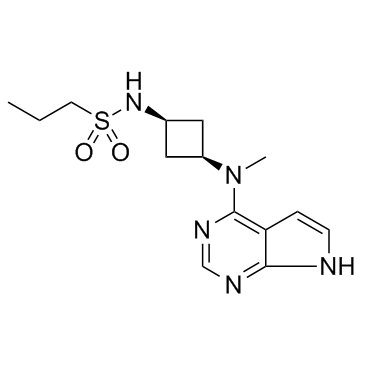
Molecular structure of abrocitinib (Image source: medchemexpress.cn)
The JADE COMPARE study enrolled adult patients with moderate-to-severe atopic dermatitis (AD) receiving background topical therapy, and evaluated abrocitinib (100 mg or 200 mg, once daily, orally), placebo 1 (matched to abrocitinib, once daily, orally), the active comparator dupilumab (300 mg every 2 weeks subcutaneously, with a 600-mg loading dose at baseline), and placebo 2 (matched to dupilumab, every 2 weeks subcutaneously).
In the study, 837 patients were randomly assigned to five treatment groups: (1) abrocitinib (100 mg) plus placebo 2 from Day 1 to Week 16, followed by abrocitinib (100 mg) through Week 20; (2) abrocitinib (200 mg) plus placebo 2 from Day 1 to Week 16, followed by abrocitinib (200 mg) through Week 20; (3) dupilumab plus placebo 1 from Day 1 to Week 16, followed by placebo 1 through Week 20; (4) placebo 1 plus placebo 2 through Week 16, followed by abrocitinib (100 mg) through Week 20; and (5) placebo 1 plus placebo 2 through Week 16, followed by abrocitinib (200 mg) through Week 20.
The co-primary endpoints of the study were: the proportion of patients achieving an Investigator’s Global Assessment (IGA) score of clear (0) or almost clear (1), with a reduction of ≥2 points from baseline, at Week 12 of treatment; and the proportion of patients achieving at least a 75% improvement in the Eczema Area and Severity Index (EASI) score from baseline at Week 12 of treatment. Key secondary endpoints included: the proportion of patients achieving the IGA and EASI response criteria at Week 16 of treatment; and the proportion of patients achieving a reduction of ≥4 points from baseline in itch severity, as measured by the Peak Pruritus Numerical Rating Scale (PP-NRS), at Week 2 of treatment. The relative itch relief of abrocitinib was formally compared with dupilumab only at Week 2.
The results showed that the study met its co-primary endpoints at Week 12: both doses of abrocitinib demonstrated superiority over placebo in terms of the proportion of patients achieving each primary efficacy endpoint. At Week 16, both doses of abrocitinib remained superior to placebo. At both Week 12 and Week 16, the active control drug dupilumab was also superior to placebo for the primary efficacy endpoints. Regarding key secondary endpoints, the proportion of patients achieving a clinically meaningful reduction in pruritus at Week 2 was statistically significantly higher with abrocitinib 200 mg than with dupilumab; the 100 mg dose showed a numerically higher proportion than dupilumab but did not reach statistical significance. The safety profile of abrocitinib in this study was consistent with that observed in previous studies. The complete results of this study will be presented at a future medicalMeetingPublished on Bioon.com.
Original Source: Pfizer Announces Positive Top-Line Results from Third Phase 3 Trial of Abrocitinib for Moderate to Severe Atopic Dermatitis, Which Showed Improvements in Skin Clearance, Disease Extent and Severity, and Itch