

Phase II Registrational Study of Lenvima (lenvatinib) plus Keytruda (pembrolizumab) Demonstrates Robust Efficacy in Advanced Endometrial Cancer
Mar 20, 2020 15:09
CST Updated
15:09
Eisai
Pharmaceutical Product R&D and Manufacturer

MSD
Pharmaceutical R&D and Manufacturer
March 20, 2020/BioValleyBIOON/-- Japanese pharmaceutical company Eisai recently announced that the positive results of the Phase II study (Study 111/KEYNOTE-146, NCT02501096) evaluating the molecular targeted therapy Lenvima (brand name: Lenvima; generic name: lenvatinib) in combination with Merck & Co.'s anti-PD-1 therapy Keytruda (brand name: Keytruda; generic name: pembrolizumab) for the treatment of advanced endometrial cancer have been published online in ClinicalTumorJournal of Clinical Oncology). The article is titled:Lenvatinib and pembrolizumab in patients with advanced endometrial cancer。
Based on the research data, the United StatesFDAIn mid-September 2019, the combination therapy of Keytruda + Lenvima was granted accelerated approval for the treatment of patients with advanced endometrial cancer who had disease progression following prior systemic therapy, were not candidates for curative surgery or radiation therapy, and whose tumors were not microsatellite instability-high (MSI-H) or mismatch repair deficient (dMMR). Additionally, in September 2019, the Therapeutic Goods Administration (TGA) of Australia and Health Canada also approved the Keytruda + Lenvima combination regimen for the treatment of patients with advanced endometrial cancer.
Notably, endometrial cancer also marks the first U.S. regulatory approval for the combination of Keytruda and Lenvima. Currently, MSD and Eisai are collaborating to develop this combination for multiple types of cancer. Previously,FDAThe combination has been granted three Breakthrough Therapy Designations (BTD) for: (1) the treatment of advanced and/or metastatic microsatellite-stable (MSS)/proficient mismatch repair (pMMR) endometrial cancer (EC); (2) the treatment of advanced and/or metastatic renal cell carcinoma (RCC); and (3) first-line treatment of advanced unresectable hepatocellular carcinoma (HCC) in patients ineligible for locoregional therapy.
KEYNOTE-146/Study 111 is a Phase Ib/II, open-label, single-arm trial that treated 108 patients with metastatic endometrial cancer who had experienced disease progression after at least one prior systemic therapy, with a median follow-up of 18.7 months. Among these patients, 94 had tumors that were not microsatellite instability-high (MSI-H) or mismatch repair-deficient (dMMR), 11 had MSI-H or dMMR tumors, and the tumor status was unknown for 3 patients. In the study, patients received Lenvima 20 mg orally once daily and Keytruda 200 mg via intravenous infusion every 3 weeks. The primary endpoint was the overall response rate (ORR) assessed by study investigators at Week 24 according to the immune-related Response Evaluation Criteria in Solid Tumors (irRECIST). Secondary endpoints included duration of response (DOR), progression-free survival (PFS), overall survival (OS), disease control rate (DCR), clinical benefit rate (CBR), safety, and tolerability as of the data cutoff date (January 10, 2019). Prespecified exploratory endpoints included independent imaging review (IIR) according to irRECIST and RECIST version 1.1, as well as evaluation based on PD-L1 status of anti-TumorActivity.
(Click the image to view a larger version))

The results showed: (1) In 108 patients with metastatic endometrial cancer (regardless of microsatellite instability [MSI] or mismatch repair [MMR] status), the objective response rate (ORR) at Week 24 for Keytruda plus Lenvima combination therapy was 38.0% (n=41; 95% CI: 28.8–47.8%), and the overall ORR at data cutoff was 38.9% (n=41; 95% CI: 29.7–48.7%), with a complete response (CR) rate of 7.4% (n=8), a partial response (PR) rate of 31.5% (n=34), and a median duration of response (DOR) of 21.2 months (range: 1.2+ to 35.6+ months). (2) In 94 patients with non-MSI-H or non-dMMR tumors, the ORR at Week 24 for Keytruda plus Lenvima combination therapy was 36.2% (n=34; 95% CI: 26.5–46.7%), and the overall ORR at data cutoff was 37.2% (n=35; 95% CI: 27.5–47.8%), with a CR rate of 7.4% (n=7), a PR rate of 29.8% (n=28), and a median DOR that was not estimable (range: 1.2+ to 33.8+ months). (3) In 11 patients with MSI-H or dMMRTumorAmong the patients, the objective response rate (ORR) at Week 24 with Keytruda plus Lenvima combination therapy was 63.6% (n=7; 95% CI: 30.8%-89.1%). The overall ORR at data cutoff was 63.6% (n=7; 95% CI: 30.8%-89.1%), with a complete response rate of 9.1% (n=1), a partial response rate of 54.5% (n=6), and a median duration of response (DOR) of 21.2 months (range: 6.1+ to 35.6+ months).
In the prespecified exploratory analysis, tumor response was also assessed by independent imaging review (IIR) according to RECIST version 1.1: (1) Among 108 patients, at the data cutoff, the objective response rate (ORR) for Keytruda plus Lenvima combination therapy was 40.7% (n=44; 95% CI: 31.4%-50.6%), with a complete response rate of 10.2% (n=11), a partial response rate of 30.6% (n=33), and a median duration of response (DOR) of 14.8 months (range: 1.2+ to 35.6+ months). The median progression-free survival (PFS) was 7.5 months (95% CI: 5.0-8.3), and the median overall survival (OS) was 16.7 months (95% CI: 15.0-NE). (2) Among 94 patients with non-MSI-H or dMMR tumors, at the data cutoff, the ORR for Keytruda plus Lenvima combination therapy was 38.3% (n=36; 95% CI: 28.5%-48.9%), with a complete response rate of 10.6% (n=10), a partial response rate of 27.7% (n=26), a median DOR that was not estimable (range: 1.2+ to 33.1+ months), a median PFS of 5.4 months (95% CI: 4.4-7.6), and a median OS of 16.4 months (95% CI: 13.5-25.9). (3) Among 11 patients with MSI-H or dMMRTumorAmong the patients, at the data cutoff, the ORR for Keytruda + Lenvima combination therapy was 63.6% (n=7; 95% CI: 30.8%-89.1%), the complete response rate was 9.1% (n=1), the partial response rate was 54.5% (n=6), the median DOR was not estimable (range: 2.1+ to 35.6+ months), the median PFS was 18.9 months (95% CI: 3.9-NE), and the median OS was not estimable (95% CI: 7.4-NE).
Regarding safety, among the entire study population (n=108), 97.2% (n=105) of patients receiving Keytruda + Lenvima combination therapy experienced treatment-related treatment-emergent adverse events (TEAEs), and 69.4% (n=75) of patients experienced grade 3/4 treatment-related TEAEs. The most common TEAEs (≥3%) associated with Keytruda + Lenvima combination therapy wereHypertension(32.4%), fatigue (8.3%), diarrhea (6.5%), and proteinuria (3.7%). In the overall study population (n=108), immune-related treatment-emergent adverse events (TEAEs) occurred in 57.4% (n=62) of patients receiving Keytruda plus Lenvima combination therapy. The most common immune-related TEAEs (all grades, ≥20%) were hypothyroidism (47.2%). Grade 3–4 immune-related TEAEs occurred in 13% (n=14) of patients, with the most common immune-related TEAEs (≥Grade 3) being severe skin reactions (4.6%).
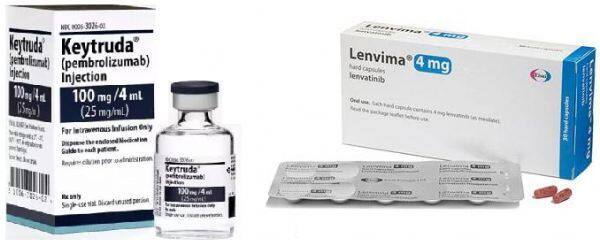
Lenvima is a targeted drug discovered and developed internally by Eisai. It is an oral multi-receptor tyrosine kinase (RTK) inhibitor with a novel binding mode, inhibiting not only those involved in tumor angiogenesis and tumor progression, but alsoTumorIn addition to other receptor tyrosine kinases (RTKs) associated with pro-angiogenic and oncogenic signaling pathways involved in immune modulation, including platelet-derived growth factor (PDGF) receptors PDGFRα, KIT, and RET, it can also selectively inhibit the kinase activity of vascular endothelial growth factor (VEGF) receptors (VEGFR1, VEGFR2, VEGFR3) and fibroblast growth factor (FGF) receptors (FGFR1, FGFR2, FGFR3, FGFR4).
Keytruda is an anti-PD-1 cancer immunotherapy that helps detect and fight tumor cells by enhancing the capacity of the human immune system. Keytruda is a humanized monoclonal antibody that blocks the interaction between PD-1 and its ligands, PD-L1 and PD-L2, thereby activating T lymphocytes that may affect both tumor cells and healthy cells. To date, there are nine PD-(L)1TumorImmunotherapy Approved, with Keytruda Leading the Field.
The Lenvima + Keytruda combination therapy is part of the strategic oncology collaboration between MSD and Eisai. In March 2018, the two companies signed a collaboration agreement worth up to $5.8 billion to develop Lenvima as monotherapy and in combination with Keytruda for the treatment of various types of tumors. In addition to the ongoing evaluations of the Lenvima and Keytruda combination therapy for several different tumor types, including renal cell carcinoma,TumorIn addition, the two parties also launched the LEAP clinical program to evaluate the combination for 11 treatment indications across six types of cancer (endometrial cancer, hepatocellular carcinoma,Melanoma, non-small cell lung cancer, head and neck squamous cell carcinoma, urothelial carcinoma). The LEAP clinical program also includes a new basket study targeting six additional cancer types (biliary tract cancer, triple-negativeBreast Cancer, colorectal cancer, gastric cancer, glioblastoma, ovarian cancer). (Bioon.com)