

BioStable Advances Aortic Valve Repair with Three Proprietary Devices, Files for IPO After Securing Four Rounds of Funding

BioStable
A Cardiovascular Device Company
In February 2020, BioStable completed its Series C financing round, marking the fourth fundraising effort for this company specializing in vascular valve replacement and repair.
BioStable, founded in 2008 and headquartered in the southern United States, is a cardiovascular device company focused on developing and commercializing proprietary valve repair technologies, offering an alternative to valve replacement for patients with aortic valve disease.
In the current era, the healthcare sector is rising rapidly, drawing increasing attention to the medical industry. Given the numerous branches within this industry, which direction should be pursued to achieve greater long-term success and enhance a company’s development prospects?
BioStable established its strategic direction from the outset, founded by a team of seasoned industry executives. Their collective expertise integrates core competencies in product development, including quality systems, design, engineering, prototyping and pilot production, in vitro and in vivo testing, manufacturing, global regulatory affairs, clinical product validation, market launch, and distribution. BioStable delivers a competitive advantage by accelerating time-to-market for medical devices and enhancing clinical outcomes.
BioStable’s founding team consists of five former executives from CarboMedics, including Charles Griffin, former President; Rusty Phillips, former Vice President of Research and Development; Al Beavan, former Vice President of Engineering; Doug Frank, former Vice President of Quality Assurance; and Don James, former Senior Director of Operations. Collectively, the team brings over 100 years of experience in the implantable medical device industry and has worked together for more than two decades.
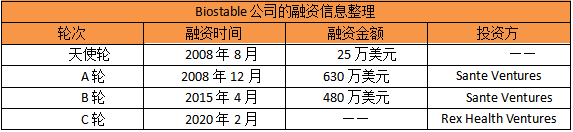
In terms of financing,BioStable secured $250,000 in angel funding as early as August 2008. It subsequently completed its Series A financing in December 2008, its Series B financing in April 2015, and its Series C financing in February 2020, primarily from Rex Health Ventures.BioStable utilizes 10 technical products and services, including Google Analytics, WordPress, and Vimeo. BioStable’s intellectual property portfolio includes seven registered patents, primarily in the field of “medical or veterinary science; hygiene.” Additionally, two trademarks have been registered.
John Wheeler joined BioStable in September 2015 as President and Chief Executive Officer. Over his 25-year career in the medical device industry, John has held numerous leadership positions in both early-stage startups and globally leading medical device companies. From 2005 to 2013, John served as Director of Product Development and Marketing at SpineRepair, a startup based in Austin, Texas, where he helped lead the company from early preclinical development through the completion of Phase III Investigational New Drug studies.
Prior to joining Zimmer, John served as the Marketing Director. During his eight-year tenure at Sulzer Orthopedics, he held various roles in marketing and product development. John possesses extensive expertise in business strategy development and the commercialization of new technologies.
In terms of academic qualifications, John earned a Bachelor of Science in Bioengineering from Texas A&M University and a Master of Business Administration from Baylor University. Leveraging his robust expertise in both business and technical domains, he has demonstrated exceptional leadership in steering the company. His efforts not only secured regulatory approvals but also elevated BioStable to new heights in promoting its technologies across the United States and Europe.
BioStable’s HAART technology (HAART 300, HAART 200, aortic root repair) is its core technology.
The HAART 300 Aortic Annuloplasty Device was designed based on mathematical reconstruction of normal aortic valve images derived from high-resolution computed tomography angiography (CTA). The HAART 300 Aortic Annuloplasty Device replicates the normal anatomy of the aortic annulus, featuring an elliptical base with a short-to-long axis ratio of 2:3, and three outwardly flaring posts evenly distributed around the circumference of the base. This device is intended to reduce annular dilation, restore three-dimensional annular geometry, and serve as a framework to guide repair procedures.
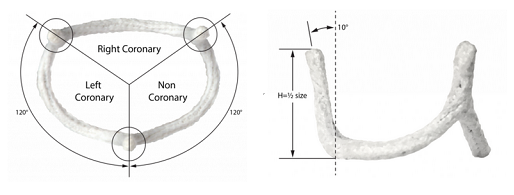
Standardized Annuloplasty Technique:Device sizing is determined by measuring the length of the leaflet free edge. Utilizing leaflet anatomy to determine implant size helps ensure that the HAART annuloplasty device restores appropriate three-dimensional coaptation geometry for the available leaflet tissue. Implantation is accomplished by placing nine circumferential sutures, which position the device beneath the annulus and away from the valve leaflets. Once implanted, the HAART annuloplasty device serves as a framework to guide leaflet repair techniques, thereby restoring valvular competence.
HAART 300 Clinical Trial
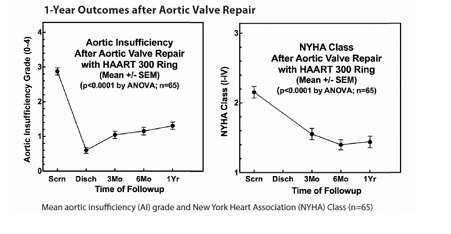
In 65 patients, the HAART 300 clinical trial provided robust evidence of the potential safety and efficacy of the HAART 300 device:
Low incidence, with no in-hospital mortality;
v 95% survival rate at a mean follow-up of 2 years;
Meaningful gradient 9.4 mmHg, valve area 2.7 cm²;
xAI grade and NYHA grade significantly improved.
The HAART 200 aortic valvuloplasty device is sold exclusively in the United States. The HAART 200 aortic annuloplasty is specifically designed for bicuspid aortic valve repair. In bicuspid valve disease, two of the three aortic valve leaflets are fused. This condition affects approximately 2% of the population, is congenital, and is frequently associated with aortic aneurysm and concomitant aortic regurgitation. The HAART 200 aortic annuloplasty device is designed to reduce annular dilation while reorienting the two leaflets into a semicircular configuration. This orientation helps establish effective coaptation geometry and simplifies the leaflet repair procedures required to restore valve function.
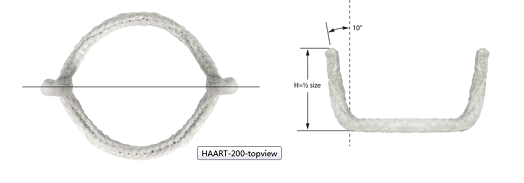
Standardized Annuloplasty Technique: Similar to the HAART 300 Aortic Annuloplasty Device, the size and implantation technique of the HAART 200 Aortic Annuloplasty Device have been standardized to simplify and enhance the reproducibility of mitral valve repair. Device sizing is selected based on measurements of the non-fused leaflet anatomy, and the device is implanted using nine sutures to position and secure it to the valvular annulus.
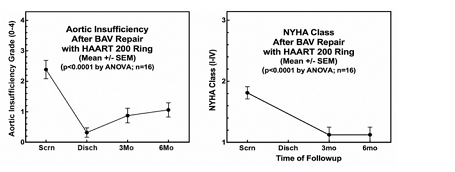
Research on the HAART 200 Aortic Valvuloplasty Device: Results from 16 patients in the HAART 200 aortic annuloplasty device study are encouraging. Significant improvements were observed in aortic regurgitation and NYHA functional class.
Aortic Valve RepairThis represents the most common presentation of aortic regurgitation combined with an aortic root aneurysm. In the context of an aortic root aneurysm, dilation and distortion of the three-dimensional geometry of the aortic valve can lead to significant aortic regurgitation, even though the leaflet tissue remains essentially intact. For many patients, the preferred surgical treatment is valve-sparing aortic root replacement, a procedure that involves resection and replacement of the affected portions of the aorta, combined with aortic valve repair to eliminate aortic regurgitation.
To Achieve Stable AnnuloplastyThe most commonly used valve-sparing root replacement requires deep dissection of the aortic root and reimplantation of the aortic valve within a synthetic aortic graft. Aortic root repair is an alternative procedure that combines aneurysm resection, graft replacement, and internal ring annuloplasty using the HAART (Heart Valve Annuloplasty Ring Technology) device. Aortic root repair provides internal geometric annuloplasty while avoiding deep root dissection.
Since its inception, BioStable has focused on the development and commercialization of proprietary valve repair technologies, providing an alternative to valve replacement for patients with aortic valve disease. The company has continued to advance its own technologies, leaving an indelible mark in this specialized field.
In the United States and Europe, more than 20,000 patients undergo aortic root replacement annually.. In most cases, the aortic valve is largely intact and functions normally. However, in these cases, approximately 70% of aortic valves are replaced because surgical procedures to repair and stabilize the aortic valve are challenging. A fundamental factor contributing to the slow progress in aortic valve repair is the lack of medical device technologies that simplify and standardize surgical processes. In particular, rigid internal annuloplasty devices are not yet suitable as the foundation for repeat aortic valve repairs.
BioStable’s developed technology is annuloplasty, which involves surgically implanting an annuloplasty ring to restore normal annular dimensions and prevent progressive annular dilation over time. By combining valvuloplasty with surgical techniques to repair damage to valve leaflets and other valvular structures, surgeons can routinely restore valve function without excising the patient’s native valve tissue.
BioStable’s ability to secure rapid financing and successfully bring its products to market is no accident. First, the company has a clear understanding of its positioning, backed by a team of experienced industry executives. A company’s success is not achieved overnight; early-stage preparations, robust technical capabilities, and the vision and ambition of its leadership all determine its prospects. As the saying goes, “A journey of a thousand miles begins with a single step.” When every step of a company’s development is meticulously planned, success becomes inevitable.
[1].Rankin JS, et al. A refined hemispheric model of normal human aortic valve and root geometry. J Thorac Cardiovasc Surg. 2013 Jul;146(1):103-108.
[2].Crooke PS, et al. Design Characteristics of a Three-Dimensional Geometric Aortic Valve Annuloplasty Ring. Innovations 2013;8:364-370.
[3].Mazzitelli D, et al. Geometric ring annuloplasty as an adjunct to aortic valve repair: clinical investigation of the HAART 300 device. Eur J Cardiothorac Surg 2016;49:987–93.
[4].Opotowsky AR, et al. A shifting approach to management of the thoracic aorta in bicuspid aortic valve. J Thorac Cardiovasc Surg. 2013 Aug;146(2):339-46.
[5].Mazzitelli D, at al. A Regulated Trial of Bicuspid Aortic Valve Repair Supported by Geometric Ring Annuloplasty. Ann Thorac Surg 2015;99:2010–6.
[6].Saczkowski R, et al. Systematic review of aortic valve preservation and repair. Ann Cardiothorac Surg 2013;2(1):3-9.
[7].David T, et al. Aortic root aneurysm: Principles of repair and long-term follow-up. J Thorac Cardiovasc Surg 2010;140:S14-9.