


On March 25, Merck KGaA announced that Japan’s Ministry of Health, Labour and Welfare had approved the marketing of Tepmetko (tepotinib) for the treatment of patients with unresectable, advanced or recurrent non-small cell lung cancer (NSCLC) harboring MET exon 14 skipping mutations. This is the first orally administered MET inhibitor to receive approval worldwide.
This approval is based on the results of the single-arm, Phase II VISION study. The study enrolled a total of 99 patients (including 15 Japanese patients) with non-small cell lung cancer (NSCLC) confirmed to have MET exon 14 skipping mutations via tissue biopsy or liquid biopsy. The results showed that the objective response rate (ORR) in patients treated with tepotinib was 42.4%, and the median duration of response (DoR) was 12.4 months. A safety analysis conducted in 130 patients demonstrated that tepotinib was well tolerated, with the most common treatment-related adverse events (TRAEs) being peripheral edema (53.8%), nausea (23.8%), and diarrhea (20.8%). TRAEs led to permanent discontinuation in 11 patients (8.5%).
Lung cancer is the most common type of cancer worldwide. In 2018, there were 2.1 million newly diagnosed cases of lung cancer globally, with 1.8 million deaths. Non-small cell lung cancer (NSCLC) accounts for approximately 85% of all lung cancer cases and includes known oncogenic mutations. MET exon 14 skipping mutations occur in 3–4% of newly diagnosed advanced NSCLC cases.
Tepotinib is an oral MET inhibitor designed to inhibit MET receptor signaling caused by MET gene mutations, including MET exon 14 skipping mutations, MET amplification, or MET protein overexpression. Currently, tepotinib has not been approved in countries other than Japan. In September 2019, the FDA granted the drug Breakthrough Therapy designation for the treatment of patients with metastatic non-small cell lung cancer (NSCLC) harboring MET exon 14 skipping mutations who have progressed on platinum-based therapy. In China, four clinical trials of the drug are currently ongoing.
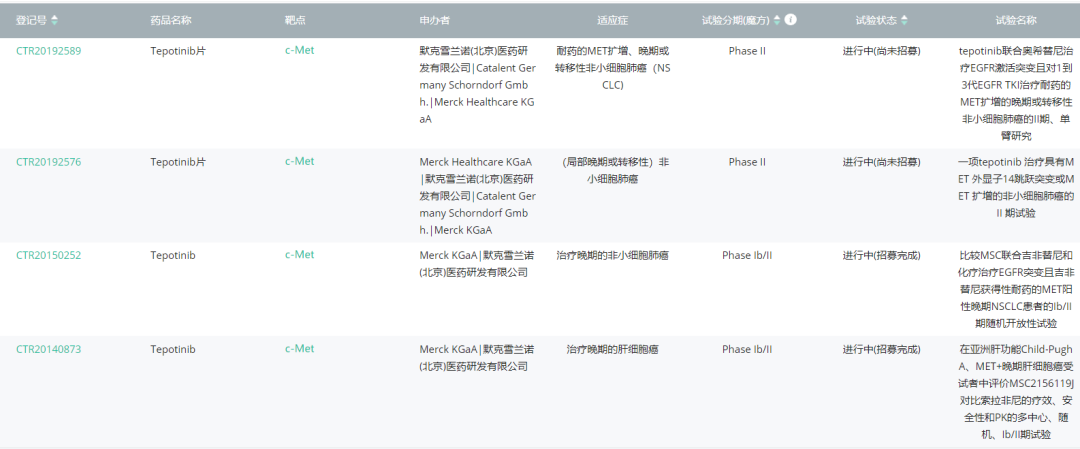
Source: PharmaCube PharmaGo China Clinical Trial Database
Prior to tepotinib, only crizotinib and cabozantinib, two MET-related drugs, had been approved for marketing globally. However, both are multi-target inhibitors and do not exclusively inhibit c-MET. Tepotinib is the first single-target inhibitor specifically directed against c-MET worldwide.
In addition, on February 11, 2020, the FDA accepted Novartis’s New Drug Application (NDA) for the MET inhibitor capmatinib and granted it Priority Review designation for the treatment of patients with locally advanced or metastatic non-small cell lung cancer (NSCLC) harboring MET exon 14 skipping mutations.