

Sanofi's CD38 Antibody Sarclisa Nears EU Approval to Challenge J&J's $3B Blockbuster Darzalex in Multiple Myeloma
Mar 28, 2020 14:45
CST Updated
14:45

Sanofi
Pharmaceutical R&D Developer

March 28, 2020 /Bio ValleyBIOON/ -- Sanofi recently announced that the Committee for Medicinal Products for Human Use (CHMP) of the European Medicines Agency (EMA) has issued a positive opinion, recommending the approval of the CD38-targeting antibody drug Sarclisa (isatuximab), in combination with pomalidomide and dexamethasone (pom-dex), for adult patients with relapsed and refractory multiple myeloma (RRMM) who have received at least two prior therapies, including lenalidomide and a proteasome inhibitor, and have demonstrated disease progression during or after their last therapy. The CHMP’s opinion will now be submitted to the European Commission (EC) for review, which is expected to make a final decision within the next 2–3 months.
In the United States, Sarclisa was approved on March 2 this year, in combination with pom-dex, for adult patients with relapsed/refractory multiple myeloma (RRMM) who have previously received at least two therapies (including lenalidomide and a proteasome inhibitor). In clinical studies, treatment with Sarclisa in combination with pom-dex significantly reduced the risk of disease progression or death by 40% compared to pom-dex therapy.
Multiple myeloma (MM) is the second most common blood cancer, with new cases worldwide each yearDiagnosisOver 138,000 cases. In Europe, 39,000 cases are diagnosed annually; in the United States, 32,000 cases are diagnosed annually. Despite available treatments, MM remains an incurable malignancyTumor, associated with a significant burden on patients. As multiple myeloma (MM) is incurable, most patients will eventually relapse and become refractory to currently available therapies. The regimen of Sarclisa in combination with pomalidomide and dexamethasone (pom-dex) will provide an important new treatment option for these patients.
The CHMP’s positive opinion was based on data from the pivotal Phase III ICARIA-MM study. This was a randomized, open-label, multicenter study conducted at 96 centers across 24 countries, enrolling a total of 307 patients with relapsed/refractory multiple myeloma (RRMM). These patients had previously received multiple (median, 3) anti-myeloma therapies, including at least two consecutive lines of treatment with lenalidomide and a proteasome inhibitor, either as monotherapy or in combination. In the study, isatuximab was administered intravenously at a dose of 10 mg/kg once weekly for the first 4 weeks, then every other week thereafter, in combination with standard-dose pomalidomide and dexamethasone (pom-dex) throughout the treatment period.
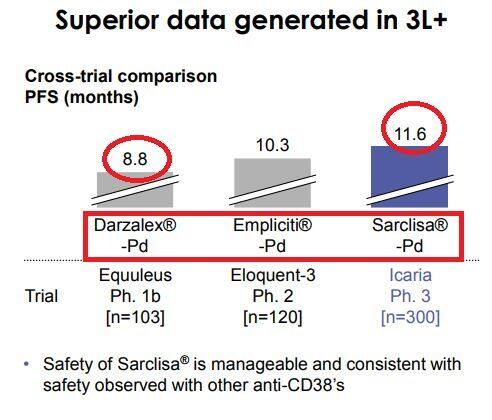
This study is the first Phase III trial to demonstrate positive outcomes with Sarclisa in combination with standard of care (pomalidomide plus dexamethasone, pom-dex), enrolling patients with relapsed and refractory multiple myeloma who are particularly difficult to treat and have a very poor prognosis, thereby reflecting real-world clinical practice. The results showed that, in this patient population, Sarclisa combined with pom-dex significantly prolonged progression-free survival (median PFS: 11.53 months vs. 6.47 months), reduced the risk of disease progression or death by 40% (HR=0.596; 95% CI: 0.44–0.81; p=0.0010), and significantly improved the overall response rate (ORR: 60.4% vs. 35.3%, p<0.0001) compared with standard of care (pom-dex). Treatment benefits were observed across all subgroups, including patients aged ≥75 years, those with renal impairment, and those with lenalidomide-refractory disease.
The active pharmaceutical ingredient of Sarclisa, isatuximab, is an IgG1 chimeric monoclonal antibody that targets a specific epitope of the CD38 receptor on plasma cells. It triggers multiple unique mechanisms of action, including promoting programmed tumor cell death (apoptosis) and exerting immunomodulatory activity. CD38 is highly expressed on multiple myeloma (MM) cells and serves as a cell-surface receptor target for antibody therapy in MM and other malignancies. In both the United States and the European Union, isatuximab has been granted orphan drug designation for the treatment of relapsed/refractory multiple myeloma (R/R MM). Currently, Sanofi is also evaluating isatuximab for the treatment of other hematologic malignancies.Tumorand the potential for solid tumors.
Following its market launch, Sarclisa will become the first direct competitor to Johnson & Johnson’s blockbuster CD38-targeted therapy, Darzalex, which was launched in 2015 and achieved global sales of $2.998 billion in 2019, representing a 48.0% year-over-year increase. Analysts at Jefferies, a Wall Street investment bank, project that Sarclisa’s annual peak sales will exceed $1 billion.
Currently, Sanofi is advancing multiple Phase III clinical studies to evaluate isatuximab in combination with currently available standard therapies for the treatment of patients with RRMM or newDiagnosisof MM patients. MM is the second most common hematologic malignancyTumorGlobally, the annual number of new cases exceeds 1.38 million. For most patients, multiple myeloma (MM) remains incurable, resulting in a significant unmet medical need in this field. (Bioon.com)
Original Source: Sanofi receives positive CHMP opinion for Sarclisa® (isatuximab) for the treatment of relapsed and refractory multiple myeloma