

Janssen's IL-23 Inhibitor Tremfya Demonstrates Success in Phase III Trials for Psoriatic Arthritis; Already Approved in China for Plaque Psoriasis
Apr 15, 2020 10:55
CST Updated
10:55

Johnson & Johnson
Healthcare Product Manufacturers, Health Service Providers

Janssen Pharmaceuticals
Pharmaceutical R&D Developer

April 15, 2020 News /BioonBIOON/ -- Janssen Pharmaceuticals, a subsidiary of Johnson & Johnson (JNJ), recently announced that data from two Phase III clinical trials (DISCOVER-1 and DISCOVER-2) evaluating the safety and efficacy of Tremfya (tremfya, generic name: guselkumab) in adult patients with active psoriatic arthritis (PsA) have been published online in The Lancet, a premier international medical journal.
Tremfya is a monoclonal antibody that selectively binds to the p19 subunit of interleukin-23 (IL-23) and inhibits its interaction with the IL-23 receptor. IL-23 is a key driver in the pathogenesis of inflammatory diseases such as psoriasis and psoriatic arthritis (PsA).
Notably, the data published in *The Lancet* represent the first Phase III clinical trial results evaluating the safety and efficacy of an anti-IL-23 monoclonal antibody for the treatment of active psoriatic arthritis (PsA). Currently, Tremfya has not been approved for the indication of PsA; its new indication application for treating adult patients with active PsA is under review by the U.S. Food and Drug Administration (FDA) review.
The DISCOVER-1 study evaluated 381 patients with active psoriatic arthritis (PsA) who had an inadequate response to standard therapy, including those previously treated with anti-Tumorpatients treated with tumor necrosis factor alpha (TNF-α) biologics (approximately 30%). The DISCOVER-2 study evaluated 739 patients with active psoriatic arthritis (PsA) who were biologic-naïve and had an inadequate response to standard therapy.
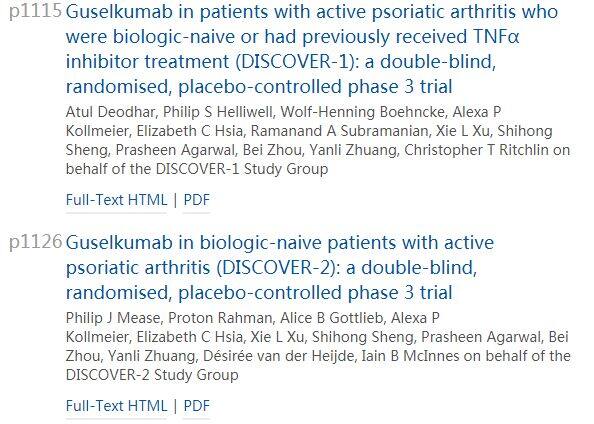
Results published in The Lancet showed that both studies met their primary endpoints: at 24 weeks of treatment, a significantly higher proportion of patients in the Tremfya group achieved at least a 20% improvement in signs and symptoms of disease (ACR20 response) compared with the placebo group. Additionally, results for secondary endpoints were also reported in The Lancet.
Joint Symptoms:(1) In the DISCOVER-1 study, 59% of patients in the Tremfya every 4 weeks (Q4W) treatment group and 52% of patients in the Tremfya every 8 weeks (Q8W) treatment group achieved an ACR20 response, compared with 22% in the placebo group (both p<0.001). In the DISCOVER-2 study, at Week 24 of treatment, 64% of patients in both the Tremfya Q4W and Tremfya Q8W treatment groups achieved an ACR20 response, compared with 33% in the placebo group (both p<0.0001). (2) In the DISCOVER-1 study, 37% and 30% of patients in the Tremfya Q4W and Tremfya Q8W treatment groups, respectively, achieved an ACR50 response, compared with 9% in the placebo group (both p<0.0001). In the DISCOVER-2 study, 33% and 31% of patients in the Tremfya Q4W and Tremfya Q8W treatment groups, respectively, achieved an ACR50 response, compared with 14% in the placebo group (both p<0.0001). Furthermore, at Week 24 of treatment, a higher proportion of patients in the Tremfya Q4W and Q8W treatment groups achieved an ACR70 response compared with the placebo group. (3) In the DISCOVER-2 study, the effect of Tremfya on inhibiting the progression of radiographic damage was also assessed, evaluated by the mean improvement from baseline in the van der Heijde modified Total Sharp Score. Tremfya Q4W demonstrated a statistically significant inhibition of radiographic progression of joint structural damage (p=0.011). At Week 24, Tremfya Q8W also showed an inhibitory effect on structural damage compared with placebo, but the difference was not statistically significant (p=0.072).
Skin:(1) In the DISCOVER-1 study, among patients with clinically relevant psoriasis at baseline (psoriasis affecting body surface area [BSA] ≥3% and a baseline Investigator’s Global Assessment [IGA] score ≥2), 75% and 57% of patients treated with Tremfya Q4W and Tremfya Q8W, respectively, achieved an IGA score of 0 (complete clearance of skin lesions) or 1 (almost complete clearance of skin lesions) with a reduction of ≥2 grades, compared to 15% in the placebo group (all p<0.0001). In the DISCOVER-2 study, 69% and 71% of patients treated with Tremfya Q4W and Tremfya Q8W, respectively, achieved an IGA score of 0 (complete clearance of skin lesions) or 1 (almost complete clearance of skin lesions) with a reduction of ≥2 grades, compared to 19% in the placebo group (all p<0.0001). (2) At Week 24 of treatment, a higher proportion of patients in the Tremfya Q4W and Q8W treatment groups achieved PASI75, PASI90, and PASI100 responses compared to the placebo group; all unadjusted p-values were <0.0001 in the DISCOVER-1 study (with p=0.0005 for PASI100), and all unadjusted p-values were <0.0001 in the DISCOVER-2 study.
Comprehensive Measurement of Soft Tissue Inflammation and Disease Activity:(1)Based on pooled data analyses from the DISCOVER-1 and DISCOVER-2 studies, among patients with enthesitis (pain at the sites where bones, tendons, and ligaments meet) at baseline, 45% and 50% of patients in the Tremfya Q4W and Tremfya Q8W treatment groups, respectively, achieved resolution of enthesitis, compared with 29% in the placebo group (both p=0.0301). (2)Based on pooled data analyses from the DISCOVER-1 and DISCOVER-2 studies, among patients with dactylitis (severe inflammation of the fingers and toes) at baseline, dactylitis resolution was achieved in 64% and 59% of patients in the Tremfya Q4W and Tremfya Q8W treatment groups, respectively, compared with 42% in the placebo group (p=0.011 and p=0.0301, respectively). (3)In the DISCOVER-1 study, 30% and 23% of patients in the Tremfya Q4W and Tremfya Q8W treatment groups, respectively, were considered to have achieved minimal disease activity, compared with 11% in the placebo group (p=0.0002 and p=0.012, respectively). In DISCOVER-2, 19% and 25% of patients in the Tremfya Q4W and Tremfya Q8W treatment groups, respectively, achieved minimal disease activity, compared with 6% in the placebo group (both p<0.0001).
Patient-Reported Outcome Measures Assessing Physical Function and Health-Related Quality of Life:Patients Treated with TremfyaThe mean improvements in the Health Assessment Questionnaire Disability Index (HAQ-DI) (both p<0.0001) and the Physical Component Summary (PCS) score of the 36-Item Short Form Health Survey (SF-36) were clinically meaningful; these two measures assess patients’ functional health and well-being from baseline (in DISCOVER-1, both p<0.0001; in DISCOVER-2, both p=0.011). Improvements from baseline in the SF-36 Mental Component Summary (MCS) score, which assesses patient-reported mental health status, did not reach statistical significance (vs. placebo, both p>0.05).
Safety:In the DISCOVER-1 and DISCOVER-2 studies, through Week 24, the rates of serious adverse events for Q4W (0% and 3%) and Q8W (3% and 1%) were similar to those for placebo (4% and 3%). The observed adverse events (AEs) were generally consistent with previous Tremfya studies and the current prescribing information. In the DISCOVER-1 study, during the 24-week treatment period, 55%, 54%, and 60% of patients in the Tremfya Q4W, Tremfya Q8W, and placebo groups, respectively, reported adverse events. In DISCOVER-2, during the 24-week treatment period, 46%, 46%, and 41% of patients in the Tremfya Q4W, Tremfya Q8W, and placebo groups, respectively, reported adverse events. No opportunistic infections or new cases of inflammatory bowel disease were observed in patients treated with Tremfya.No new safety signals reported.
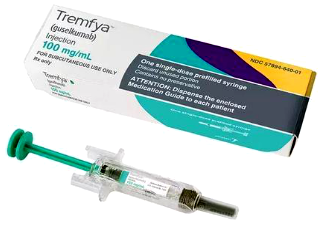
Tremfya is a human monoclonal antibody targeting the p19 subunit of interleukin-23 (IL-23), and it is the first approved selective IL-23 inhibitor. IL-23 is a cytokine involved in variousAutoimmunityplayed a key role in the treatment of inflammatory diseases. Currently, Tremfya is also being developed for otherAutoimmunityTreatment of inflammatory diseases, including Crohn’s disease (Phase IIb/III), ulcerative colitis (Phase IIb/III), and hidradenitis suppurativa (Phase II). Tremfya is administered via subcutaneous injection. The dosing regimen for the treatment of plaque psoriasis is 100 mg administered at Weeks 0 and 4, followed by 100 mg every 8 weeks thereafter.
To date, Tremfya has been approved in multiple countries and regions worldwide for the treatment of adult patients with moderate-to-severe plaque psoriasis. In China, Tremfya (Tremfya) was approved for marketing in Hong Kong in November 2018. On the Chinese mainland, it was submitted for approval in late June 2019 and received approval from the National Medical Products Administration (NMPA) of China in December 2019, for the treatment of adult patients with moderate-to-severe plaque psoriasis who are candidates for systemic therapy.
Notably, Tremfya was included in the “First Batch of Overseas New Drugs Urgently Needed for Clinical Use” released by the Center for Drug Evaluation (CDE) of the National Medical Products Administration (NMPA), with therapeutic indications covering erythrodermic psoriasis, plaque psoriasis, pustular psoriasis, psoriatic arthritis, and psoriasis vulgaris. The NMPA accelerated the approval of Tremfya’s market launch through its priority review and approval pathway. (Bioon.com)
Original Source: The Lancet Simultaneously Publishes Two Phase 3 Studies Detailing Comprehensive Efficacy and Safety of TREMFYA (guselkumab), a First-in-Class IL-23 p19 Subunit Inhibitor, in Psoriatic Arthritis